Archive for October, 2011
Living Ashore (October 2011)
Posted by Kathy Clark in Trips on October 22, 2011
October 22, 2011
(by Leanne)
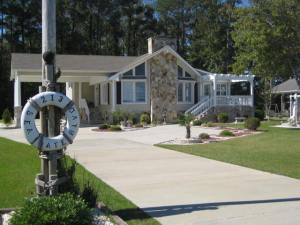
Our Temporary Home in Sea Gate
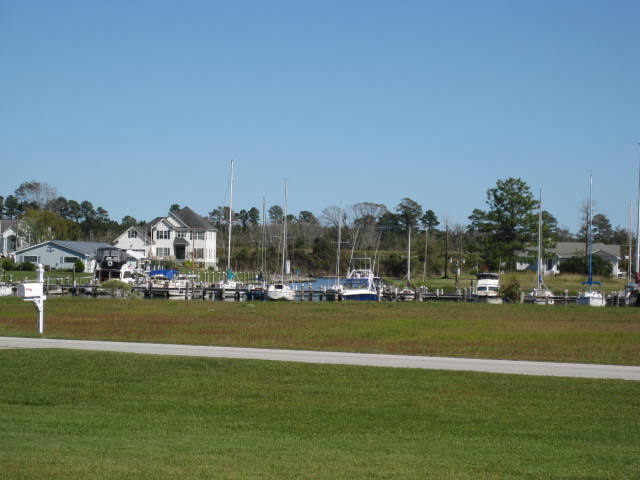
With Shear Madness now on the hard stand and repairs commenced we have all moved ashore and rented a house at Sea Gate in Newport, NC. Sea Gate is a lovely relaxed community located on the intracoastal waterway with the local marina being the hub of this small community. The marina has 70 berths (none large enough for a Nordhavn), a marina store which doubles as the local convenience shop with the community coffee group and the weekly happy hour also held at the marina facilities. The view of the marina from the house makes us feel right at home as we can at least see water and we are storing our kayak there so we can do some adventuring on the ICW. The only negative to living ashore is the amount of mosquitos (aka mossies) in the area. This is a result of the high levels of rainfall experienced from the hurricane. The mossies are most vicious at dawn and dusk and attack anything that moves, which requires fast movement from the hot tub back into the house to limit the bombardment. As the locals are frequently lamenting the increased levels of mossies we know it must be bad.

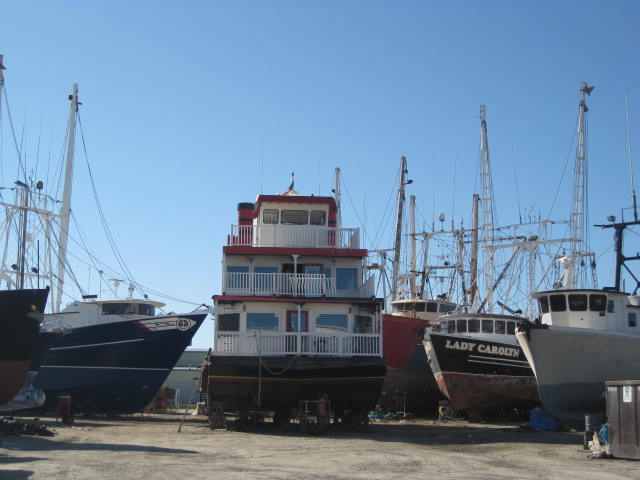
Jarrett Bay Boatworks Yard
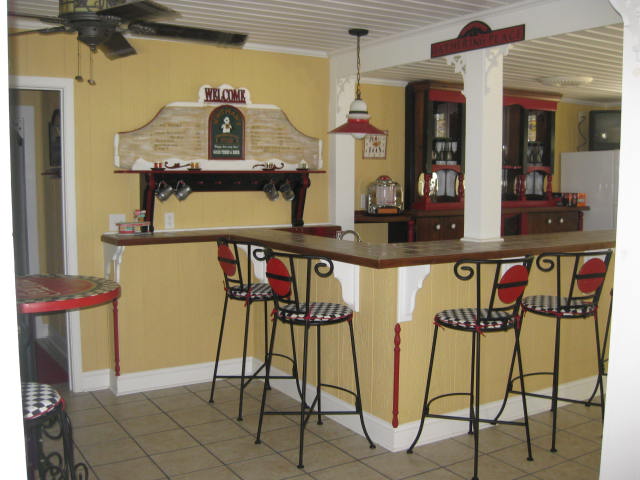
The house is palatial after the boat, with five bedrooms, a downstairs bar and most importantly a hot tub – which is appreciated by all as the body ages. The extra bedrooms will be used by Brian and Troy, from Celtic Marine, when they arrive from Florida in November to commence the electronic repairs. The fifth bedroom has now been turned into Brian’s store room with all the unserviceable electronic gear removed waiting his return. While the bar room would make a great place for a party, the back room is now filling up with spares & equipment removed from the boat. This will allow easy access for the contractors to install the new equipment.
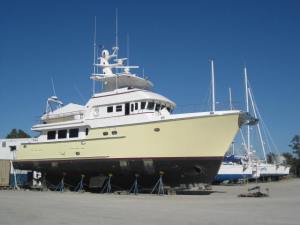
Shear Madness anchored in the boat yard
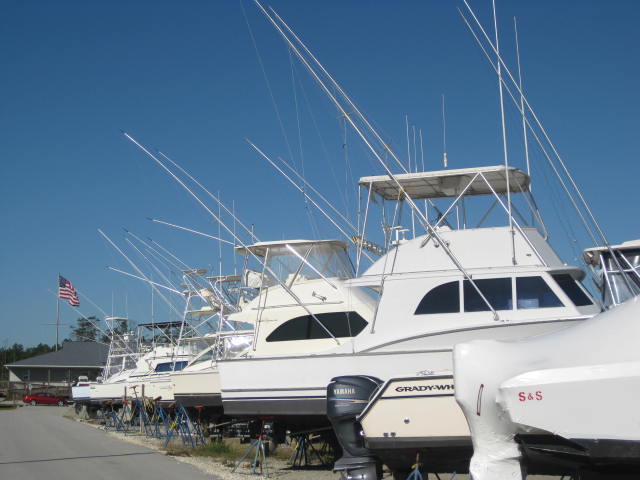
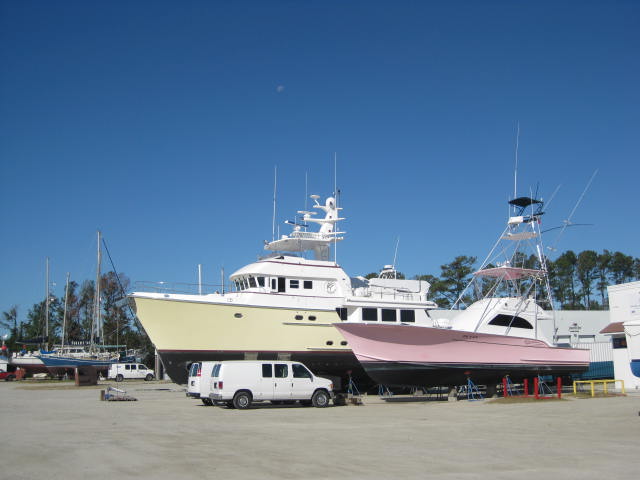
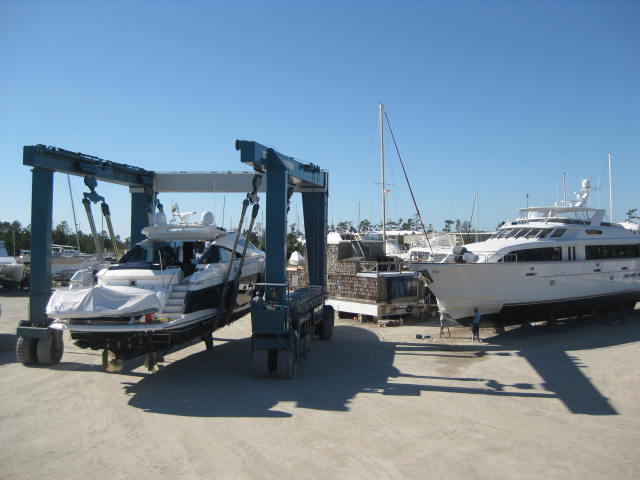
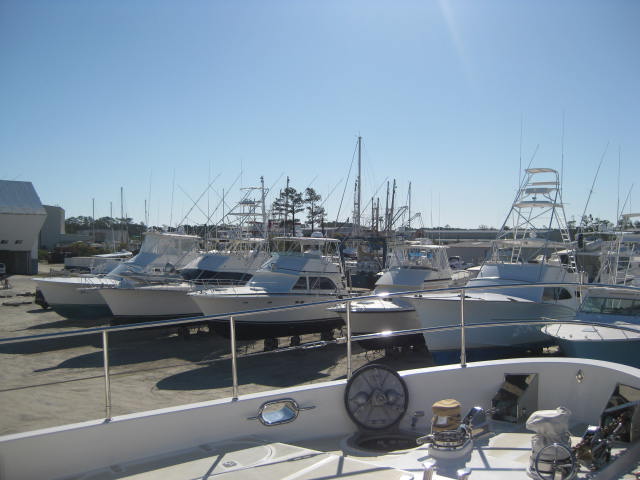
Back at Jarrett Bay Boatworks, Shear Madness is looking comfortable on her stands; however she is attracting a few comments with her anchor now down (for some work to be done on it). The boat yard is an impressive 175-acre facility offering a one-stop boat building (up to 120 ft in length) and marine service facility. We are all enjoying looking at the different boats which range from small trailer yachts, sport fishing boats, yachts, catamarans, commercial trawlers and 200ft luxury yachts. The boatworks is an interesting place to have the ‘office’ in as there is always something to watch as boats are moved in, around and back into the water.
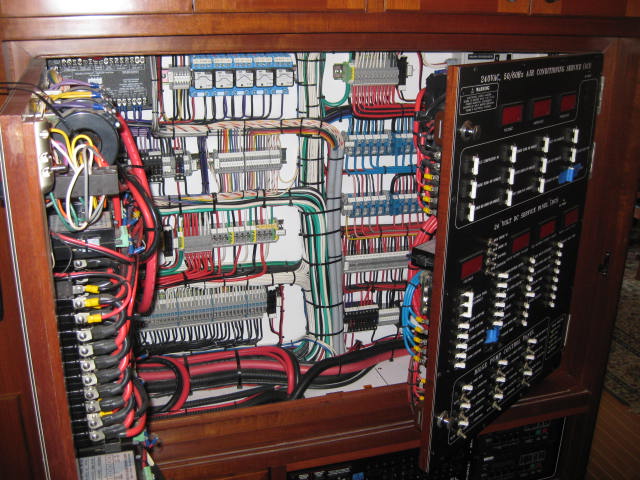
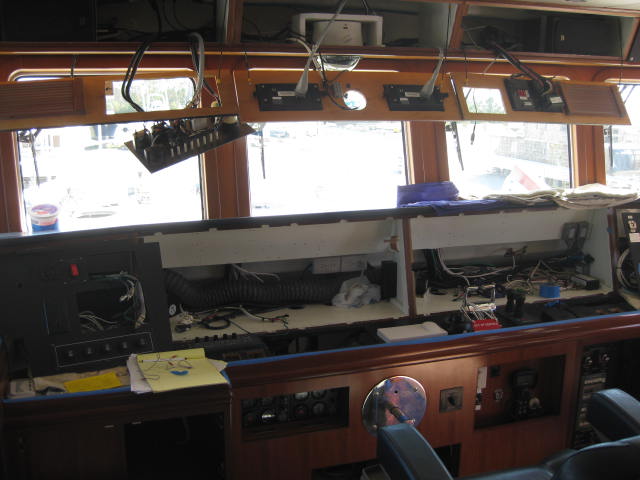
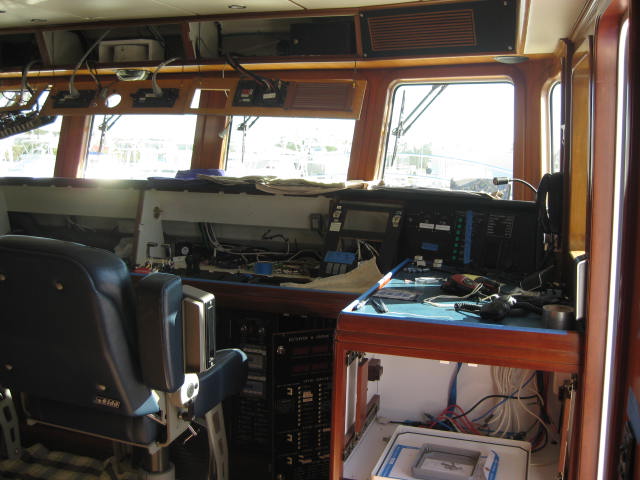
The inside of the Pilot House is now resembling a workshop test bench with all the electronic gear removed and work on the electrical systems commencing. John is now in his element working alongside Steve and Buddy from Offshore Marine Electronics as they pull out the numerous cables, wires and circuits for diagnosis and repair. Although it all looks like ‘spaghetti’ to me, given John’s experience of pulling things apart onboard the Orion I have confidence that he and the team will return the equipment back to the original location and, more importantly, to an operational mode.

John (center) with Steve and Buddy from Offshore Marine Electronics
Brian from Celtic Marine arrived last week to complete a work scope of the electronics/navigation and entertainment system. This will allow Brian and Troy to return in Nov with the replacement parts they need to complete the work. During this period all the electronics from the Pilot House were removed and are now stored in the house. An additional advantage of Brian’s visit was he now has the TV working – this was just in time with the Rugby World Cup semi-final game able to be watched onboard on the large screen. Even better were the results with NZ winning 20-6 against Australia. No need to ask, or even report, who we want to win Rugby World Cup in the final game this weekend with NZ versus France
Bradley has been kept busy managing the numerous phone calls / emails to the contractors and insurance company to keep the repair schedule on track. Our revised project timeline is (hopefully) departing by end of November. Kathy and Leanne are being kept busy implementing an inventory management system. This requires going through every locker, cabinet and space onboard identifying what the space is called and then recording what is being stored where. We started with the charts and have now catalogued 217 charts that include Europe, South and Central America, USA and Canada – this task was enjoyable and allowed us to dream about our future cruising areas.
We will keep you updated as the repairs progress.
Click on these links to see a recent article in the Washington City Paper about the “other” Shear Madness – the play at the Kennedy Center and the wedding that took place there, leading to the name of a Nordhavn!
Click on any photo to enlarge!
Haul Out (October 2011)
Posted by Kathy Clark in Trips on October 11, 2011
October 9, 2011

Positioned for the Travel Lift
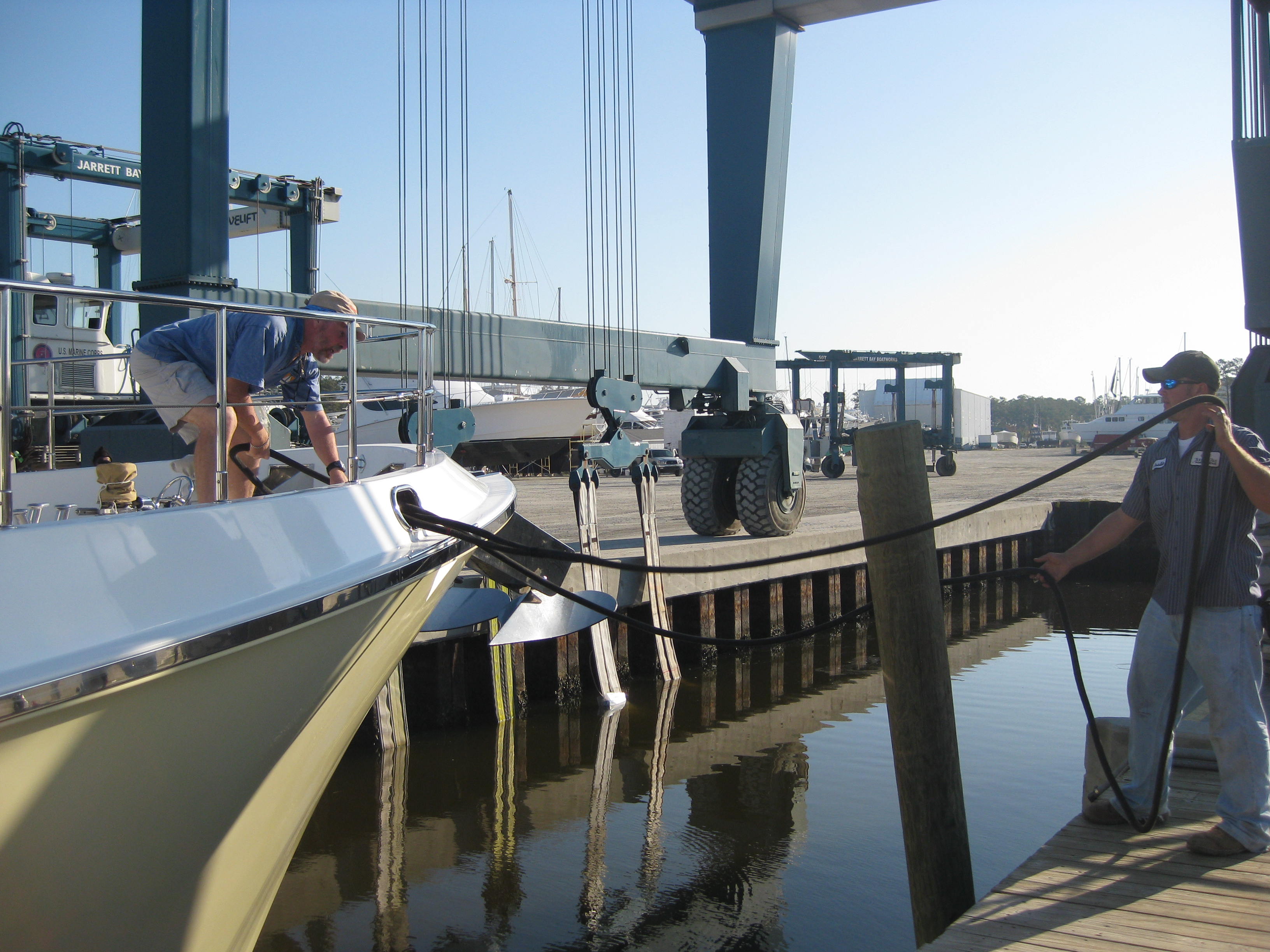
How do you haul a 250,000 pound boat out of the water? With a 200 Ton Travel Lift. It really is quite an impressive sight to see. At Jarrett Bay, they haul many boats a day and have a variety of sizes of travel lifts. We needed the big one! The boatyard has a haul-out dock where boats are first pre-positioned and tied alongside. Since the space is tight and we were still without bow and stern thrusters, we chose to move to this area early in the morning while the wind was very calm. The next step is to position the travel lift. This is a specially designed piece of equipment that straddles the loading bay. Lifting straps are then lowered into the water to a depth below the boats draught (in our case 8 feet). Then the boat is moved by hand, with a bunch of guys pulling lines until it is positioned on top of the lifting straps. Care must be taken that the straps aren’t positioned over the stabilizers, sonar, or other sensitive areas on her bottom. Once the boat is positioned, the lifting process begins. The boat is gradually hoisted until it is out of the water and the bow clears the top of the dock. Then the travel lift carefully and slowly moves the boat to the washdown area where she receives a nice bath with fresh water from a pressure washer. This removes much of the marine growth from the bottom. After the bath, she is moved to the space where work will be done and positioned on blocks – lots of them to hold her firmly in place.
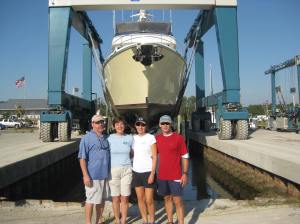
Shear Madness and crew - Bradley, Kathy, Leanne, and John
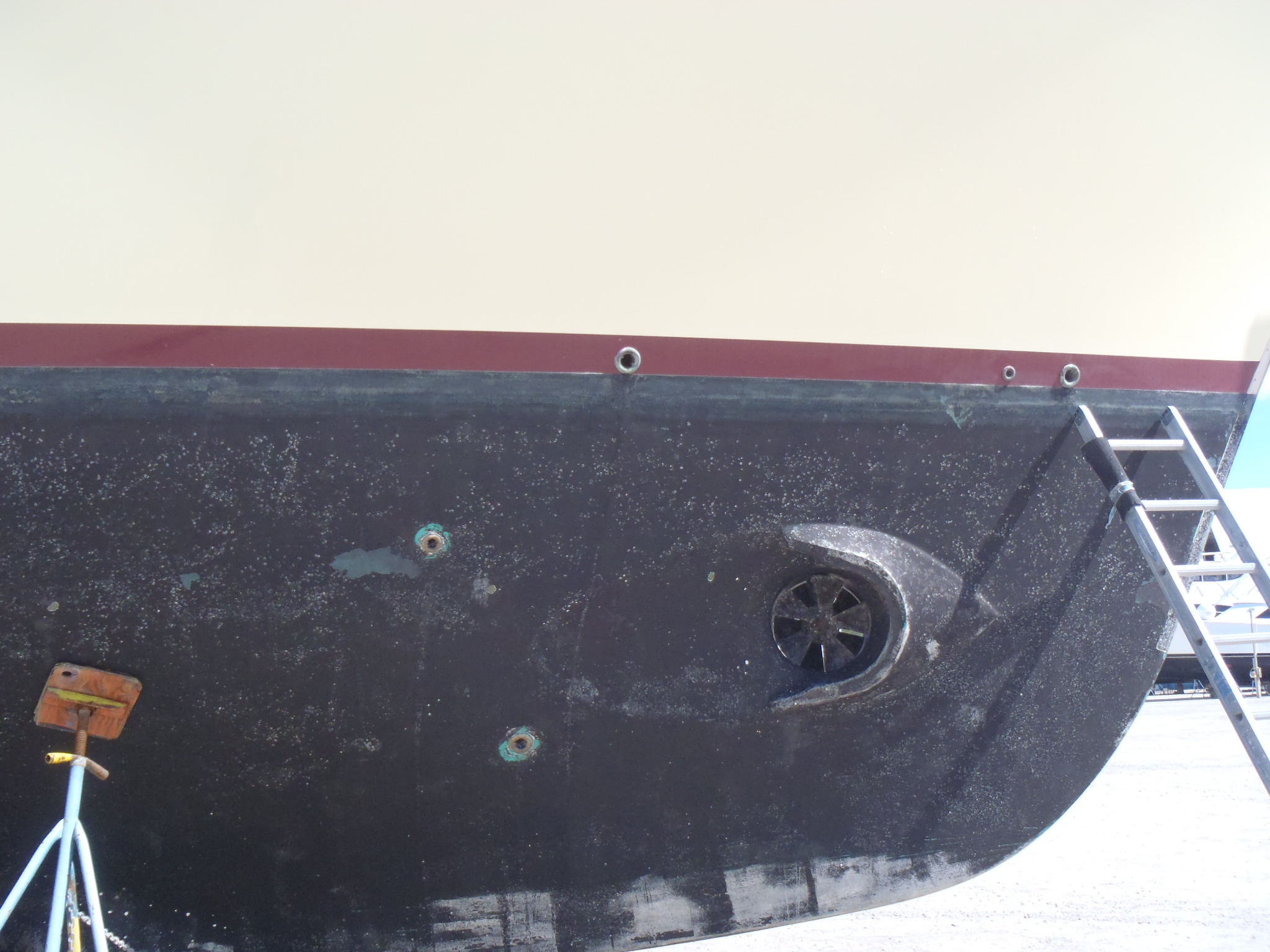
Power cords are then connected, a ladder is put in place to allow you to get on and off the boat (the deck at this point is 10 to 12 feet off the ground). Next, plastic floor covering is installed on all exterior decks and interior floors. Boatyards are very dusty and dirty places and protecting the surfaces is important. The boat is now ready for whatever work needs to be done. Our first step was to visually inspect the exterior of the boat, looking for anything out of the ordinary. Much like a bullet wound, lightning often creates more damage on its way out then on it way in. Our inspection did not reveal any obvious additional damage from the lightning nor any other unexpected findings. Next, we inspected and cleaned all the through-hull fittings. These are the places in the hull where a hole has been put in order to allow seawater to enter the boat – for example for cooling the engines or generators – or to allow “stuff” to leave the boat – such as exhaust, bilge pumps, or gray water (water from showers or sinks). Shear Madness has 37 different through hull fittings and these need to be periodically inspected as each one is a potential source of trouble should it fail or leak.
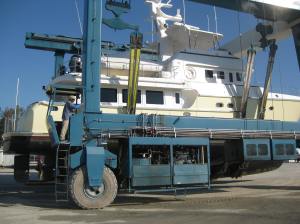
This is why it's called a "Travel" Lift
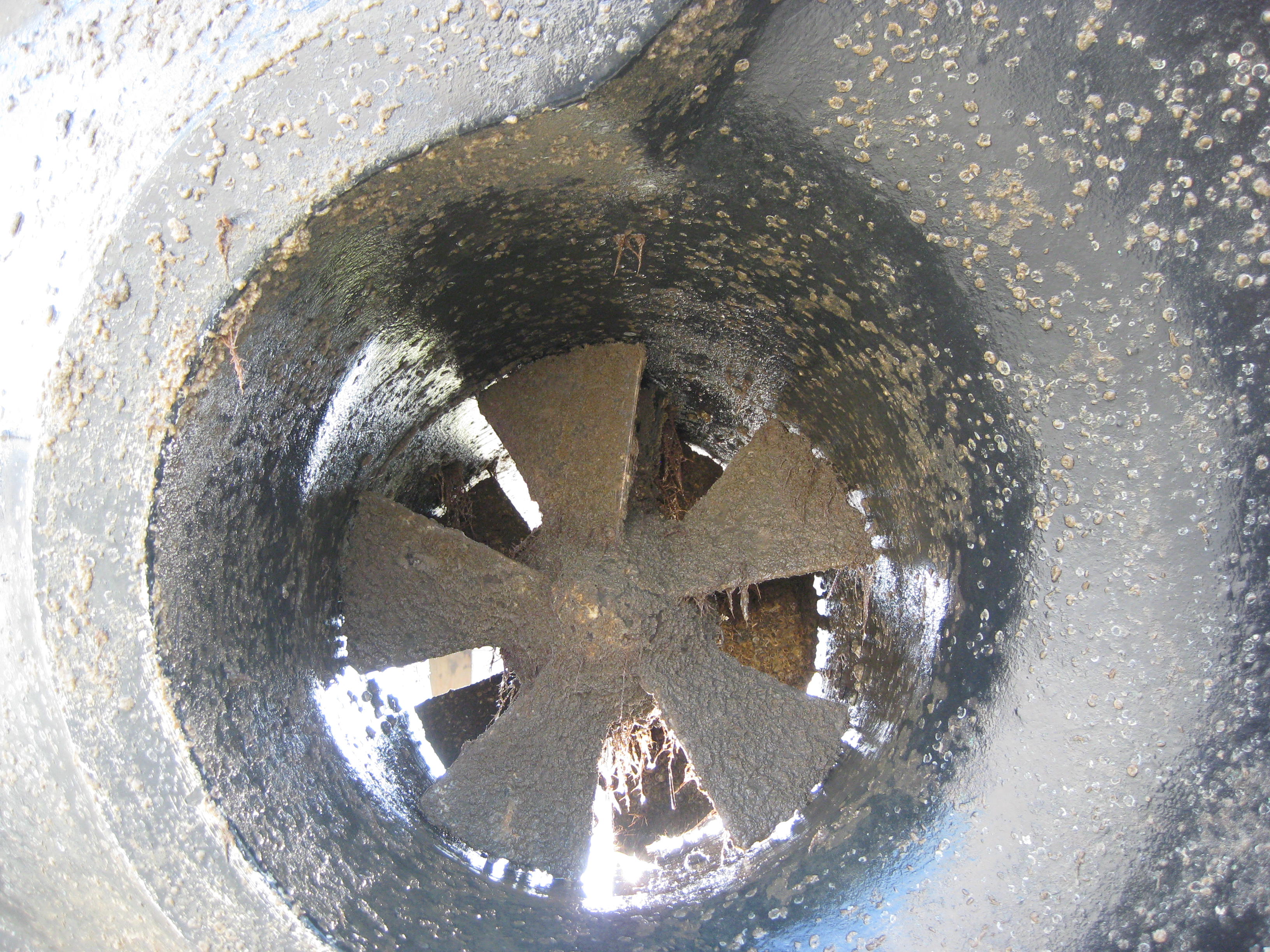
Other things that are inspected and serviced if necessary during a haul out are the main propellers (which move the boat forwards and backwards), bow and stern thrusters (propellers located on the bow and stern which assist in moving the boat laterally), stabilizers (large hydraulically operated fins which smooth out the ride in rougher seas), sonar (for depth readings) and rudders (which provide steering through the water). Since this equipment is normally underwater, working on them will usually only occur during the haul-out.
We are now ready for the serious repairs to begin. Brian, our electronics guy who worked on the boat while it was in Florida, will be coming this week to plan his project. Work on electrical systems should also begin soon. We also need specialists for the bow and stern thrusters. As we begin to get more systems operational, we will be able to conduct additional testing and will likely identify more things that need attention. Click below to play a 3 minute video of the haul out:
With the boat hauled out we are not able to live onboard so we have rented a house, close to the marina, for a couple of months until Shear Madness is back in the water. The extra living space and hot tub has been appreciated by all!
Click on any photo to enlarge and leave a comment by clicking on the COMMENT link below the photos! To subscribe to this blog and receive updates whenever they are posted, click on the “Follow” Button or scroll down to the bottom of the posts to “Email Subscription”. For the latest book reviews, click here!





Passage down the Intracoastal Waterway (Sept 2011)
Posted by Kathy Clark in Trips on October 7, 2011
September 28th, 2011
(This blog entry is authored by Leanne)

Sweet Hope (Sweetie) leaving the dock at Colonial Beach
With the engines now repaired and fully serviceable, it was with anticipation that Shear Madness finally departed Colonial Beach Marina at midday to head south for repairs, via the Intracoastal Waterway (ICW). For this trip Shear Madness, with all her navigation, bow and stern thrusters, communications, and electronics systems still not functional (we had a handheld GPS, laptop computer, and handheld VHF), was following ‘Sweet Hope’ (Nordhavn 64ft) with Captain George and Leanne jumping ship to provide crew support for George. With limited VHF radio capability on Shear Madness, hand held walkie-talkie radios between the two boats provided easy communications. After our radio call signs of ‘Madness’ and ‘Sweetie’ were established we were ready to depart.
With Sweetie departing first and standing off the dock in case assistance was required, Bradley successfully exited the dock, proving that bow and stern thrusters are not required, and we were on our way. With a light breeze, calm seas and following in the wake of Sweetie it was fabulous to be underway again. Sweetie was the ‘eyes and ears’ for Madness providing regular information on depth, boat traffic, relaying information from the VHF traffic and importantly where to anchor.
Madness following close on the heels of her guide Sweetie
The first day was an easy run of 35 miles down the Potomac River back into the Chesapeake Bay. Thankfully Madness experienced no major problems and was able to enjoy the day on the water. During each day the engines needed to be run on ‘wide open throttle’ mode (good engine husbandry) which resulted in Madness powering past Sweetie with a loud ‘Yee-haw’, only to slow down to wait for Sweetie to take the lead again. (Note from Kathy – Racing Nordhavn’s seems a bit like racing Clydesdales – not real fast but LOTS of power!).
For our first anchorage, George found us a picturesque local river to enjoy the tranquil setting and sunset. Part of the deal for Leanne going onboard Sweetie was to assist George in improving his culinary skills. Leanne took up this challenge and provided a 101 Cheesecake making lesson to George. Given how quickly the cheesecake was consumed Leanne reports the lesson was a success! As the sun rose we had the anchors stowed and were on our way south.

George learns to make cheesecake
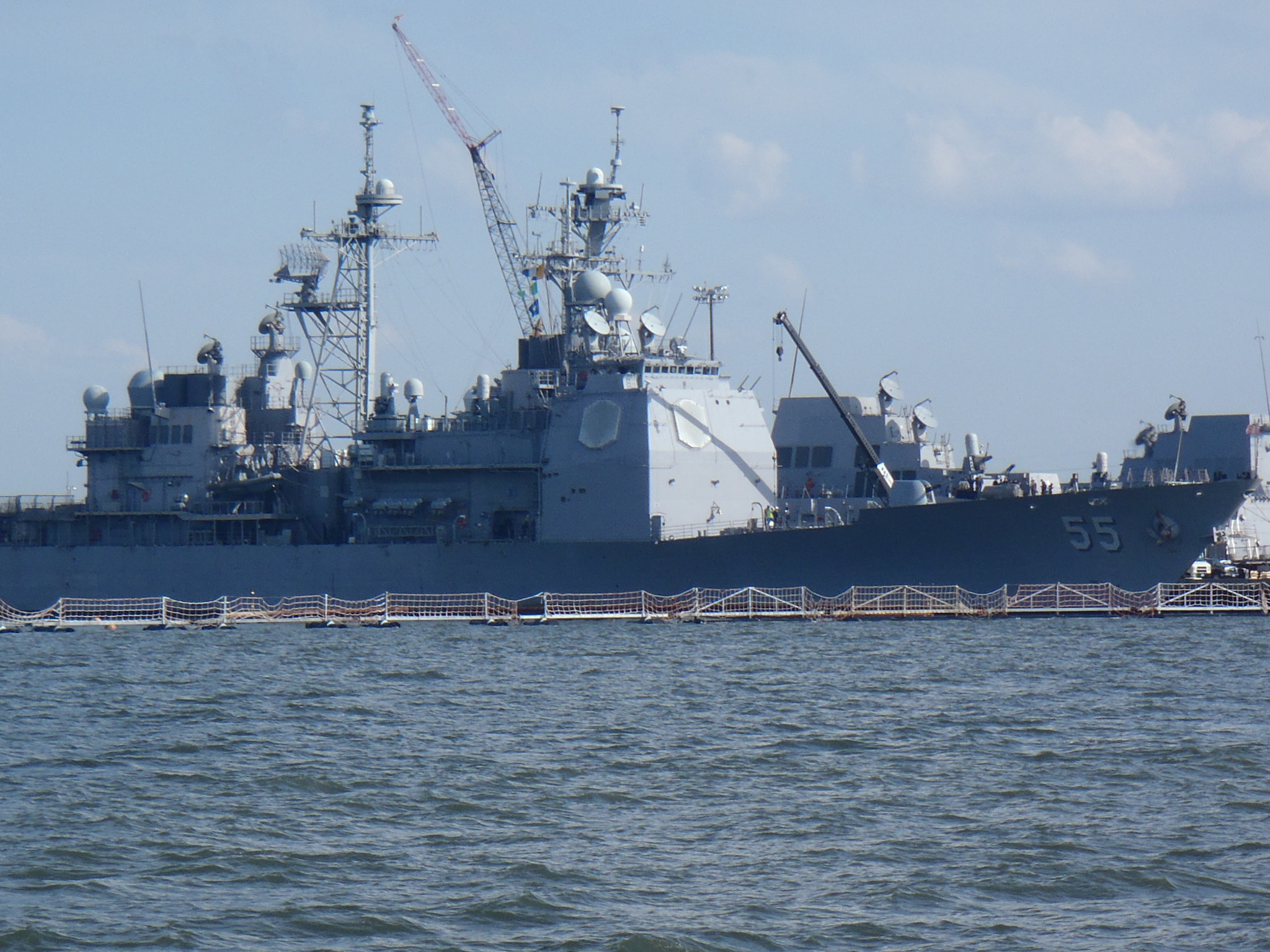
After a longer day of 85 miles we arrived safely at Portsmouth, with the Sweetie team being hosted for an enjoyable dinner on Madness with the inevitable ‘onboard stories’ being recounted. Portsmouth is a beautiful town steeped in history with numerous marinas, great architecture and ambiance and is just a short ferry ride across from Norfolk. Norfolk and Portsmouth are home to naval shipyards and container ports so there was plenty of shipping to watch out for. Fortunately we had two nights at Portsmouth to allow the engine technicians to come back on board to replace a few more parts and give the engines a tune-up, which gave all of us a welcome break and time to explore the local area.
Early Saturday morning saw us departing Portsmouth to enter the ICW at mile zero. The ICW is a series of interconnected rivers, canals, and sounds that provide protected passage from Norfolk to Florida. The ICW is ideally suited to boats with a shallower draft, but with careful reading of the charts and constant watching of the depths we had no problems coming down the ICW. Our route was via the Virginia Cut which saw us passing through one lock, and 22 bridges.
ICW Scenery
The first 11 miles were busy ones with 7 bridges and the one lock to pass through. The majority of the bridges were opened on set hours so required time management to ensure we arrived when the bridge was due to open and not before. Unfortunately we learnt this lesson the hard way with a 45 min wait for one bridge to open.
This was also our first trip through a lock. A lock is a mechanism for joining together two bodies of water at different levels. In this case, we were going from a higher point to a lower point. To accomplish this, the lock gates ahead of us are closed, all boats wishing to get to the other side enter the lock and dock alongside. Then the gate is closed behind us and the water level inside the lock is reduced bringing all boats down to the level of the lower water. When complete, the front gate is opened and all boats continue on. Then boats heading the other way enter the lock, the gate is closed, water is put back into the lock to raise the boats, and off they go. Fortunately, it was an uneventful but interesting experience for all of us.

Waiting for a bridge to open
The ICW was a scenic route to travel, passing through a variety of rivers, bays and canals with the scenery changing frequently. There was plenty to watch both on the water and off as we passed through the many local towns. The barges were always interesting to watch, especially given the loads some of them were pushing. One was at least a mile long, literally a “sea-train”. Sunday night was spent in a bay anchoring after passing through mile 160. This was a large bay with only Sweetie and Madness anchoring providing another peaceful night to watch the sunset. Next morning was a relaxed departure at 0730 with the boats being surrounded by fog which gave it quite a surreal atmosphere to motor away from.
Our last day on the ICW was a short 45 miles to reach our final destination of Jarrett Bay Boatworks where Shear Madness is to be hauled out of the water to start the repair process. The ICW was a most successful trip, with no problems managing the depth or shoaling, and one we would consider again as opposed to the outside passage which can be a lot rougher and more difficult past Cape Hatteras. Without Sweetie and Captain George, assisted by Leanne, Madness would not have been able to complete this trip. For this we remain grateful to Captain George for leading the way and being our ‘eyes and ears’.
Click on any photo to enlarge. Please leave a comment – we love to get feedback!







 Shear Madness