Archive for October, 2012
2012-10-30 It Was a Dark and Stormy and Windy and Cold Night
Posted by Kathy Clark in Trips on October 30, 2012
October 30, 2012
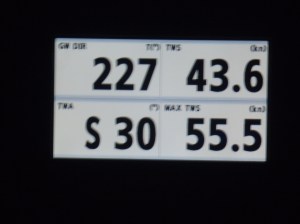
Sustained winds from the WSW of 40+ KNOTS (45+ MPH) with gusts in the 50’s
As expected, we had the worst of the storm last night. The winds did shift towards the West-Southwest, the direction where we have a bit less protection. We saw sustained winds in the 45-50 knot range with the highest gust a mere 57 knots (65 MPH). Of course, the strong winds waited until after dark! While all was well aboard Shear Madness, there was some excitement. Our neighbor in the anchorage called us on the radio just before midnight to report that his anchor was dragging and he was getting dangerously close to a dock onshore. We were discussing what, if anything, we could do to assist him when he fortunately called back to say he had it under control and had reset his anchor. We were greatly relieved as we hated to leave him on his own, but in order to assist, we would have had to pull up our anchor and go dangerously close to shore ourselves. Fortunately, it was not a decision we had to make.

Strong wind, cold temps, low pressure, and note how out position changed with the winds shift to the South
Shear Madness rode out the storm very well. Bradley stayed up on anchor watch until the early morning hours while I got a little (not much really) sleep. By 2am the winds had begun to ease and the worst appeared to be over. So we just monitored the wind and our position from the TV in our cabin. Anytime the wind speed is 50% higher than the temperature in Fahrenheit, it will be a little exciting and you hope you don’t have to go out. We had temps of 35F and winds of 55 knots! We saw the Weather Channel reporters continually talking about the barometric pressure – the lowest I observed was 974.
This morning the winds are in the 20’s and we are safe and comfortable. The winds are expected to continue to blow from the South-Southwest so we debated whether to move to somewhere more comfortable. However, though we feel some motion, we really are not uncomfortable and the thought of bringing up 120 meters of muddy anchor chain in 35 degree weather with moderate winds is not that appealing. We’d rather wait until things settle a bit and enjoy our coffee and breakfast.

Snubber line held, some nice chop in the water, but winds have eased
One note – you may have heard about the disastrous fate of the HMS Bounty Replica that was underway around Cape Hatteras. One statement from that story was a quote from their Facebook page “Rest assured that the Bounty is safe and in very capable hands. Bounty’s current voyage is a calculated decision … NOT AT ALL … irresponsible or with a lack of foresight as some have suggested. The fact of the matter is … A SHIP IS SAFER AT SEA THAN IN PORT!”
While we made the decision that we would be safer at anchor than at a dock, we would never had thought we’d be better off UNDERWAY in a hurricane near Cape Hatteras, known as the Graveyard of the Atlantic! We have a serious anchor, plenty of chain, were not that far from shore, and had two big diesel engines we could use in an emergency. We never, ever considered the possibility of going out to sea!
Thanks to all of you for your concern, your support, and your comments. We can now check off our bucket list “Ride out a hurricane on a boat at anchor”. Our biggest concern now is how difficult it will be to get our anchor up! It will be pretty well dug in.
2012-10-29 Sandy Monday
Posted by Kathy Clark in Trips on October 29, 2012
October 29, 2012

Securing the backup snubber line to deck cleats
We had a bit of excitement last night after dark. About 9:30pm we started getting wind gusts of 45+ knots when we heard an ominous noise from the bow. We donned our foul weather gear and went out to investigate. Our intuition was correct – the snubber line had snapped, going into the water and taking the claw connecting it to the anchor chain along with it. The rubber hoses which provide chafe protection had worn through, allowing the line to saw against the stainless steel claw until it was weakened enough to break during a strong wind gust. While had a spare snubber line at the ready, we had to determine how best to rig the backup. I went inside to start the engines so that we would be prepared in the event things took a turn for the worse. Bradley focused on getting another line ready, using one of the claws from the anchor braking system. We were disappointed to find that our forward (bow) deck light was not working, so had to work by flashlight. I also discovered that the batteries in two of our “ready” flashlights with rechargeable batteries had not held their charge. Fortunately we keep several waterproof lights that were ready to go, so I just had to grab another one.

Snubber on deck cleats
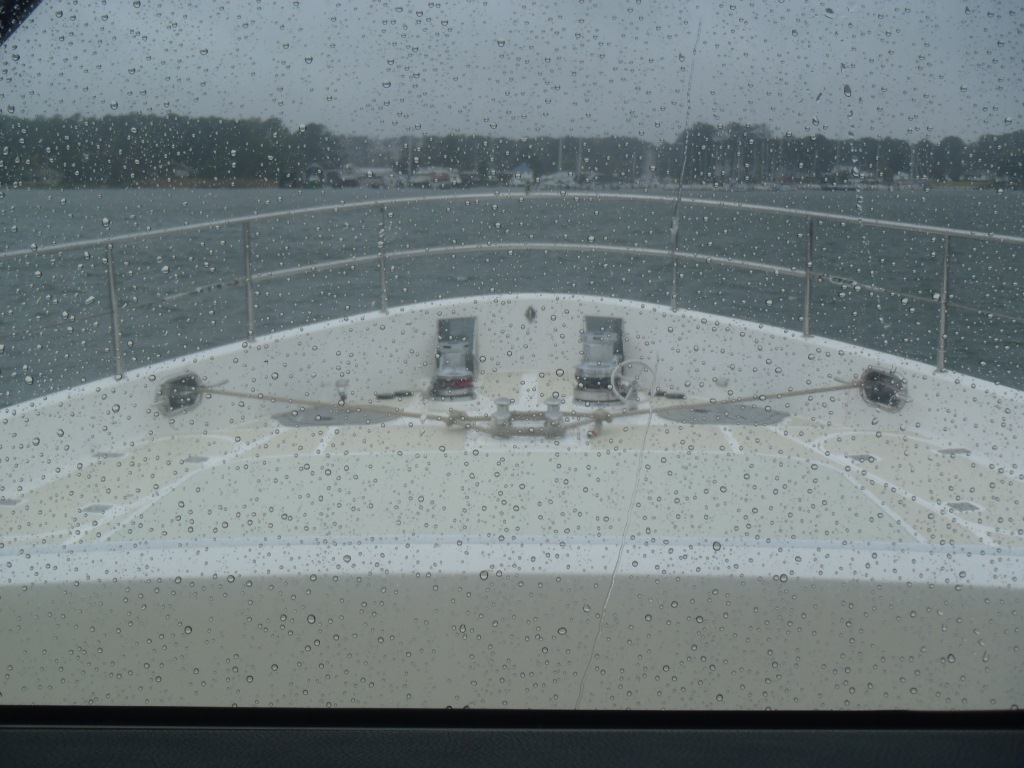
Once Bradley had the new snubber line ready to deploy, we decided to take the opportunity to let out some additional anchor chain. As they say, anchor chain does no good sitting in the anchor locker! So out it went. We now have 115 meters of chain out (over 345 feet). After little more than an hour of the problem occurring, we had the new snubber in place and were set for the night. Given the darkness and the need for both of us to be focused on getting the snubber re-set, there are no photos of this actual event. The winds eased a bit over the next hour, allowing us to get a good night’s sleep. We are grateful to have the Nobeltec display available on the TV in our cabin as it allows us to simply look up and ensure that we haven’t moved outside our swing radius.
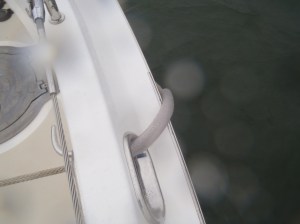
Hoses provide chafe protection
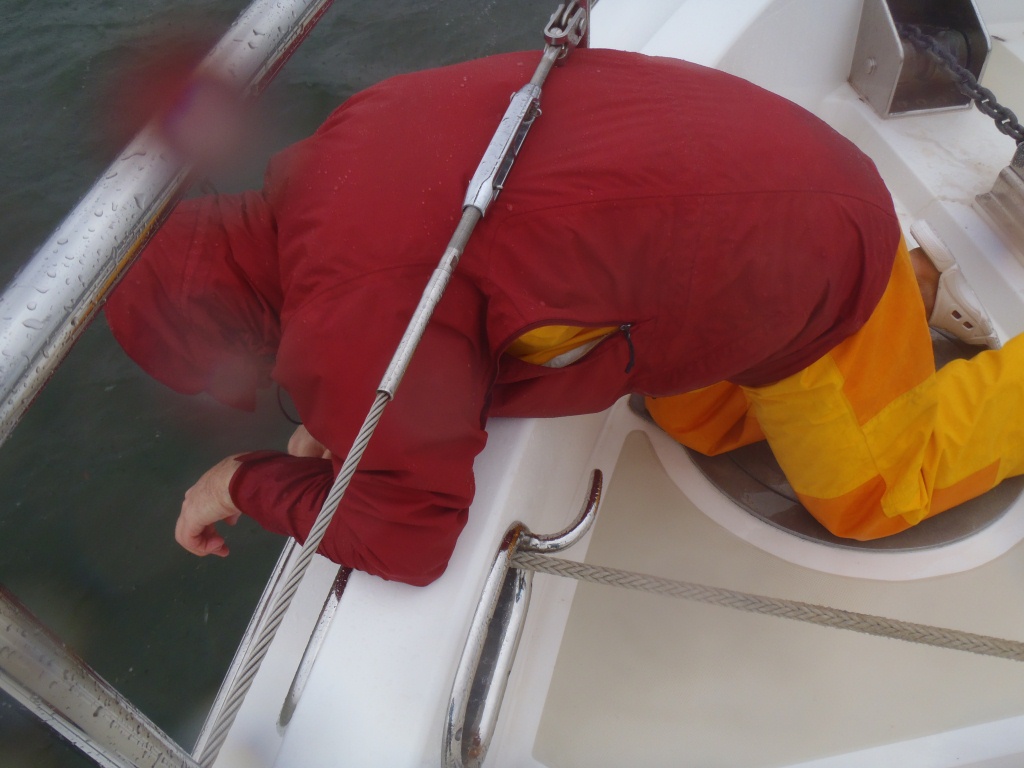
The project for this morning was to put good chafe protection in place on the new snubber line and to devise a backup solution in case we lose this one. Braving the wind and rain, we set out on deck. We needed to bring the anchor up enough to ease the tension on the snubber, untie it from the deck cleats, slip the protective hose over the end, then re-tie it and position the hoses to ensure they are doing their job. Not a complicated task, but the weather is now downright chilly (41F) and the winds were a sustained 30+ knots with gusts in the 40’s, accompanied by a driving rain. But Captain Bradley soon had all in place and we were once again sitting safe and secure.
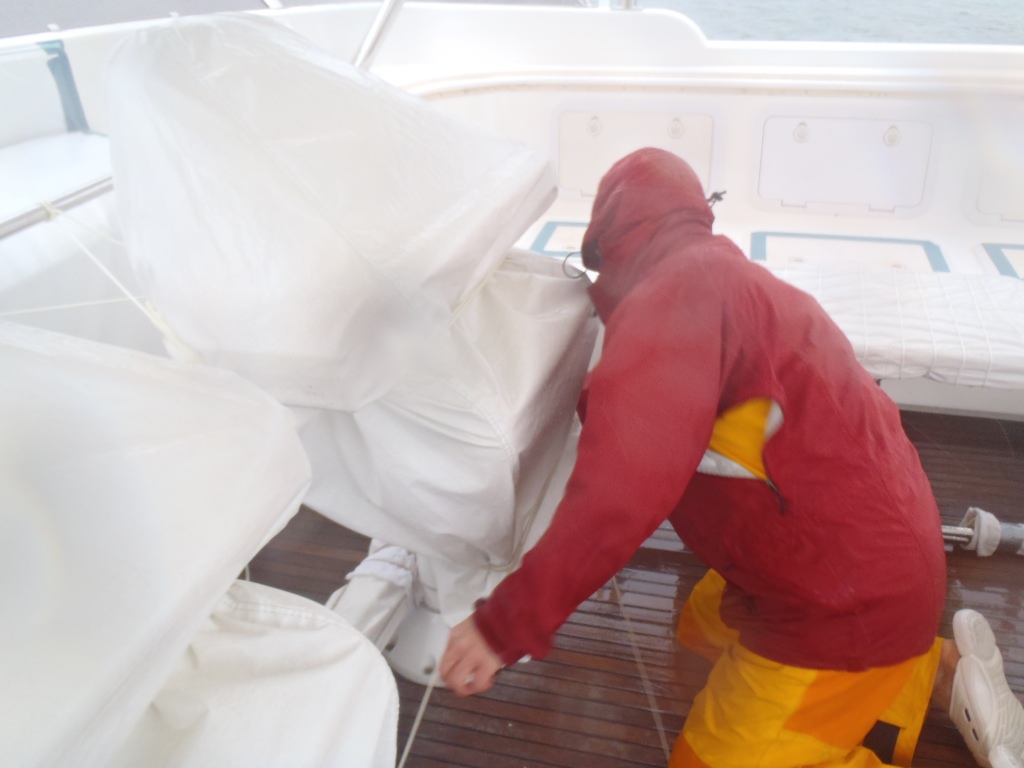
A check of the tender deck and flybridge revealed that the tie-downs on the helm chairs in the flybridge had come undone and the line was lying in a tangle on the deck as the chair covers flapped more than I wanted to see! It took ten minutes to untangle the line and my fingers haven’t been that cold in a while! But again, this was not a difficult task and we soon had the chair covers secure again.
We returned inside and shut off the engines. The engine room was nice and warm, making it a good place to hang our wet weather gear to dry. For now, we are once again safe and comfortable. The worst of the storm should pass by this afternoon and evening. As it does, we expect the winds to shift direction from the north to south/southwest. This will be the point where we have the least protection from the wind in this anchorage, so we are hoping we do not have to move! Thus far, we’ve been reasonably protected and have only seen gusts of 45-48 knots. We’d like to keep it that way! Thanks to all for your concern and comments!
-

- Positioning the chafe protecting hoses
-
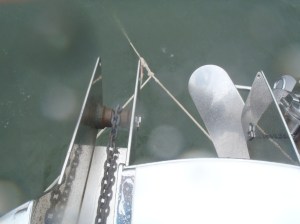
- Snubber line seen from bow

-

- Securing the anchor by setting the brake on windlass
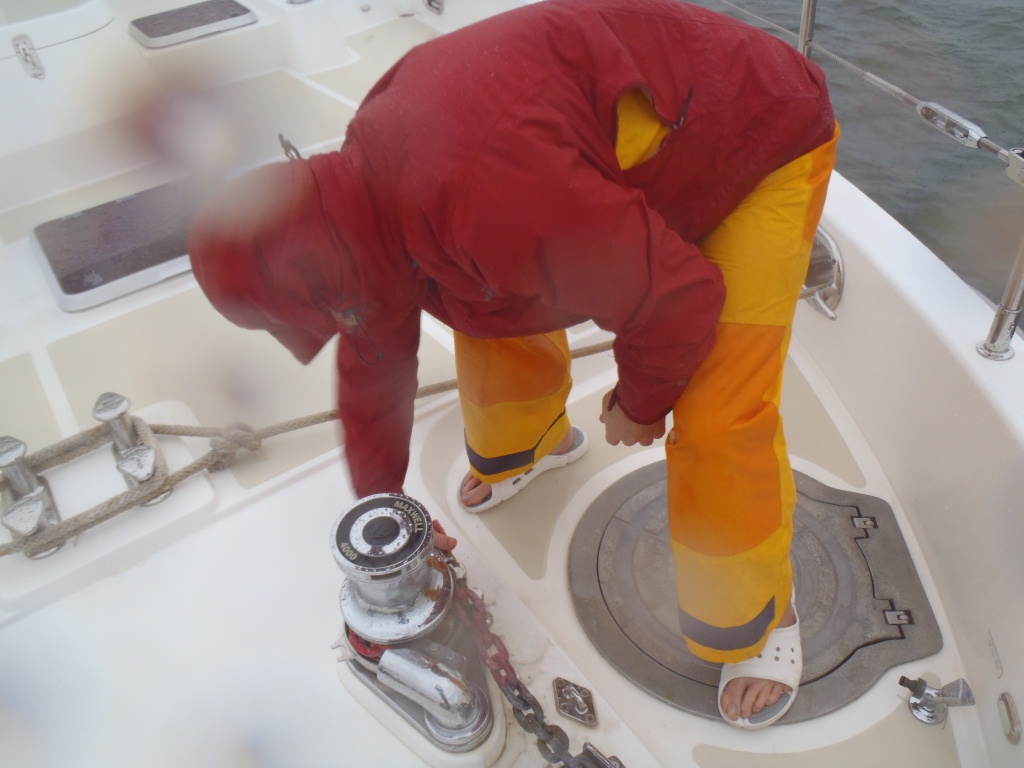
-

- Putting on additional anchor brake
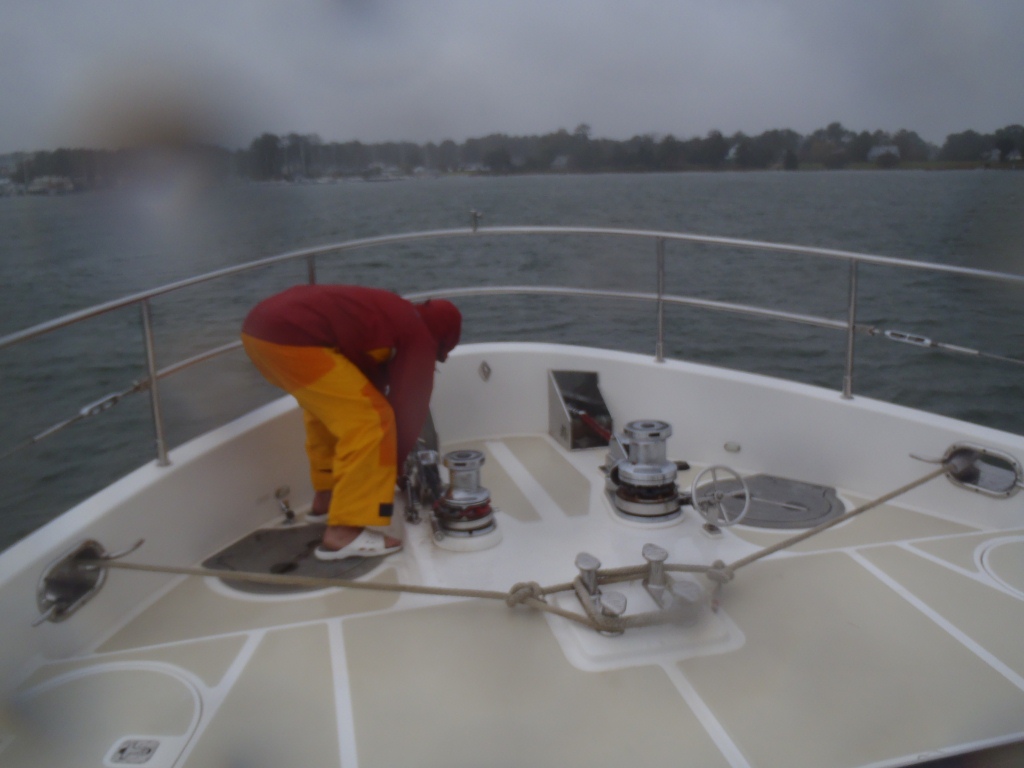
-

- The Shenandoah Flag is riding out the hurricane with us
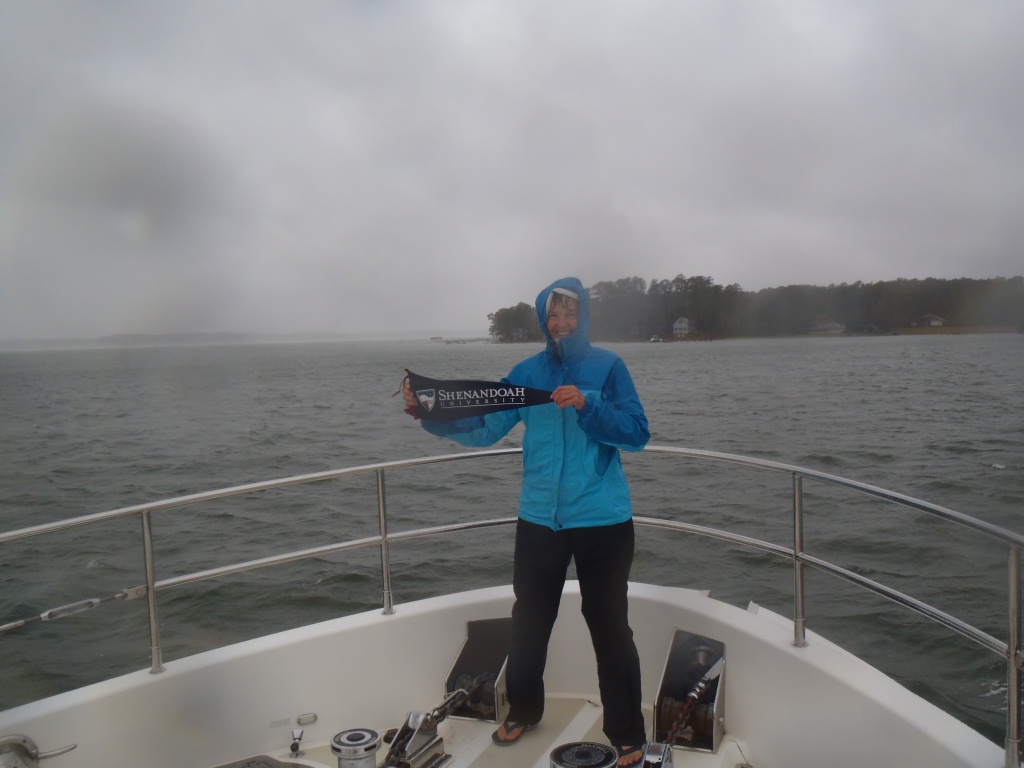
-

- Tie Downs on helm chairs in flybridge have come undone
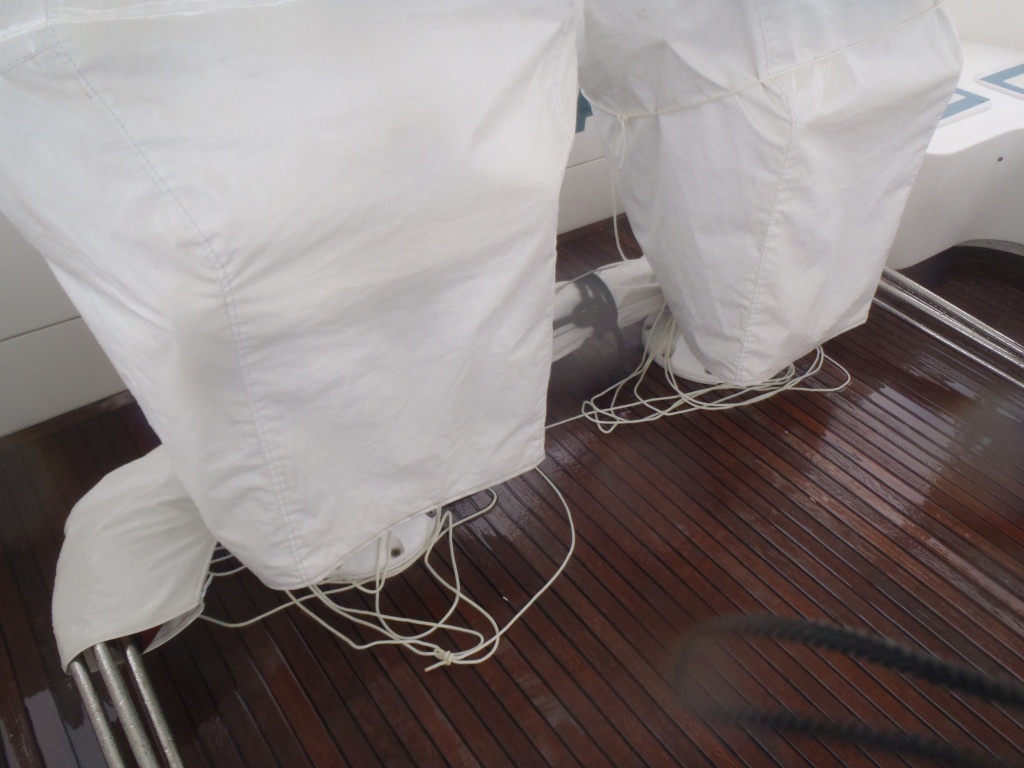
-

- Getting helm chair covers re-tied
-

- Some of the flybridge settee hatches are losing their protective tape

-

- Snubber line setup seen from the Pilothouse
-
- The current spot is where we are since letting much more chain out

2012-10-28 She’s A-Coming!
Posted by Kathy Clark in Trips on October 28, 2012
October 28, 2012

Temporary solution to leak in guest cabin
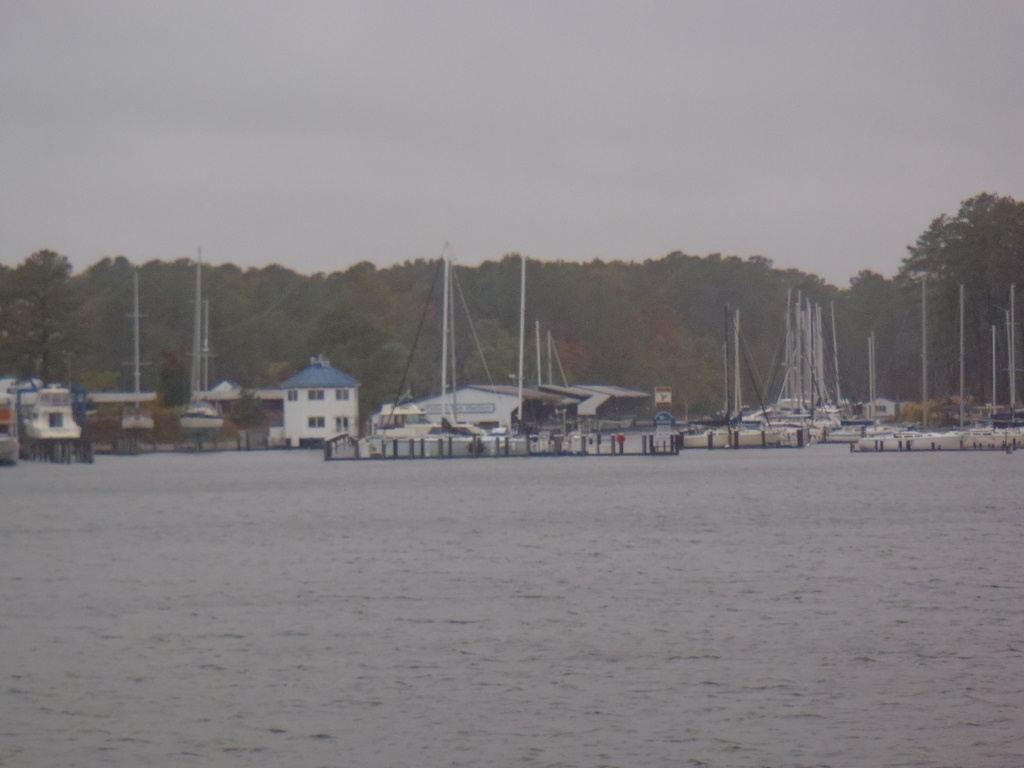
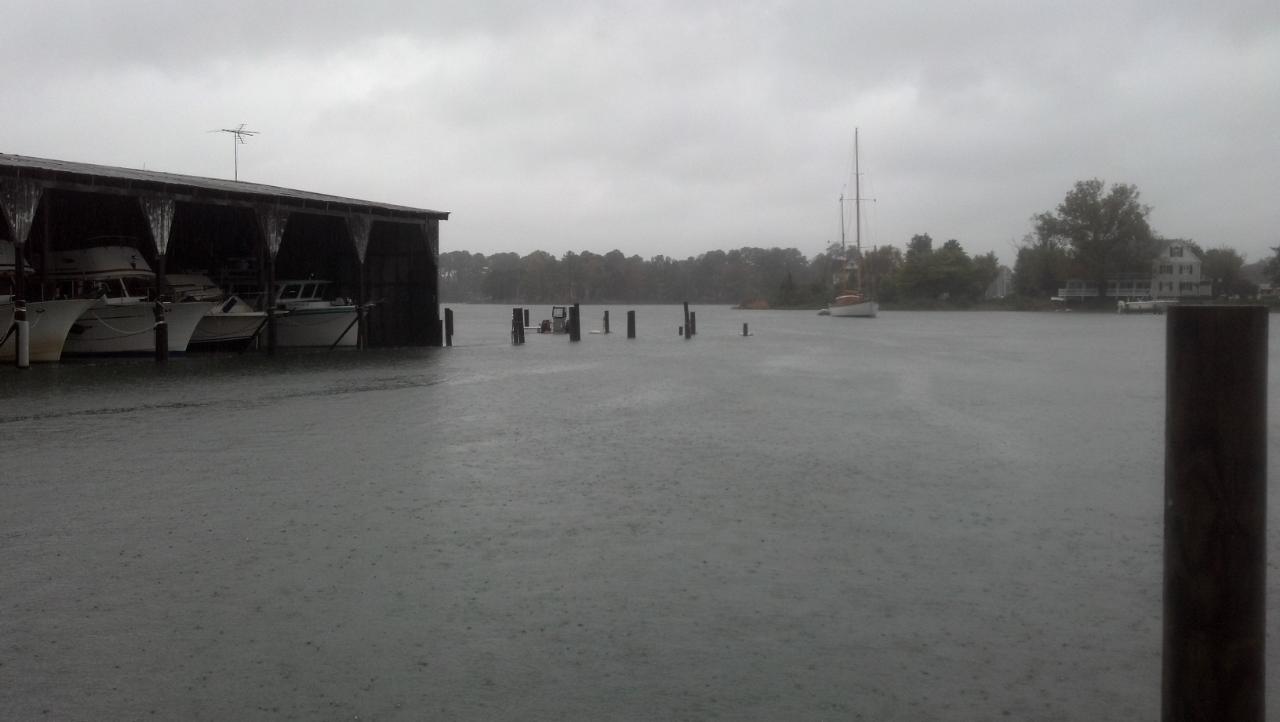
So far we’re pretty happy with our decision to anchor out. A friend sent us some photos from the Deltaville Marina and the dock we were on yesterday is already under water. We’ve had steady rain all day and winds are building, but so far we are very comfortable. Our winds are now in the high 20’s with gusts into the high 30’s. We can see that the docks at some of the local private homes and at the Fishing Bay marina are now underwater. And the real storm hasn’t reached us yet – this is just the warm-up.
The heavy rain has turned up a couple small leaks on board. One is in the port guest cabin and we’ve been trying to identify and fix it since we bought the boat. It’s still leaking but we’re now pretty confident we’ve identified where and why, so hopefully we’ll be able to fix it for good. For now, we’ve got a chamois and bucket set up to catch water. We’ve got another very small leak from the overhead hatch in the starboard guest cabin but it’s not major. A bit more frustrating is that despite a fair amount of work done in the anchor locker over the past couple weeks, we still have some water seeping into the machinery space in the bow. Again not major, but this heavy rain does give us a chance to examine all the leaks more closely. At least they are fresh water, not salt, and won’t do any real damage.

Nobletec charting software set up to monitor position
We have our Nobletec charting software set up to help us ensure we are not dragging our anchor. You’ll see in the photo the boat icon, which shows our current position. Then you’ll see the pink spot – this is the actual track of the boat since we dropped anchor yesterday afternoon. I’ve added the black lines extending 70 meters (about 210 feet) from where we dropped the anchor as a visual guide. As you can see, we swing a bit on the anchor chain, but are pretty well staying put. Fortunately, we can also see this display on the TV screen in our master cabin, so can keep an eye on things from there.
We’re also monitoring the wind using our Furuno RD-33 instrument. We have it set to show the wind direction, current wind speed, and highest recorded wind speed. As of this morning, our highest gust was 33 knots. As I write this, we’ve now seen 40.2 knots, but expect it will get a lot higher over the coming 48 hours. We’ve donned our foul weather gear and done some checks outside. It’s amazing how comfortable it is inside and what a difference in sound, feel, and temperature once we venture out on deck. We’ve still got cell phone coverage, internet, and DirecTV.

Wind direction, wind speed, wind angle, and max gust
A couple people have asked about our anchor set up. We have two 300-pound CQR anchors set up on our bow each with 100 meters of chain. One is connected to an electric windlass (winch) and the other to a hydraulic, giving us some options. As you think about anchoring, it is not the weight of the anchor and chain that keep the boat safe, but the anchor digging into the mud. The weight of the anchor and chain help this process, but the key is setting the anchor in the bottom. There are three theories regarding anchoring for heavy weather. One, both anchors are deployed at approximately 45 degrees separation. Two, deploy one and keep the second in the ready. Three, deploy the first anchor, put out some chain – about 15 meters – and then add the second anchor to this chain, the theory being the second anchor acts more like a huge weight to prevent the chain from being lifted up and thereby keeping the first anchor in the ground. We prefer the second option and while we could do three, it would be very difficult to attach the 300 lb anchor to the chain while on the bow and even more difficult to retrieve. The key problem with option one is the risk of fouling the two anchors (getting them tangled together). We have set our port side anchor, the one on the electric windlass and have a snubber line bridle set up. This is a line that goes out through the hausers (openings) on either side of the bow. A “claw” then connects this line to the anchor chain and enough chain is let out so that the strain is taken by the line, rather than by the single windlass connection. We do not have an engine running now, but if the winds strengthen significantly we have the option of keeping an engine running to allow us to take some strain off the chain and be ready in the event of an emergency.
Today was spent baking cinnamon bread, watching movies, catching up on emails, relaxing,Click on any photo to enlarge and you can now REPLY to blog update emails and it will post your reply to the blog as a comment! Hurray, it’s about time WordPress! I’ll update the blog frequently until after the storm is past, then will go back to a more normal 3-4 week update cycle.
-

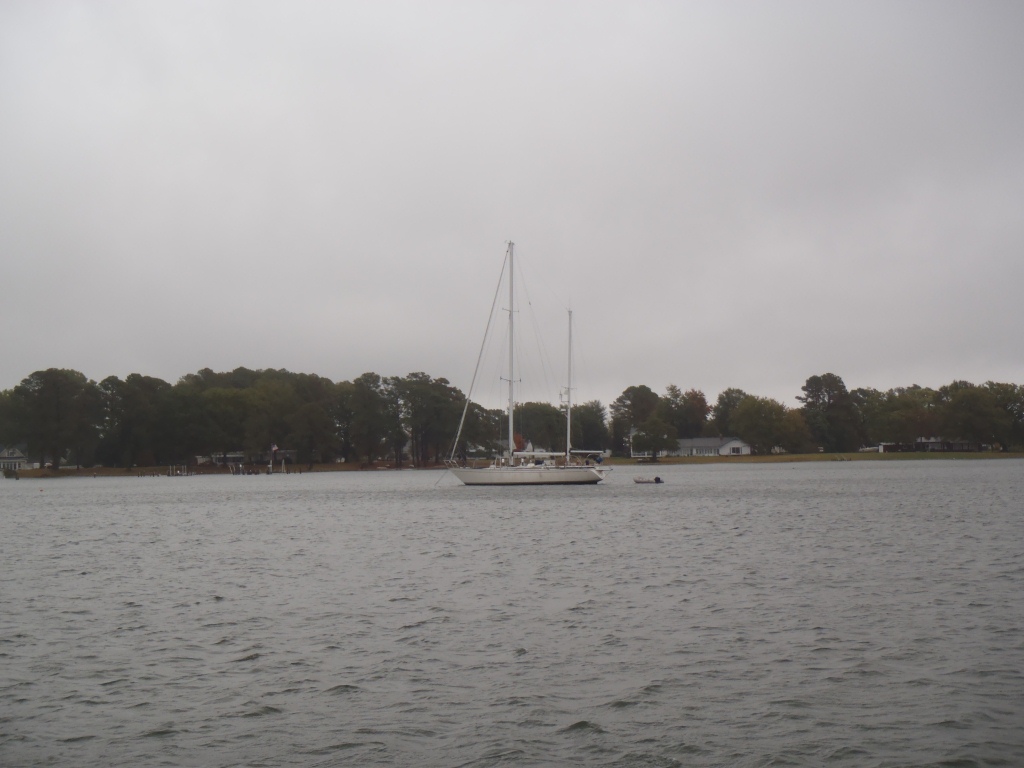
- Our neighbor, the Swan sailboat
-
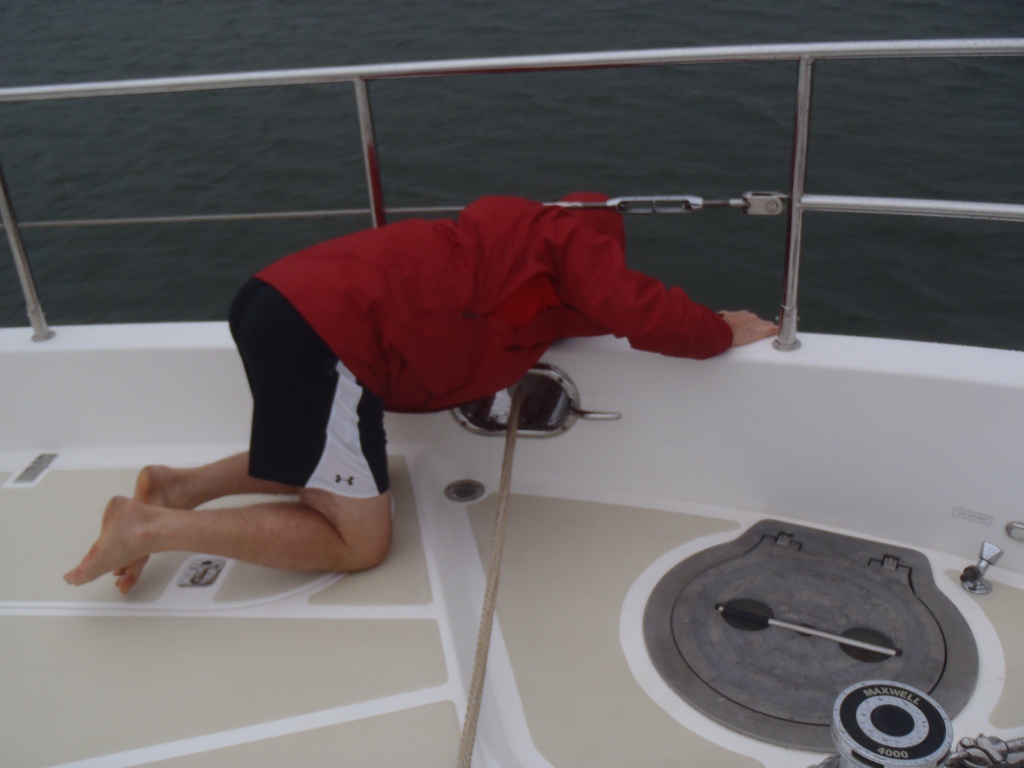
- Checking for chafe on the snubber line
-

- Local marina – docks approaching being underwater
-

- The fuel dock where we were yesterday is underwater (photo by Aaron Lasher)
-

- Yesterday we were at the high and dry fuel dock

2012-10-27 Waiting for Sandy
Posted by Kathy Clark in Trips on October 27, 2012
October 27, 2010
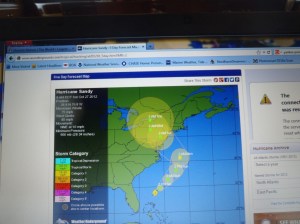
Sandy’s projected track
We are in Deltaville, VA where the Rappahannock and Piankatank Rivers meet the Chesapeake Bay, waiting for the onset of Hurricane Sandy which is due to pass this way in the next 48-72 hours. After examining our options and much deliberation and discussion, we have decided to head out to ride out the storm at anchor. We are now tucked into Fishing Bay, which offers good protection for winds from all directions except South. Why, you might ask, would anyone leave a lovely marina and head out into a hurricane? Well, let me try to explain.
Deltaville Marina has fixed docks, not floating docks. That means the docks are at a fixed height and in the event of a tidal surge, common with a hurricane, boats may actually be lifted ABOVE the docks. This provides plenty of opportunity for damage. For the past 48 hours, the boatyard has been lifting boats out of the water as both boats and docks are thereby safer. However, given our size, we are too large to be lifted out at Deltaville or any other nearby marina. Our best alternative at Deltaville was to go into the slip for the 75-ton travel lift.

Most of the boats at the marina have been hauled out
While it’s a large enough slip to accommodate us and would allow us to be tied up securely, it also has the potential to cause damage to the boat. Unlike the standard wood docks, this slip has steel bays on either side, only a few feet above the normal high tide level. With a large storm surge, the risk is that our hull could come into contact with those metal sides and the boat would not likely win! In addition, the risk from flying debris is much greater where there are lots more boats, buildings, and other potential flying missiles.
On the other hand, being at anchor avoids many of those risks. Presuming the anchor is properly set and adequate preparations are made, the risk to the boat is lower than being in a marina. Although it will likely be a bit nerve wracking and potentially uncomfortable for a while, we elected to take this option. We chose Fishing Bay, a nearby anchorage because it is deep, large, and reasonably protected from the north, which is where the winds are initially expected. We spent all day yesterday preparing the boat.
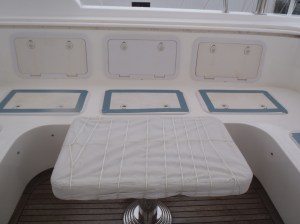
Flybrige settee – cushions removed, hatches taped and table cover secured
This included removing everything possible that might blow or sustain damage from the tender deck and flybridge such as the tender cover and bimini top, all dive equipment normally stored in a zippered deck box, all cushions, life vests, lines, fenders, etc.
It was just a couple miles to the anchorage but the winds are already starting to pick up. Nothing serious yet, just a hint of what’s to come at 10-15 knots. We are secured with over 200 feet of anchor chain out with one other boat, a Swan 57 sailboat, here with us. For now we are relaxing and waiting, but when the fun begins, we’ll be standing anchor watches, making sure we’re not moving! I’ll try to provide an update when the worst is over, but we’ll have to see if we have internet coverage throughout! So don’t be alarmed if you don’t hear from us for a while.
Of you’d like to see where we are you can go to www.marinetraffic.com and enter the vessel name Shear Madness. A special thanks to all those at Deltaville with local knowledge and our boating friends and other Nordhavn owners for their advice and expertise in helping us through this decision. Click here to send us an email or leave your comment below!
-

- Things stored in guest cabin heads

-

- Cushions and things stored in Pilot House watch berth

-

- Tender instrument cover secure

-
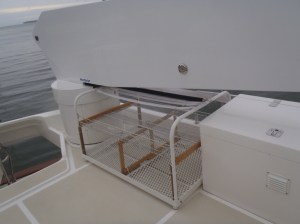
- Dive equipment box emptied and ready

-

- Bimini top from tender put away

-

- Chairs on Flybridge secured

-

- Flybridge instrument covers secured

-

- Tender deck readied for weather

-

- At the fixed dock waiting to go

-

- View of Fishing Bay

-

- Our location in Fishing Bay

2012-10-11 Family, Friends and a few more Issues
Posted by Kathy Clark in Trips on October 12, 2012
October 11, 2012

Karen and Kathy
The past few weeks have been a chance to spend some time with family, old friends, and new friends. In mid-September we left the boat and drove to Northern Virginia where more than 70 people gathered for a reunion of my former company Landmark Systems. Despite short notice, a lousy mailing list, and a weeknight date, the turnout was great and we had a wonderful time reminiscing about the Good Ole Days – it’s been over ten years since Landmark was acquired! We also attended the outdoor wedding of a good friend on a beautiful day and I caught up with many long unseen friends. Speaking of which, I also re-connected with my best friend from 5th through 7thgrades! Karen and I were inseparable for several years, but went different directions in high school and had not seen each other in many years – we never quite determined how many! But we picked up right where we left off – spending a night at Karen’s house and later hosting Karen and husband Mark onboard Shear Madness for dinner.

Dinner with Lloyd and Arlene, Braun and Tina, Dee, and Susan
After arriving with the boat in Solomons, we had a busy weekend, with friends Lloyd and Arlene, Tina and Braun, Dee, and Susan over for dinner on Friday. A fabulous night! On Saturday we had an “open boat” party attended by over 35 friends and family from the DC-Baltimore-VA area. Time was too short to properly catch up with everyone! Our friends Ken and Christine with kids Margaux and Elliott stayed the night and Ken made his famous pancakes for breakfast.
We weren’t done yet! Bob, the manager and director of Shear Madness, the play, finally came for a visit to Shear Madness, the boat along with his partner John. Thirteen years ago Bob had worked us into the cast of the play during our wedding and though we’ve kept in touch, we had not seen each other since. It was great to catch up and it’s no surprise to learn that someone who makes his living with Shear Madness is really funny and entertaining! Bob and Bradley, on opposite sides of the political spectrum, also enjoyed trying to convince each other of their points of view – that too was entertaining and all in good fun!

John and Bob visit the real Shear Madness!
After a day of rest to catch our breath, we departed Solomons to head back to Deltaville to complete some projects. Upon arrival, we met up with friends Linda and Douglas from Aries Too and Peter and Joanne from Journey, both Nordhavns, for a dinner aboard Shear Madness. And another typical cruiser story – for a few months I have been emailing a woman named Marie whose boat was also struck by lightning. We’ve never met but have exchanged stories about our respective repairs by email. When Marie heard we were heading to Deltaville, she told me “you have to contact our friend Bill who lives right across from the marina”. So when we arrived I sent an email to Bill explaining that Marie had suggested I contact him. No more than 15 minutes later there was a knock on the hull and there was a man standing there with a big smile, a bottle of wine, and an invitation to his house!
For technical details, scroll down below photos. Check out new Boat Photos and leave your comments below or click here to send us an email.
-
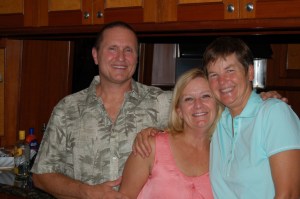
- Mark and Karen with Kathy

-
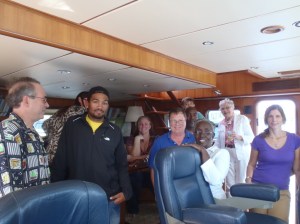
- Open Boat Party

-

- Open Boat Party – Glenn and Sue

-
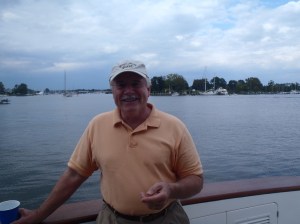
- Open Boat Party – Tom

-
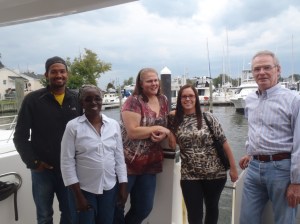
- Boat Party – Kevin, Maureen, Debbie, Kristina, Pat

-

- Boat Party – all those feet are onboard!

-
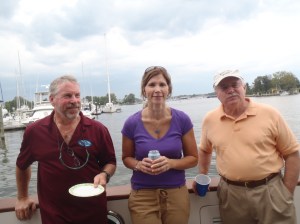
- Boat Party – Bradley, Amy, Tom

-

- Boat Party

-
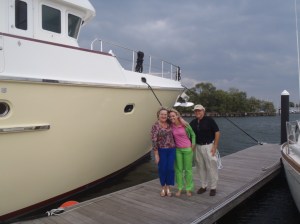
- Boat Party

-

- Boat Party

-

- Boat Party – Marilyn and Susan
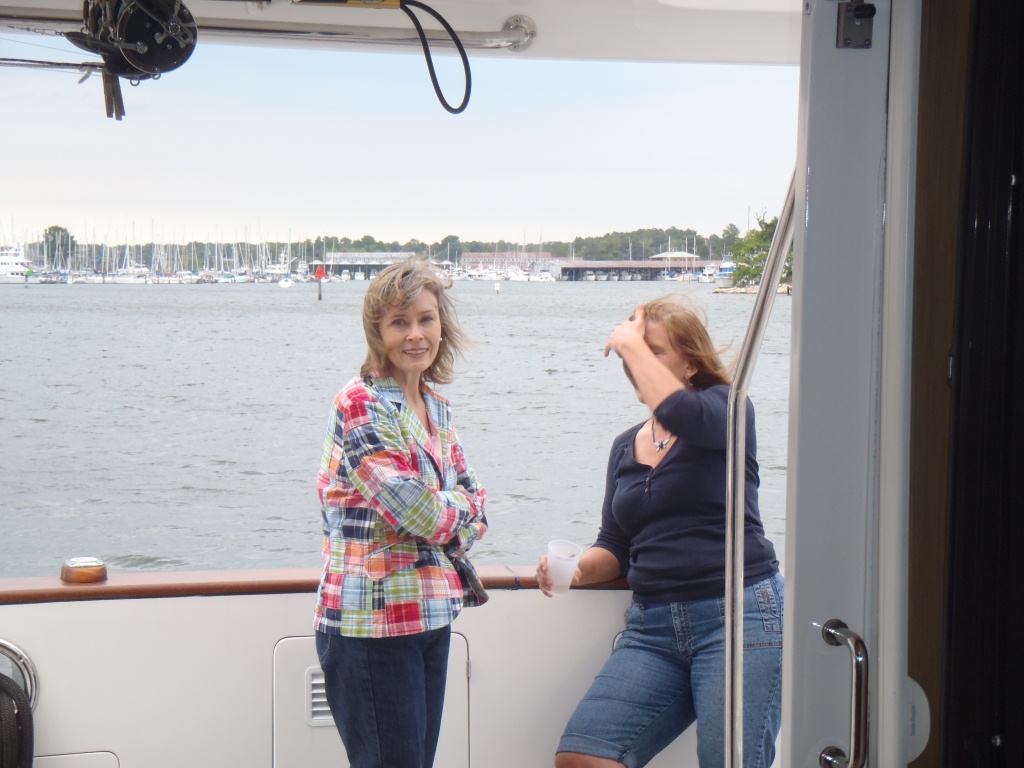
-

- Boat Party – Dan, Susan, Rosemarie

-
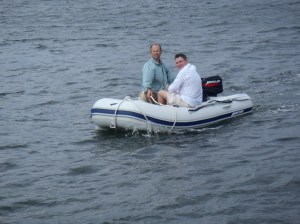
- Boat party – James and Steve arrive by tender

-
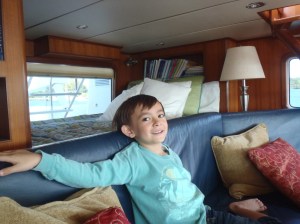
- Boat Party – Joshua

-

- Boat Party – Paul, Sara

-

- Boat Party – James, Bradley and Steve

-

- Ken, Christine, Margaux, and Elliott

-

- Kathy with Bob and John

Autopilot

Pilothouse with wheel on – see cabinet behind wheel
- As reported in the last update, we had some strange behavior of the autopilot (AP), a Simrad AP25, on the trip to Solomons. It was periodically shutting itself off, or switching from “Auto” to “Follow Up (FU)” mode by itself, sometimes requiring us to turn off the circuit in order to regain control. We have two AP systems consisting of separate steering pumps and processors (computers). We can select Primary or Alternate AP via a switch in the Pilothouse. The systems share two heads (control panels), one remote control, and five Follow Up Steering Levers (appropriately called FU25’s). Because we were experiencing the problem with both the Primary and Secondary system, we suspected one of the common components was the likely cause. Once safely in the marina, Bradley began the tedious task of diagnosing the problem which uncovered another issue – a bit of a flaw in our redundancy.

Wheel removed for access to AP wiring
The wiring that connects all the AP components is located beneath the helm station in the Pilothouse and requires removal of the wheel in order to access. If there is a problem with the autopilot, as in this case, and we have to manually steer, you need to use the wheel, thus making it difficult to remove in order to solve the AP problem! Anyway, Bradley began by disconnecting all the FU units from the AP. This is easier said than done as each of the 5 FU’s has five wires. Each then had to be reconnected one at a time to determine which one was causing the problem. Fortunately, even while not moving at the marina, we could re-create the problem by simply turning the AP on in standby mode. Soon it would switch itself into Follow Up Mode. Each test took several hours as the failure is not immediate, with Bradley squeezing himself into the small cabinet over and over. However, we eventually concluded that the Flybridge FU unit was the culprit, most likely due to an electrical issue from the lightning strike, and with all other components re-connected, we successfully made the trip to Deltaville with no further problem. Of course, the FU25 model we have is no longer made, so we are evaluating whether a newer model FU50 will work with our system, or whether we can find a couple FU25’s somewhere.
We continue to have one additional issue with the Autopilot which I have mentioned previously. When in “Nav” mode where the AP is steering along a route with multiple waypoints, sometimes when a waypoint is reached, the AP wants to do a turn that bears no relation to the next waypoint. We had determined that a piece of data called BWW (Bearing Waypoint to Waypoint) that is sent to the AP is all zeroes when this problem occurs. So let’s say we are on a course of 180 and the next waypoint will be a course of 170. We should make a 10 degree turn upon arrival at the first waypoint and the BWW should be 170, which is then subtracted from our current heading to result in a course change of 10 degrees. However, if the BWW is zero, the AP will attempt a turn of 170 degrees. Not good. Fortunately, any turn of more than 10 degrees requires a confirmation, so will not be automatically executed. So, although we know that the BWW is zero when this happens, we haven’t quite figured out WHY it is zero. But I have developed a theory which I am now testing. We use Nobeltec Trident TimeZero chart plotting software which interfaces to NavNet 3D, an integrated product including chart plotting, radar, and other information. Navnet is also the source of the data sent to the autopilot. Routes can be shared between Nobletec and Navnet (both Furuno products) and can be created, activated, and changed in either system. Typically, I create and activate routes in Nobletec and I wondered if the problem could somehow lie between these two systems rather than between Navnet and the AP. Upon leaving Solomons, I activated a route with multiple waypoints in Nobletec. We had the problem occur at our second waypoint change. I then wondered about a specific parameter called the Waypoint Arrival Radius. This can be set to tell the software when it should recognize that a waypoint has been reached and the next one should be activated; that is how close you need to be to the waypoint before you have “arrived”. What would happen if Nobletec thought we had arrived at a waypoint, but Navnet didn’t? Seems possible that scenario could result in NavNet not sending correct data to the AP. To test my theory, I canceled the route, changed the arrival radius so that Navnet would recognize arrival sooner than Nobletec, and activated the route in Navnet rather than Nobletec. I added a bunch of additional waypoints, all of which were executed with no problem. Since this problem is intermittent, it’s way too soon to tell if we have found a cause and/or solution, but I can’t wait to get out and test it again!
We’ve added a new project to the list at Deltaville – to re-wire the shared AP components and connect them to a switch that will allow us to isolate each component without having to remove the wheel.
Deltaville projects
We have a list of projects to complete at Deltaville, including:
Servicing generators
Installing new engine exhaust fans
Designing and installing screens for the pilothouse doors and main salon side door (really needed in anchorages with lots of flys or bugs when we want breeze)
Installing new anchor snubber-line system and new anchor swivels
Small repairs to a couple ports and hatches and swim ladder
Updating our electrical drawings to reflect all the changes made with the lightning strike repairs
 Shear Madness