Archive for category Trips
It’s Better in the Bahamas (May 2012)
Posted by Kathy Clark in Trips on May 16, 2012
May 13, 2012

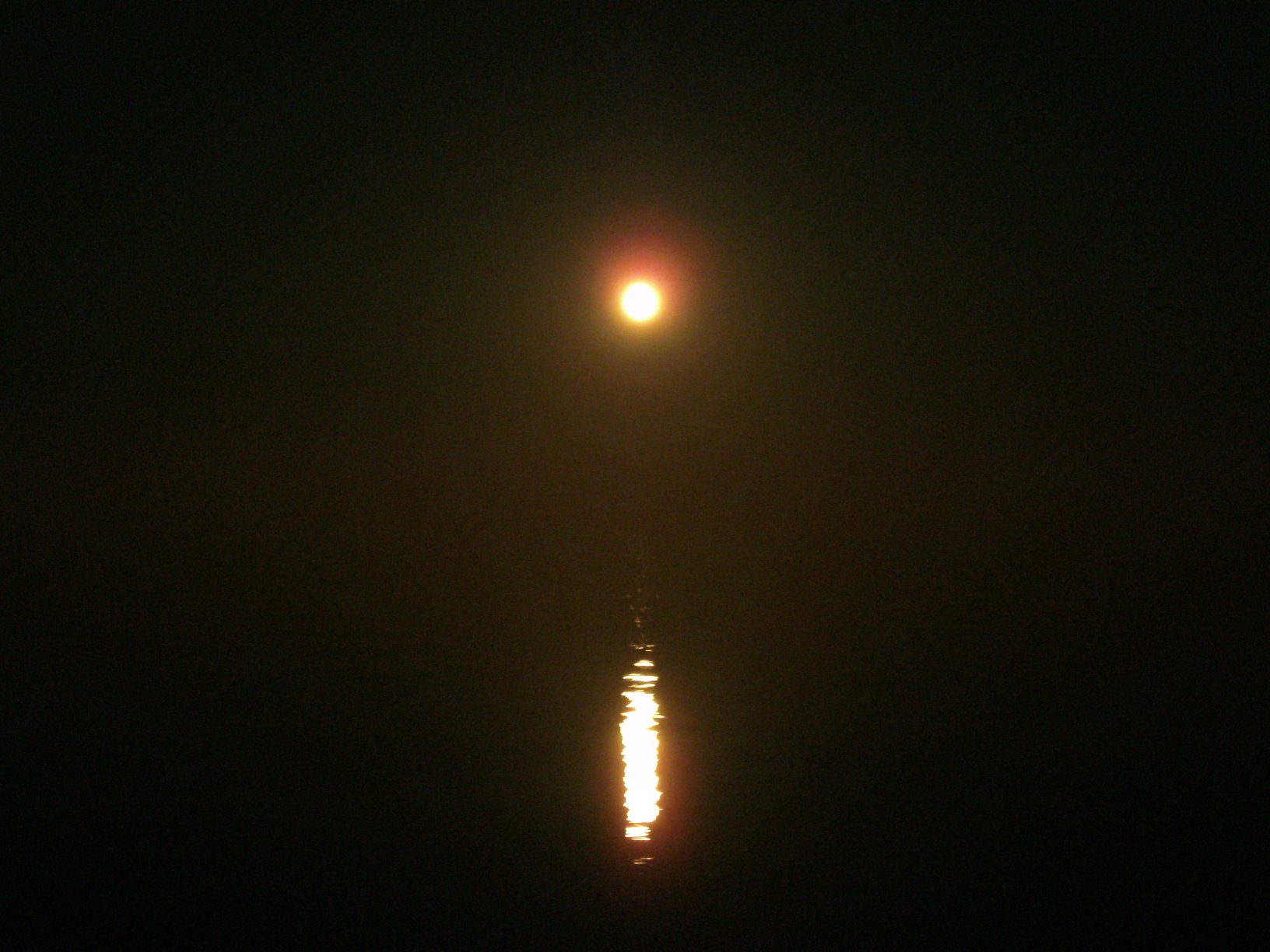
Full Moon at West End, Grand Bahama
It is finally time to get back into cruising mode! We have chosen the Exuma Islands in the Central Bahamas as our destination. The plan is to depart Palm Beach, work our way slowly to the Exumas, spend 4-6 weeks there, then return to Palm Beach to finish the last remaining details from our repairs and to fix any new issues that come up on this shakedown cruise. On this trip Bradley and I are handling the boat completely on our own.
Once we were finally ready to depart for the Bahamas, the winds decided to blow 20-25 knots from the east for a few days, so we waited for them to settle down. The boat could certainly have handled it, but we were looking for a comfortable and uneventful trip. Finally on May 3 we departed Old Port Cove Marina and made the short (1 hour) trip to Lake Worth Inlet where we anchored for the night, positioned for an early morning departure to West End on Grand Bahama Island. There were two reasons for the short first leg. First, we need a near high tide to safely get out of the marina, so there are only certain windows of opportunity to exit. We also wanted to time our trip so that we arrived at West End in daylight and in time to make it to the Customs office before their 5pm closing.

Rainbow at Morgan’s Bluff on Andros
At 54 miles and with the Gulf Stream to cross, that means about an 8 hour trip, so an early morning departure is desired and we wanted to be close to the open ocean for a departure before sunrise (ie, in the dark), Second, we wanted a night at anchor to allow our bodies to adjust to the motion of the boat and to run the generators and make sure our battery charging systems are working OK. The night at anchor was lovely and despite a small problem with the charging system, we were GO for departure!
We woke early and were on our way at 4am the next morning. The trip across was delightful – perfect conditions and all our new electronics performed very well. We arrived at West End, Grand Bahama around noon. The only reason we were stopping at West End was to clear customs and obtain our cruising permit. We did not really want to have to take the big boat in to the marina, and it was low tide, so we decided to anchor outside the harbor entrance, launch the tender, and have Bradley go in to see if we could get cleared in without bringing the boat into the harbor. We had obtained all the forms in advance and everything ready to go. We hoisted the yellow “Q” flag – to show that we had arrived in a new country but had not yet cleared through customs. “Q” means quarantine, from days when incoming boats were quarantined to ensure no infectious diseases were on board and whenever a vessel enters a new country, the first order of business is to “report in”. The Bahamas have so much boat traffic from the US that the customs process is fairly quick and easy. Bradley set off in the little tender and was back in 30 minutes, cruising permit in hand! We lowered the “Q” flag and hoisted the Bahamas “courtesy flag”, a small flag of the country you are visiting,on the starboard halyard which signifies that you have entered the country legally. Our larger, country of registration flag from the Cayman Islands, is flown from the stern of the boat at all times.

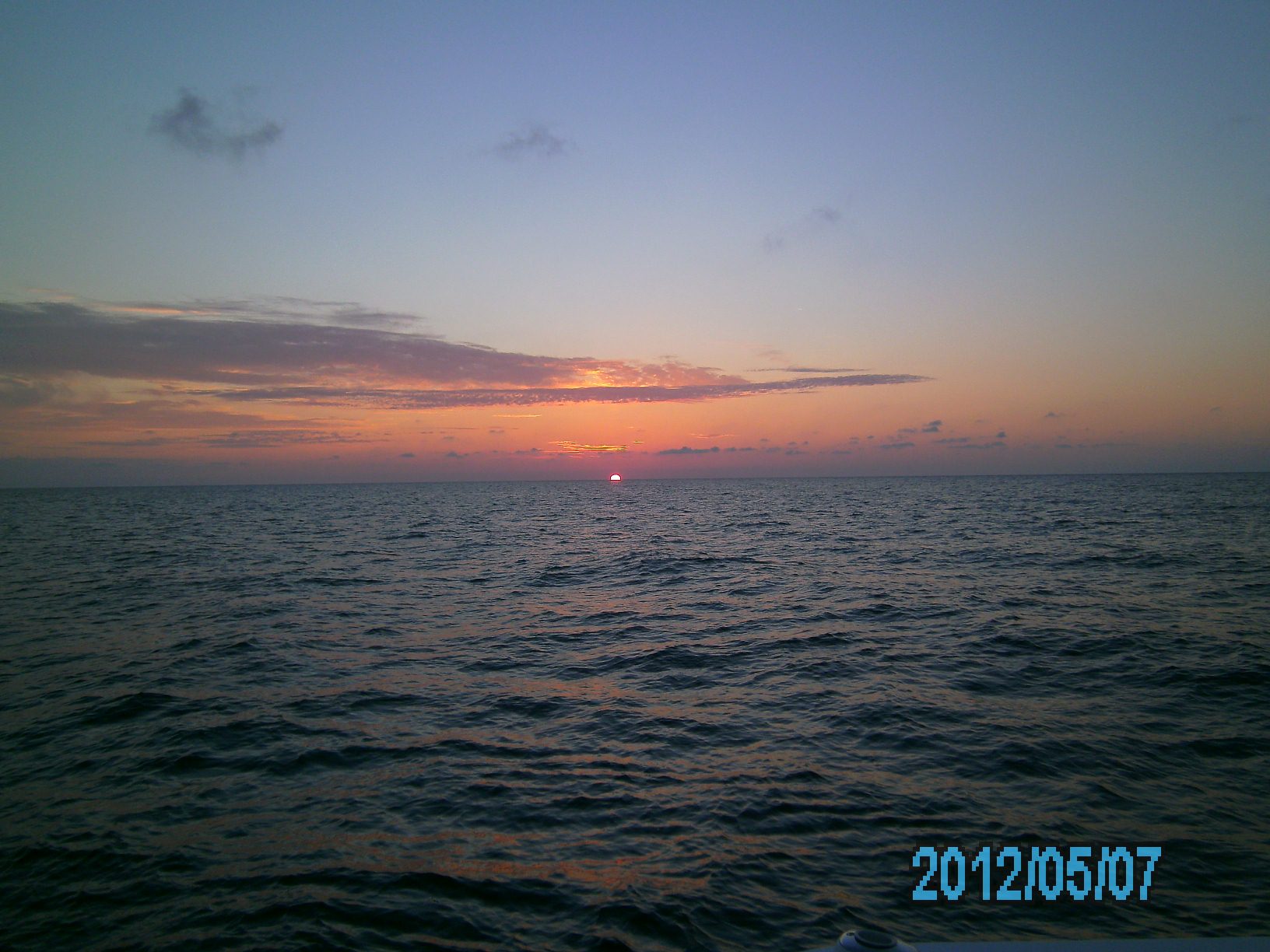
Sunset at Joulter Cays at north end of Andros
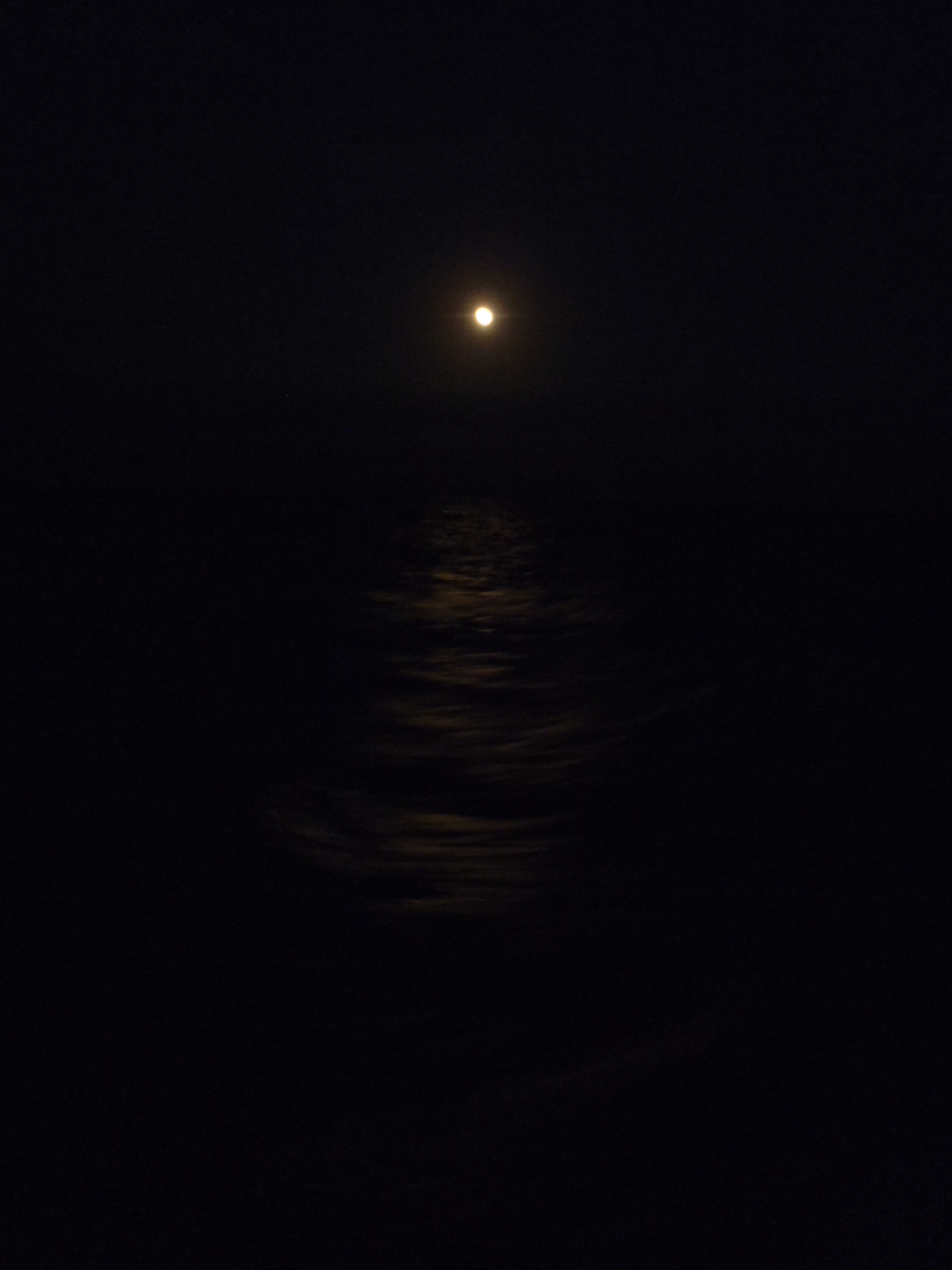
Although the holding was poor (meaning the anchor could not really dig in securely), there was almost no wind, so we stayed overnight at our anchorage where we were treated to a spectacular full moon – actually a Super Moon where the moon is at its closest point to the earth and also full. This happens only once a year and it truly was beautiful! The next leg of our trip would be between 50 and 70 miles. We had two possible stopping points with the option to continue on past the first if things were going well. We again departed early – at 3am – and had a fabulous trip in calm conditions. We decided to continue past the first stopping point and travel through the Northwest Channel, arriving at the Joulter Cays at the top of Andros Island around 4pm.
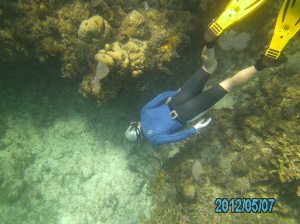
Bradley has a look at a reef
Now it was time for some playing and relaxing. We couldn’t wait to get in the water and do some snorkeling. I also wanted to try out my new underwater camera. The water was warm and crystal clear. We found some small reefs with some nice snorkeling and really enjoyed being back in tropical waters! We then moved a few miles south to Morgan’s Bluff, where there was a bit more shelter and some better snorkeling. We had two nice nights there and took the little tender out for some good rides. While the size of this tender makes it very easy and safe for us to get on and off the big boat, the ride is quite a bit bumpier than the large one we left behind for this trip. This tender is an inflatable with an air floor, which means you REALLY feel the water – each wave is like a speed bump. It’s great for short trips or when the water is flat, but is more of a challenge in choppy seas. We’re still convinced the right answer is something in between the two!

At anchor at Staniel Cay
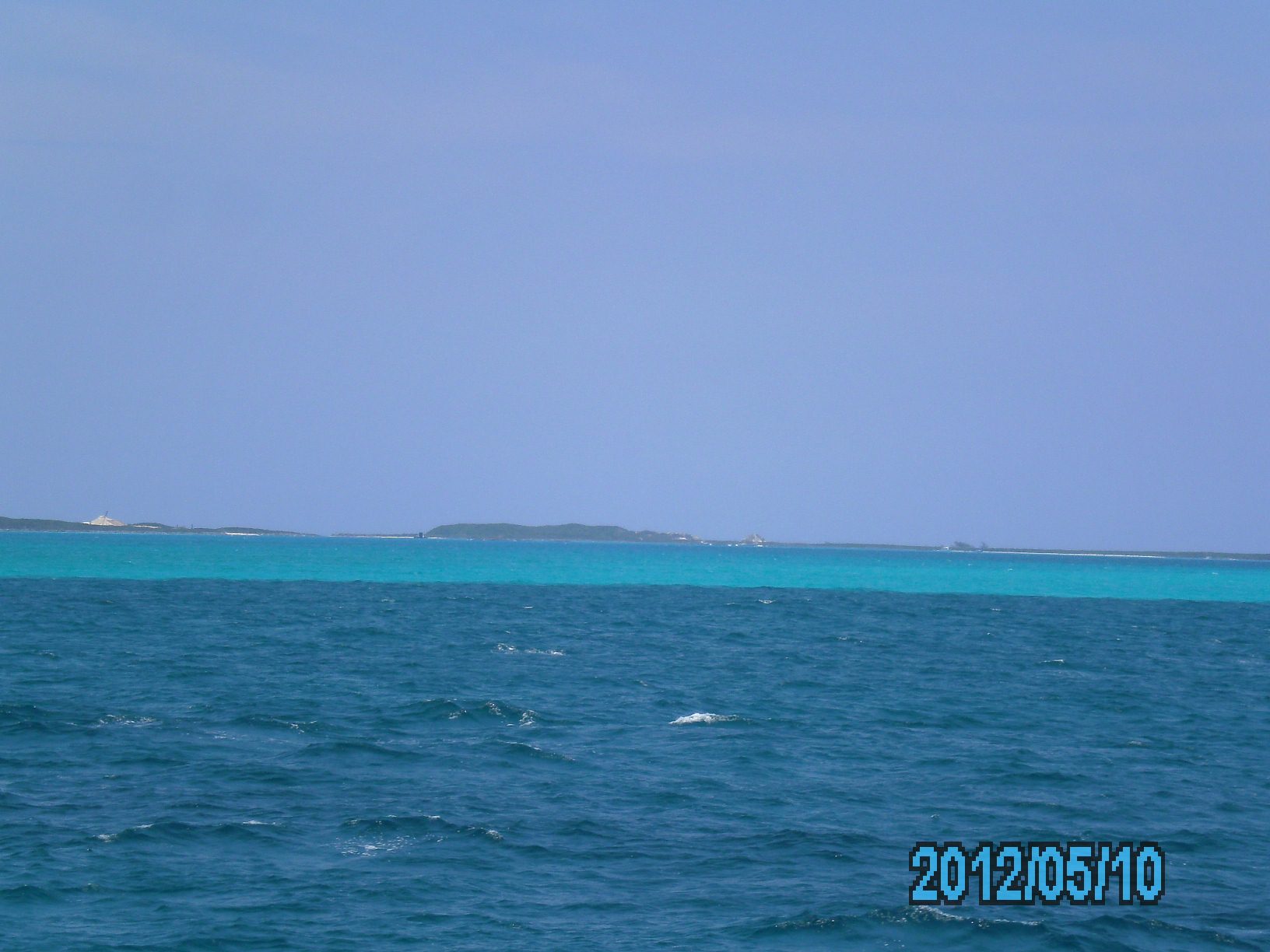
From Andros, we were set to head to the Exumas. Our plan was to go across the Tongue of the Ocean, then to anchor somewhere on the Exuma Bank. Our start was delayed due to a problem with one of our watermakers (more on technical problems later). But by 7:30am we were underway for an 11 hour journey to Norman’s Cay where we anchored for a night. Next it was south to Staniel Cay. Once on the Bank, depths are much shallower, making for a more nervous journey. We kept a sharp lookout, being careful not to venture into the really shallow parts! Fortunately, the water is crystal clear here and it is easy to see the differences in depths reflected by different colors of the water. Once at Staniel Cay we found a fellow Nordhavn (a 68 footer) with her owner George aboard. George has cruised extensively in the Bahamas and was a great source of information for us since our boats both require the same amount of depth – about 7.5 feet. It was great to catch up with George and he came aboard for a nice dinner on the flybridge.

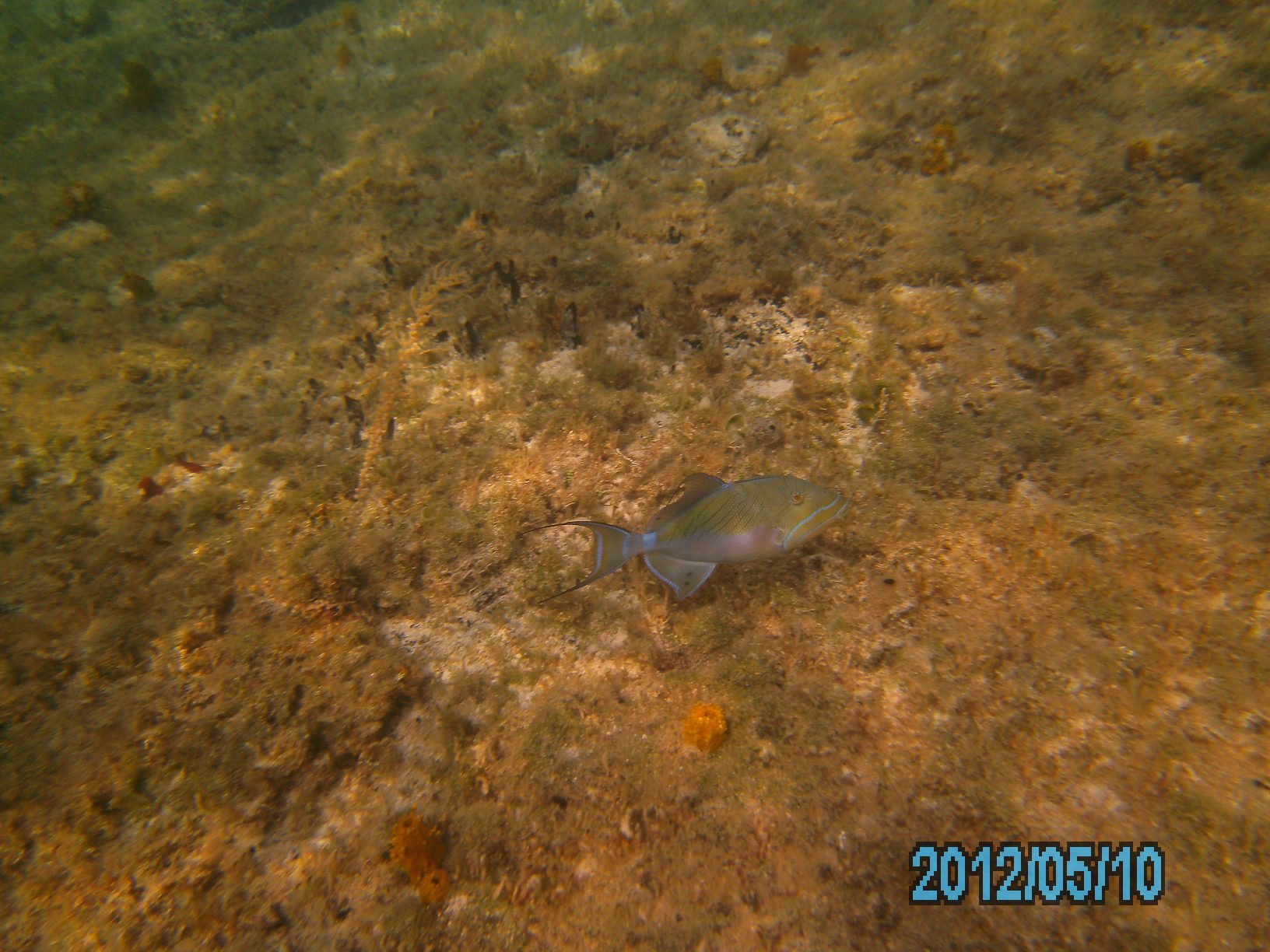
This fish liked having his photo taken – he was quite a ham!
We did a little snorkeling and moved for a day six miles south to Black Point on Bitter Guana Island where we found more good snorkeling and a few small caves that were fun to explore. We are enjoying having some time to relax and catch up on reading. There is no internet access here so we are quite islolated – just what we wanted! As the winds again changed direction, we headed back to Staniel Cay where we visited the famous Thunderball Grotto, a snorkeling cave made famous by the James Bond movie Thunderball. We met a nice couple aboard a sailboat, Dianne and Walter, and visited each other’s boats for happy hours. We’ll hang out here for a little while before heading south, ultimately to George Town to pick up some guests in a couple weeks.
Below are more photos and below that is some information about the technical problems we experienced on this trip for those who are interested.
There are also some new book reviews and a 3 minute video of the highlights of our trip so far. Leave a comment or click here to send me an email.
-
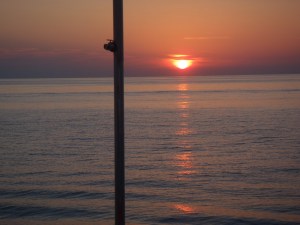
- Sunset at West End
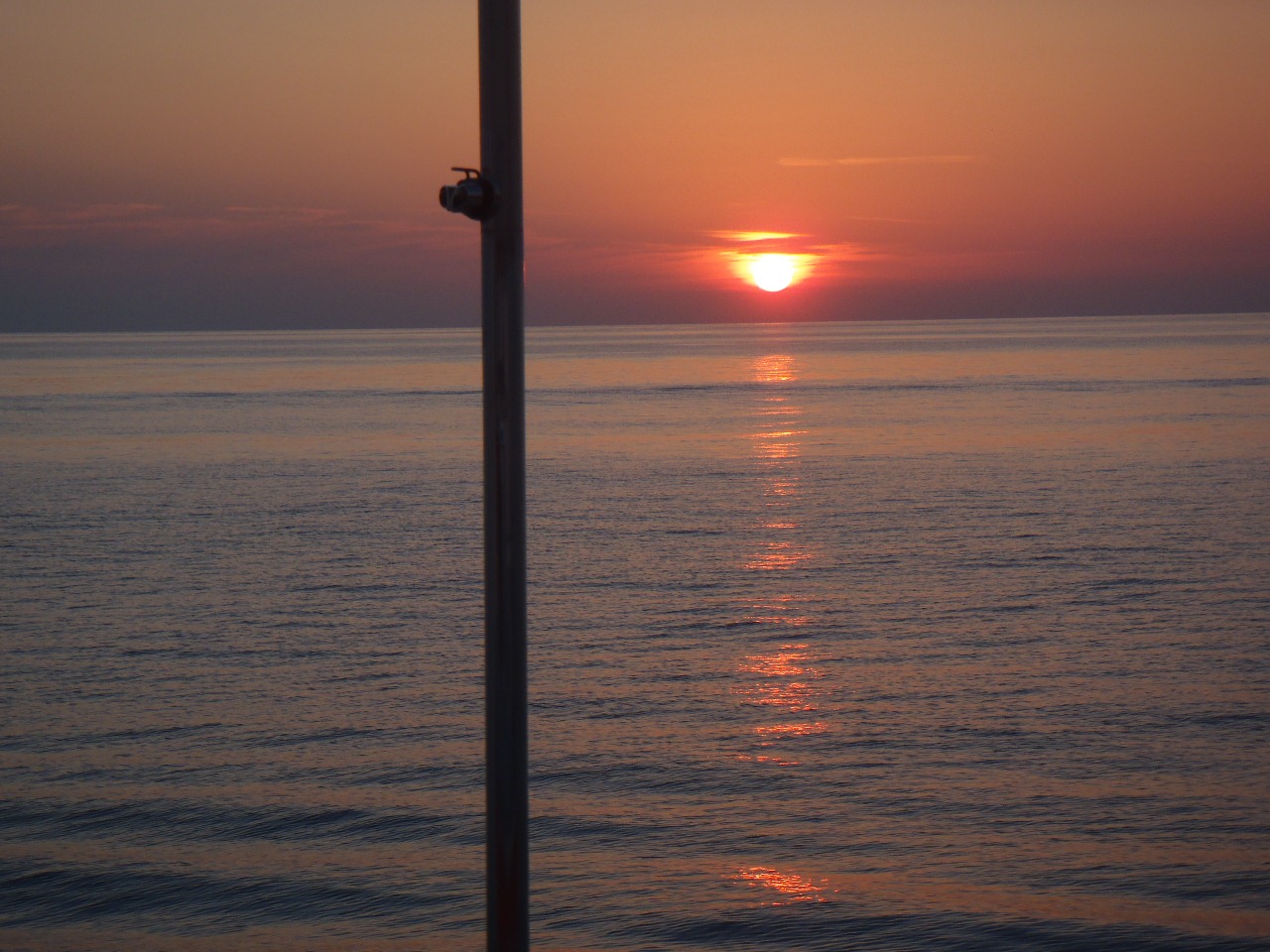
-
- Full Moon reflects on water at Andros
-
- Sunset neat Morgan’s Bluff, Andros
-
- A nice reef fish, but a little too small for dinner

-
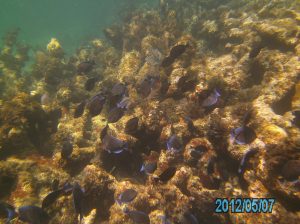
- Reef fish

-

- The colors in the water are wonderful – easy to see depth changes
-

- Fish on the Reef at Black Point
-

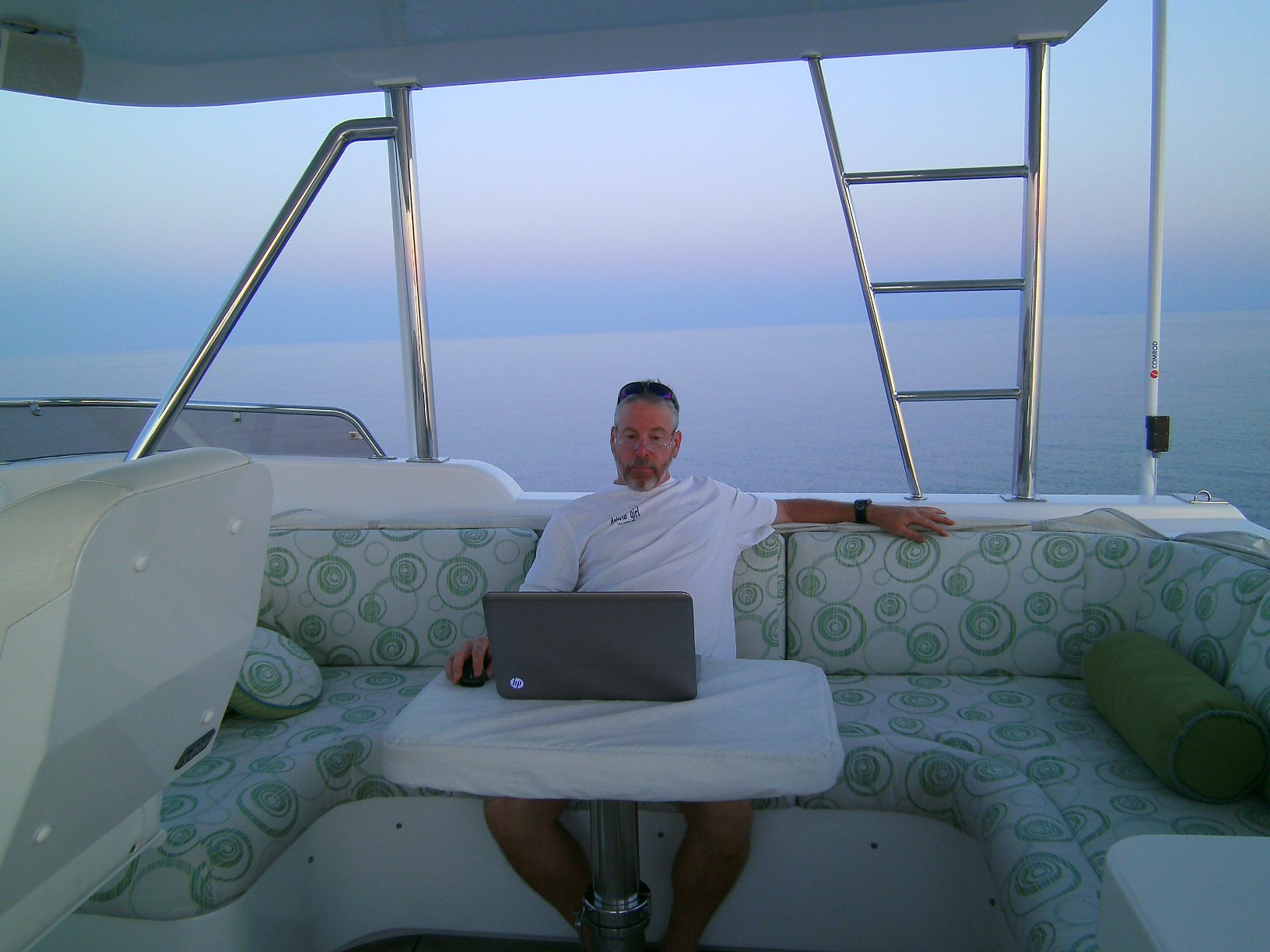
- No internet access, but the flybridge is a great place in the evening!
-

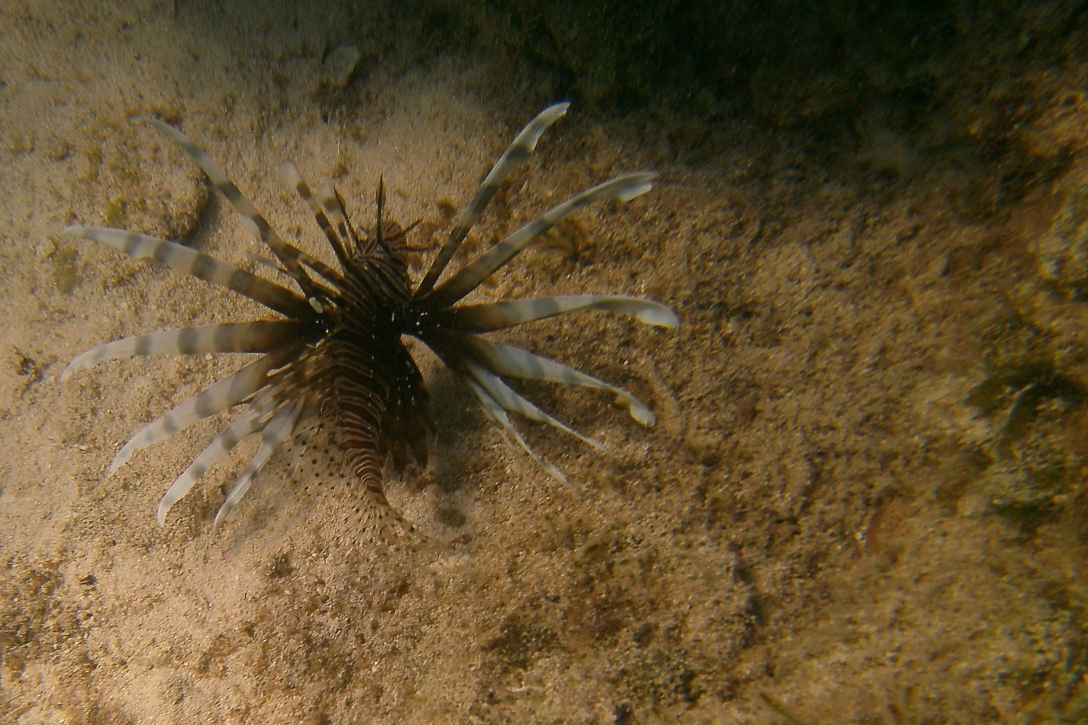
- Lion Fish – an invasive species that is damaging the reefs
-

- Bradley and our small tender at sunset in Staniel Cay

-

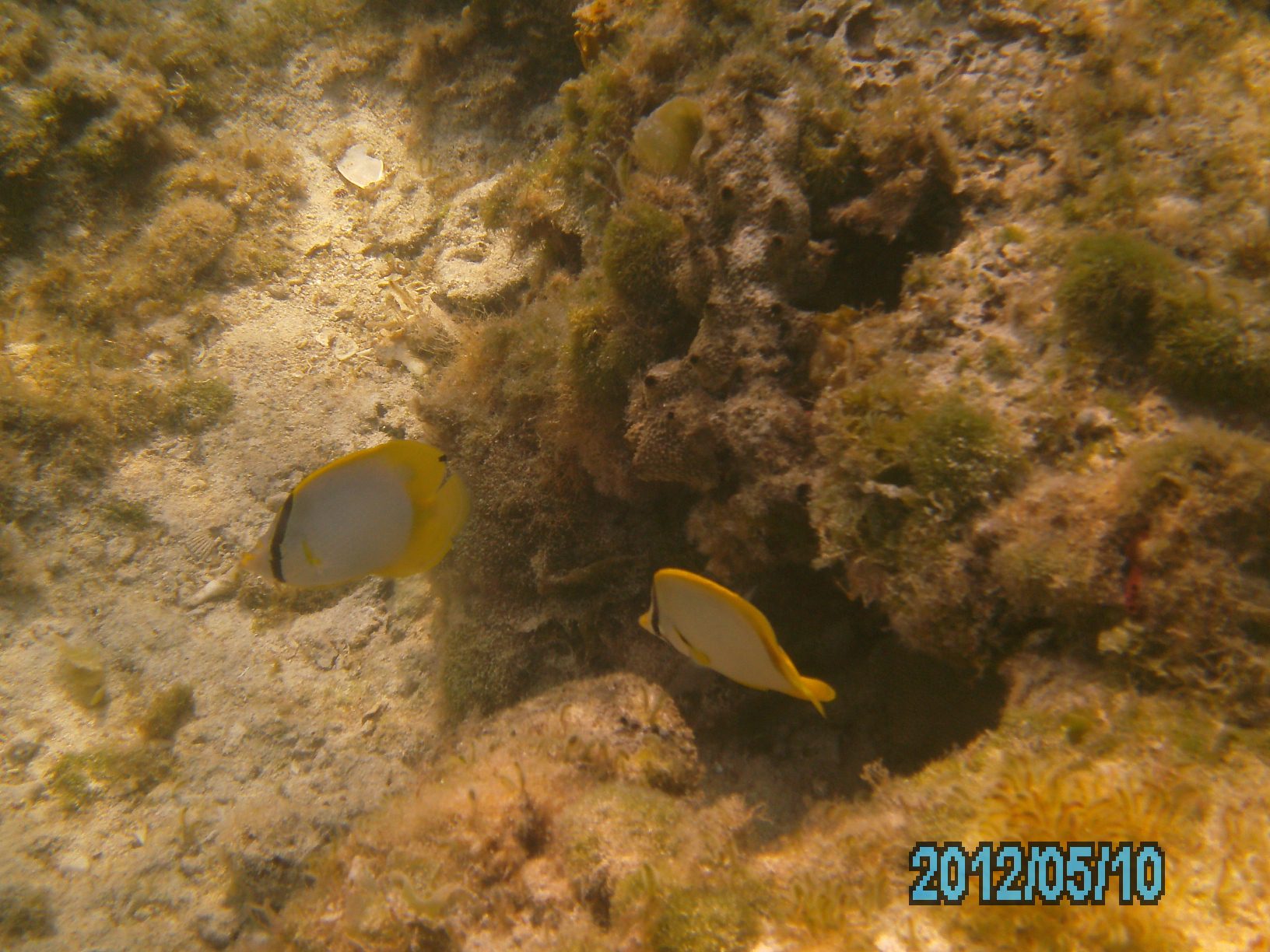
- More pretty reef fish
-
- Bradley investigates a reef

-
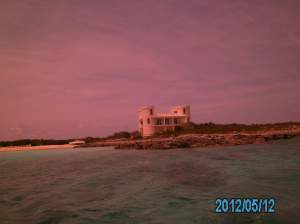
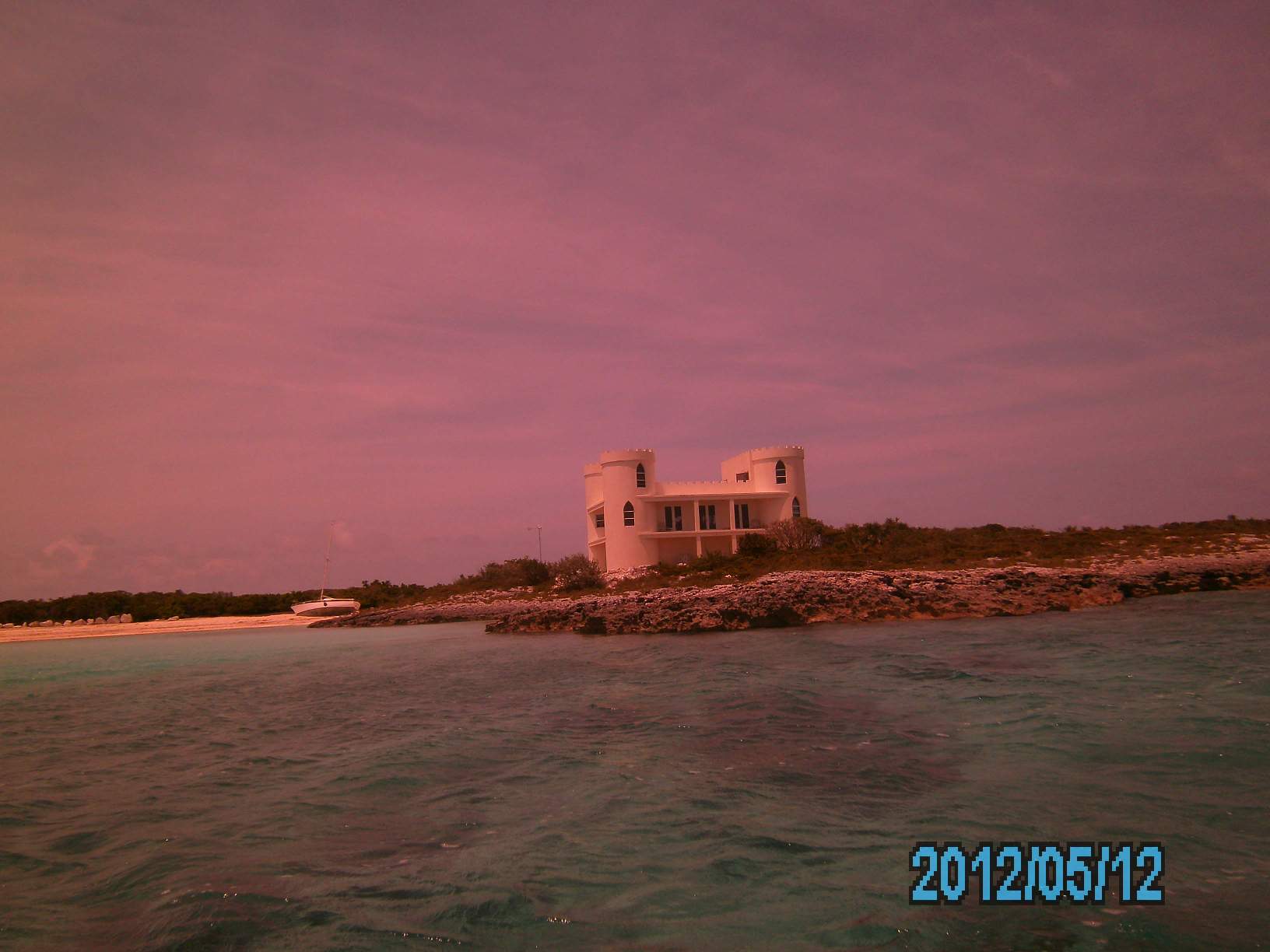
- A “sand castle” house at Black Point
-
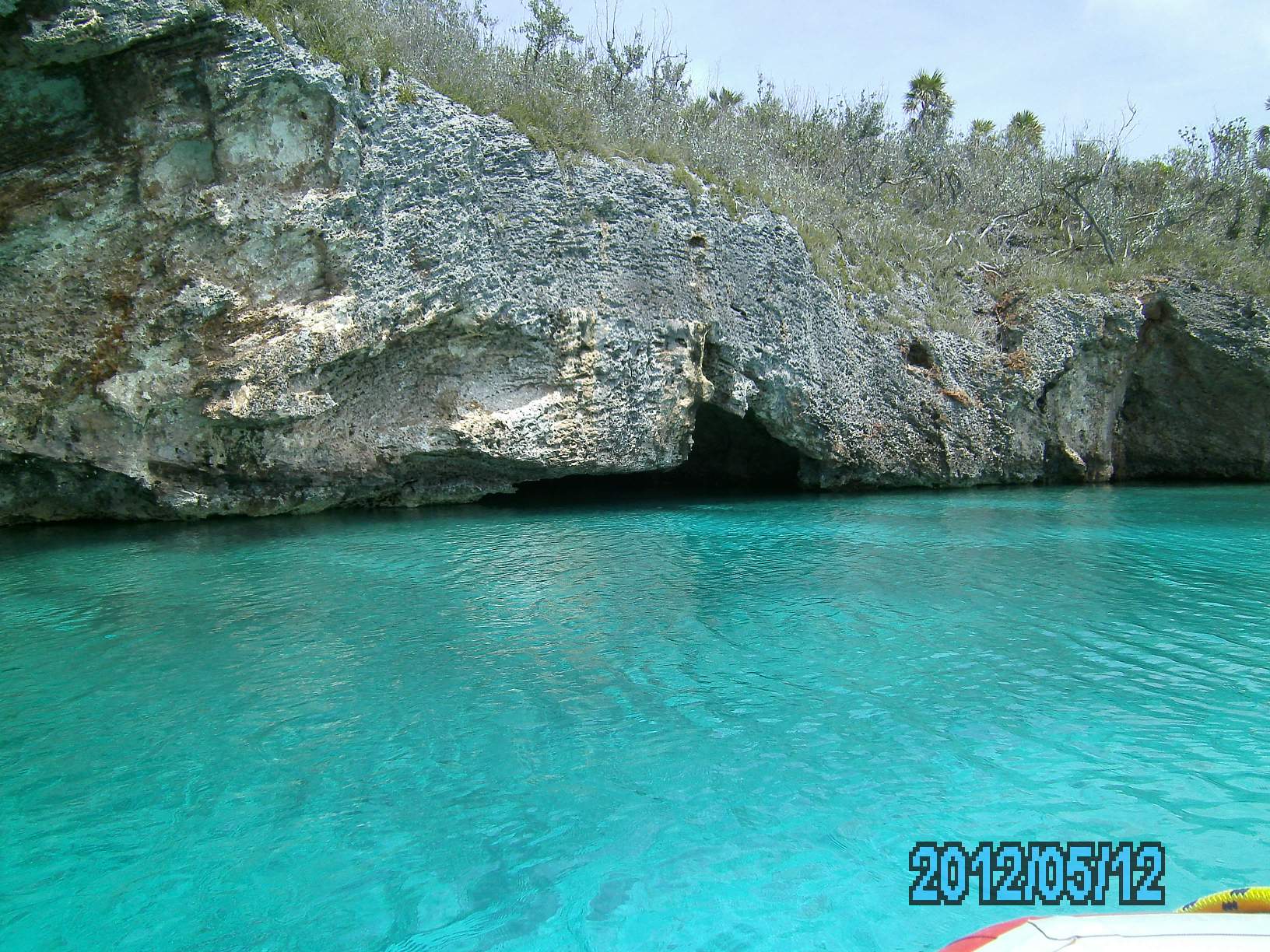
- Cave at Black Point from the outside
-

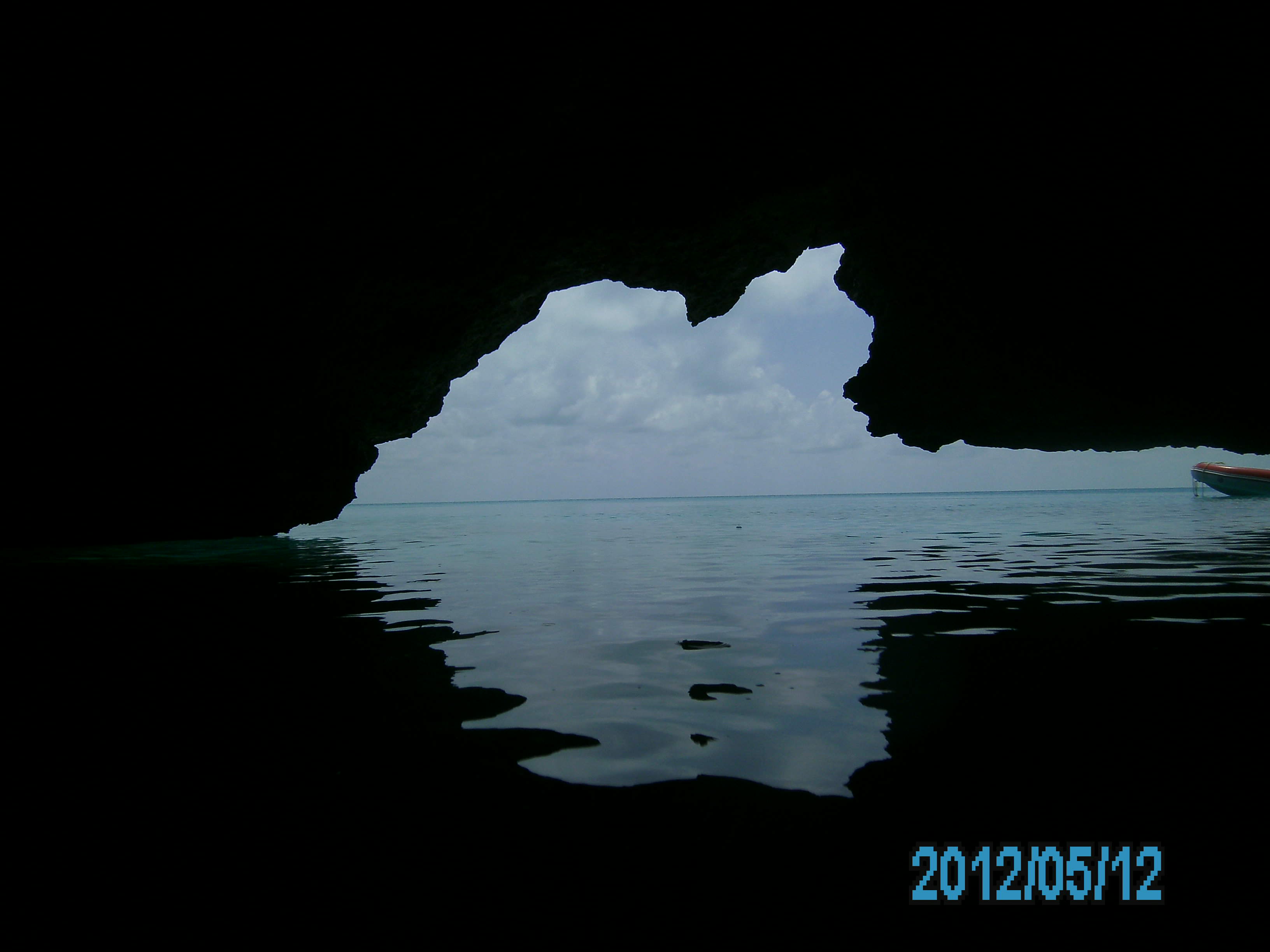
- Cave at Black Point from the inside
-
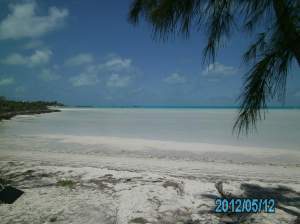
- View from Black Point land

-
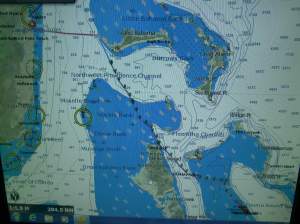
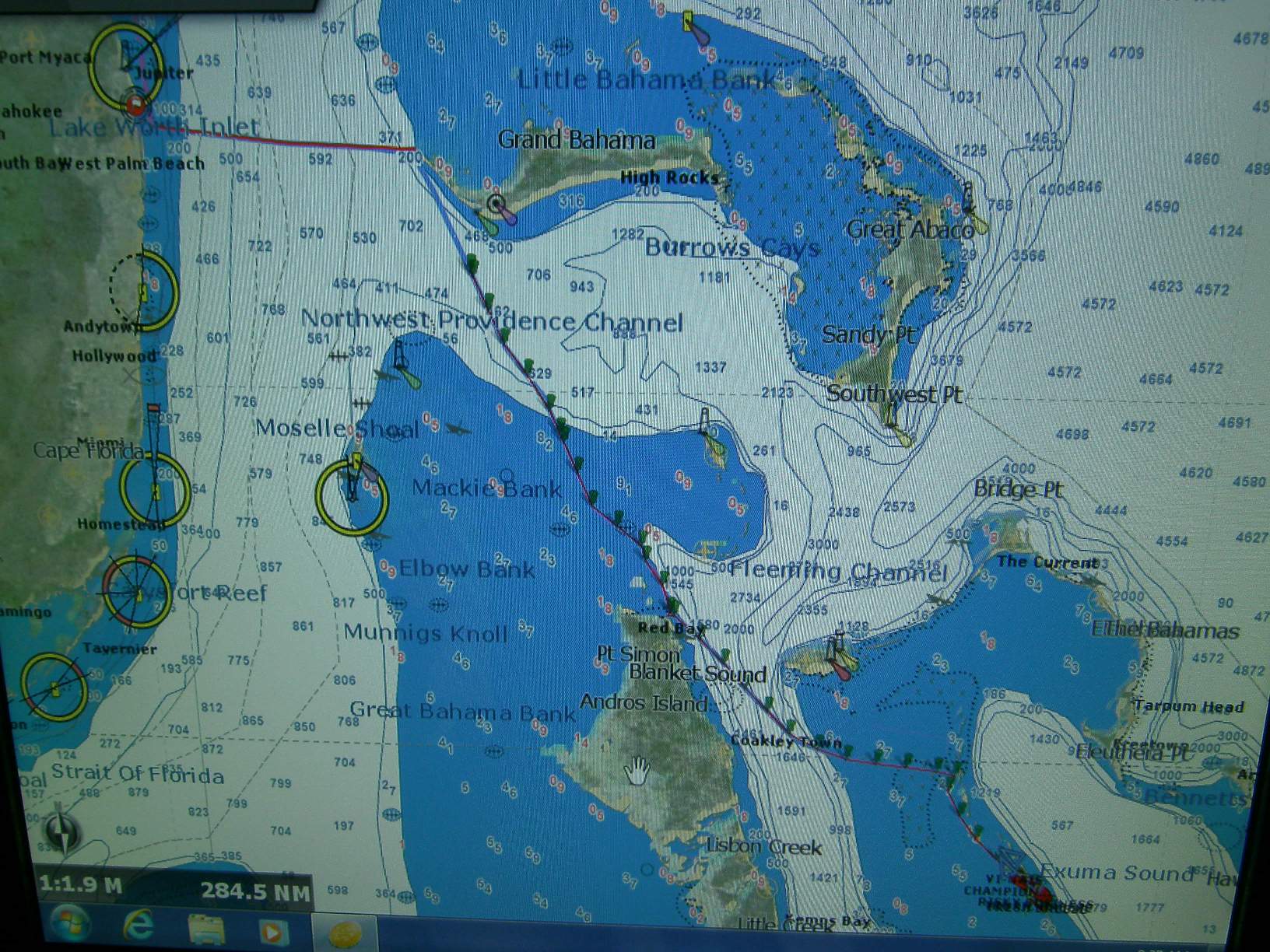
- Our Route from Palm Beach to the Exumas
-
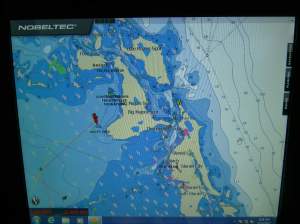
- Our anchorage at Staniel Cay/Big Majors

Technical Problems
Warning – this section is only for those who are interested in technical aspects of equipment and problems. No mention of sunsets or rainbows…….
This trip is serving as a shakedown cruise for all the new equipment we have installed over the past eight months. We expected to have some problems, but for the most part things have worked well. Here are a few of the problems we have found:
- Mastervolt charging system. We replaced our previous Xantrex Inverters with a Mastervolt system made up of three battery chargers, one inverter, two shunts, and two control units. This system converts incoming 120 or 240V AC shore power (or onboard generator power) to 24V DC to charge the 2040 Amp Hour battery bank and, when operating the boat on battery power, converts (inverts) 24V DC from the battery bank to 120 and 240V AC. The battery charge levels are monitored by the Mastervolt control unit as well as by a separate Xantrex meter. This allows us to see how many amp hours have been used and what percentage of the total 2040 amp hours have been consumed so that we can determine when it is necessary to run the generator when not connected to shore power. Prior to leaving Palm Beach, we had adjusted the settings on our Mastervolt controls to allow it monitor the system as a whole – that is, to show the total amp hours used for the whole battery bank, the percentage of overall charge for the entire battery bank, the amp hours being put in from all three chargers, and other data about usage. That involved setting the two shunts up as one “virtual shunt”, per instructions from Mastervolt and under the supervision of an electrical engineer and Mastervolt dealer, James C. After disconnecting from shore power and moving to our first anchorage, Bradley noticed that the battery charge percentage for the batteries was different between the Mastervolt meter and the Xantrex meter. Initially we were concerned that the charging system was not functioning properly as the Mastervolt meter showed the batteries losing amps faster than we thought they were being consumed by onboard systems. After some diagnostics and a phone call to James C., we determined that when we set up the virtual shunt for our 2040 amp battery bank, the Mastervolt system calculated that the bank was actually half that capacity, so it is using 1020 amp hours for all its calculations. The charging system is actually working properly, but the Mastervolt controls will have to be re-programmed, which I will do next time we are on shore power and in phone range in case I need help. For now, the Xantrex controls are accurate and allow us to determine the real battery status.
- One of the last repairs we undertook was for our watermaker systems. The Village Marine tech, Tom, visited us several times to replace various electronic controls. Since we didn’t know exactly what parts were bad, we would replace one, then test, only to find something else not functioning. However, after several visits, all appeared to be working. We replaced all the membranes as well as the control units, so the systems were like new. We tested the system in the marina, but did not put any of the “product” water into our water tanks. We have two identical watermakers located in the engine room. There are various parts – low pressure pump, high pressure pump, filters, and membranes. The control units are stacked with one atop the other. The first time we tried to make water while at anchor, Unit 2 functioned perfectly. The first step is for it to take in sea water, then to begin the reverse osmosis process to turn that into fresh water. A salinity meter tests the product water, which is “dumped” back into the sea until salinity reaches less than 500 ppm (parts per million). Then a valve is triggered and the water is directed into our fresh water tanks. Unit 2 quickly achieved the required salinity and water was directed to the tanks. However, unit 1 was taking a long time for the salinity to come down. It was gradually reducing and we theorized that there was a lot of salt built up in the system, so we continued to let it run, monitoring the salinity from the remote panel in the pilothouse. Finally the salinity approached 500 ppm, but when Bradley went below to check, he found that a hose on that unit had sprung a leak and water was dripping onto unit 2. We shut off Unit 1 and determined the leak was coming from a hose connector. Perhaps this was what had caused all the trouble. Bradley tightened the connection and we re-started the unit. Again it took a long time for the salinity to come down, but it did, slowly but surely. We went about some other projects and when I returned to check, I found the hose had once again come apart and was leaking profusely onto Unit 2, which was now showing an error message on the control. It also looked like some water had gotten into the control panel. Now, neither unit was operational, and we were not about to go cruising without at least one functional watermaker. We killed the power to both units and removed the front of the control panel for unit 2, cleaning up all obvious water. Fortunately it was fresh water, not salt water! We left it to sit overnight and in the warm and toasty engine room, overnight it had dried nicely and Unit 2 fired up with no problem and has been working great. Unit 1, however, is out of commission until we can determine what is wrong. It seems there are two problems; taking too long for the salinity to come down, and then when it does, some problem with opening the valve to the tank, result in pressure that blows out the hose connection. We’ll be emailing our Village Marine tech in an attempt to diagnose and fix remotely.
- Our autopilot (Simrad AP25) continues to have intermittent problems with Nav mode as reported in the last post. Sometimes when it reaches a new waypoint, the BWW (bearing from waypoint to waypoint) field is null (zeroes), causing the auto to get an inaccurate course to steer to the next waypoint. I gather some additional data from Navnet when this occurs, and confirmed that Navnet is showing the proper course to the next waypoint, so the problem lies somewhere in the transmission of data from Navnet to the Autopilot. This is a minor annoyance as we do not rely on this feature. Especially here in the Bahamas with very little water below our keel, we rely on a sharp lookout and attention to course. Our routes and waypoints serve only as a guideline.
- We have noticed a problem with our Nobletec Trident chart system in which it seems to report erroneous distance and time to arrival data for waypoints along a route. We have documented this problem and will work with Nobletec support to try to resolve.
- While at Morgan’s Bluff, we encountered a small but severe thunderstorm (sound familiar?). It was alarming as there were several strikes very nearby with terrific thuncerclaps. Later, we noticed several problems. First, we were unable to get the display from our Navigation computer into the Flybridge. This turned out to be due to a tripped power outlet that, once reset, resolved the problem. Second, we found that our phone system was not working (this system is a small PBX that provides intercom and links to our satellite phone and onboard cell phone (when we have cell coverage)). Tracking that down revealed a power strip/surge protector that was dead. Replacing it had the phones back online. But it seemed to confirm that we had been very close to lightning yet again! The third problem is that we are no longer able to get video from our DirecTV system into the main salon. Here in the Bahamas, we are still able to receive DirecTV and we have two receivers. One provides service for all the sleeping cabins and the other is for the main salon only. We are able to get the audio from that receiver but no video. We can get video from our DVD player, so it appears the problem is either with the DTV receiver or somewhere in the connection. We don’t really need TV anyway, but we still look forward to the day when everything just works perfectly……LOL.
Otherwise, things have been working pretty much as designed. It’s been a good opportunity to learn about all of our new electronics. We can now program custom displays on our Furuno RD-33 (wind meter), use the Furuno radar much more effectively by setting up guard zones and automatic target acquisition, which then overlays onto our charts, use the Nobletec logging function to determine if we are moving from our anchor location (which we can then monitor from the master cabin TV), and much more!
More details about all the lightning strike repairs are still being written.
Sea-Trials and Tribulations (April 2012)
Posted by Kathy Clark in Trips on April 29, 2012
April 29, 2012
It’s been awhile since our last update and hopefully this will be the last post for a while that even mentions repairs! Although nothing on a boat ever seems to get “completely” finished, we have now completed the huge majority of repairs from the lightning strike eight months ago! Last week we took the boat out to calibrate the magnetic compass which has been way off. We have two types of compasses on board – a gyro compass, which uses a fast-spinning disc and rotation of our planet to automatically find geographical direction, and a magnetic compass, which contains a magnet that interacts with the earth’s magnetic field and aligns itself to point to the magnetic poles.
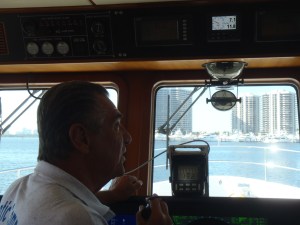
Swinging the Compass
Calibrating the magnetic compass is accomplished by bringing a specialist on board with equipment that provides accurate readings, then “swinging’ the compass by turning the boat in a circle to determine its deviation at various points and placing magnets on the compass to reduce the deviation as much as possible. There will always be some deviation and every boat should have a deviation card, which shows the deviation at each cardinal (North, East, South, and West) point as well as intermediate points. All compasses on board are now in reasonable agreement and can be relied upon for navigation.
We also conducted sea trials to test all our new electronics. Over the past six weeks or so our Nauticomp monitors have been working well. While in the marina, we have left them on most of the time with various things displayed on the screens and have exercised the brightness and on/off controls frequently. We have had no further failures so believe the problems have been fixed. The day of our sea trials saw some nice winds of 20+ knots. We left the marina with Brian from Celtic Marine Electronics on board and headed out into the ocean and east to the edge of the Gulf Stream where we found some nice waves to give us a good bouncing around. This allowed Brian to make some adjustments to our Satellite compass and autopilot. We continue to experience one problem with the autopilot not working properly in “Nav” mode – that is when it is set to automatically follow a pre-programmed route.
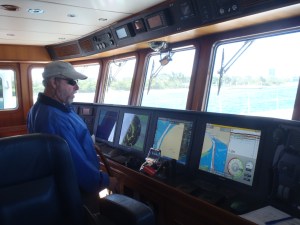
Heading out for sea trials with all electronics on!
In this case, when a waypoint is reached, the autopilot is not getting the proper heading information to execute a course change to the next waypoint. For now, this can be worked around by manually selecting the new waypoint – it’s never a good idea to totally rely on an autopilot anyway. We will gather some more information to diagnose and ultimately correct this problem, but for now, we are comfortable that the systems are working well enough for us to GO CRUISING! Our plan is to depart for the Bahamas within the next week or so, depending on weather.
We’ll stay in the Bahamas for 5-6 weeks, then return to Florida for some fine tuning of systems and to do a couple weeks of land travel. For now, the crew will consist of just the two of us. We had a couple who had planned to join us, but just days before coming, one of them received an unsolicited job offer they decided was too good to pass up. We found another couple who we really liked, but a background check turned up some problems with their “story” so we bid them goodbye. We are quite comfortable taking the boat by ourselves but ultimately would like another couple to join us as there is so much more that we can accomplish with a couple extra hands – longer passages, more adventurous locations and of course some help with the maintenance and cleaning of a 72 footer!
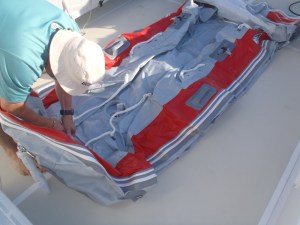
The inflatable tender will go to the Bahamas
For this trip, we’ve decided to leave our large tender in Palm Beach as it’s very heavy and unwieldy to get on and off the boat with just two people, especially in rough conditions. We’re going to use our small, inflatable Achilles dinghy, which we have now inflated for the first time. We are thinking of selling or trading our large tender for one that is slightly smaller and lighter and better configured for our needs – that is, less infrastructure for steering console, seating, and electronics and more open space for dive gear and fishing equipment (see photos below to see what I mean!).
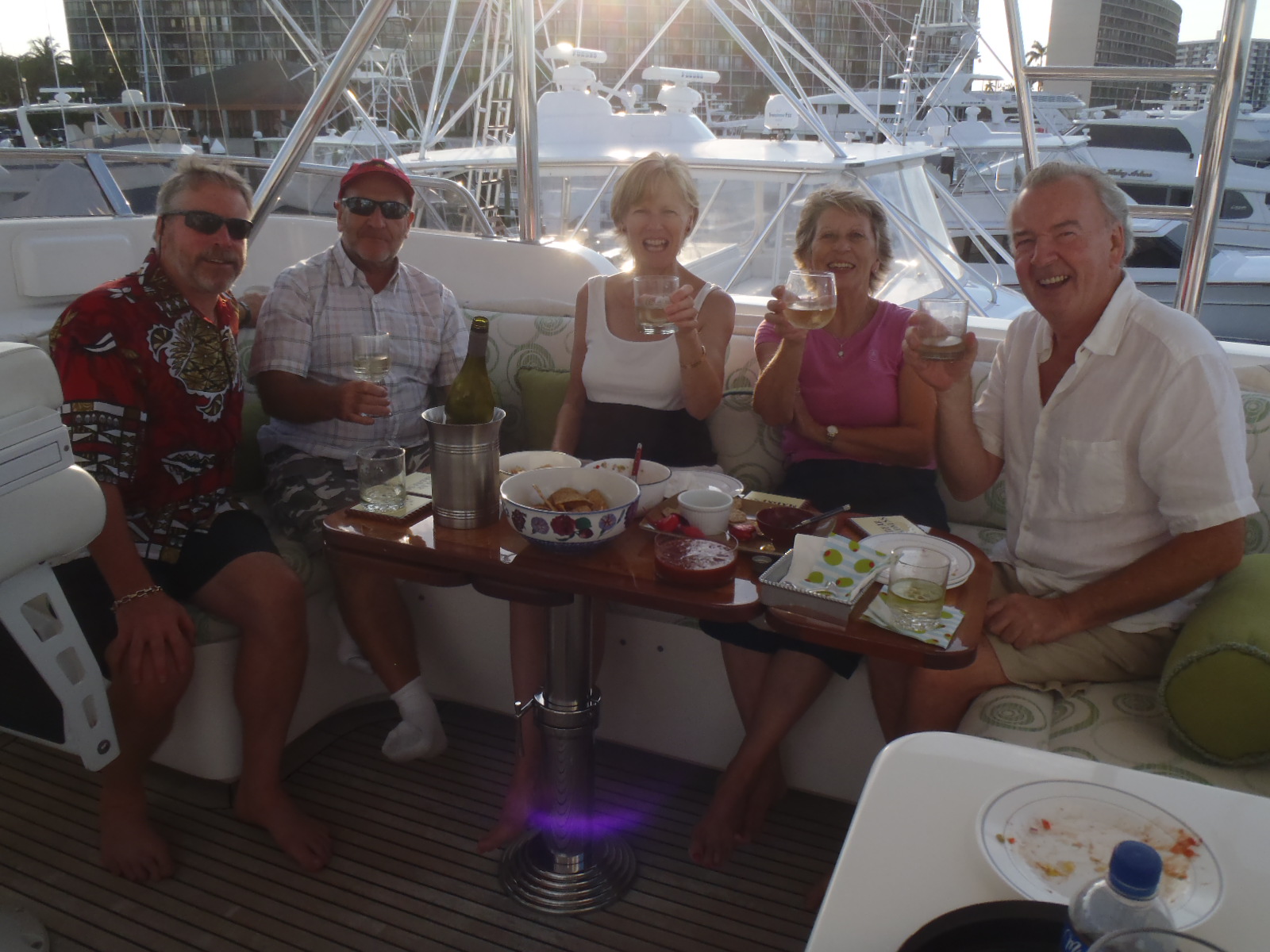
Besides working on the boat, we’ve had time to visit with some old friends and make some new ones! We’ve had some wonderful dinners with Doug and Eloise and Tom and Marlene (who I did not take any photos of) as well as Sudhakar and Bina who all live in or around Palm Beach at least part time. We’ve also met Nordhavn owners David and Susie from Last Mango and Bill and Rosie, the new owners of Nexus and Bob and Jan from Emeritus. We’ve also spent some time in Naples where Bradley’s daughter and family came for a vacation, and to Sarasota to attend Bradley’s Cousin (once removed) Barry’s 85th birthday.
Our next update should be from the Bahamas!
If you receive this update by email, remember DON’T REPLY. Click below to leave a comment or email me by clicking here. Click any photo to enlarge.





Old Port Cove (March 2012)
Posted by Kathy Clark in Trips on March 10, 2012
March 10, 2012

At Nordhavn owners gathering with Jeff fom Nordhavn and Grace of Tides (N64) owners Debbie and David
Since arriving at Old Port Cove Marina nearly a month ago, we have been busy completing the remaining repairs and enhancements on the boat. The watermakers are now fully functional, improvements have been made to the hydraulic cooling system, new actuators (motors) have been ordered for the engine room vents, and all new entertainment system equipment has been ordered and mostly received. We are still shaking out some bugs in our new monitors in the pilot house which, despite previous repair, have continued to fail. The vendor, Nauticomp, is working hard to determine the cause of the problems and we hope to have this sorted out very soon! For those wanting more technical details, they will be coming! I am working on a report of all the repairs from the lightning strike and all the additional improvements we have made over the past six months. We are hopeful that all remaining installations will be completed by the end of March.
Kathy puts on "real" clothes to attend Lloyd's celebration in Virginia
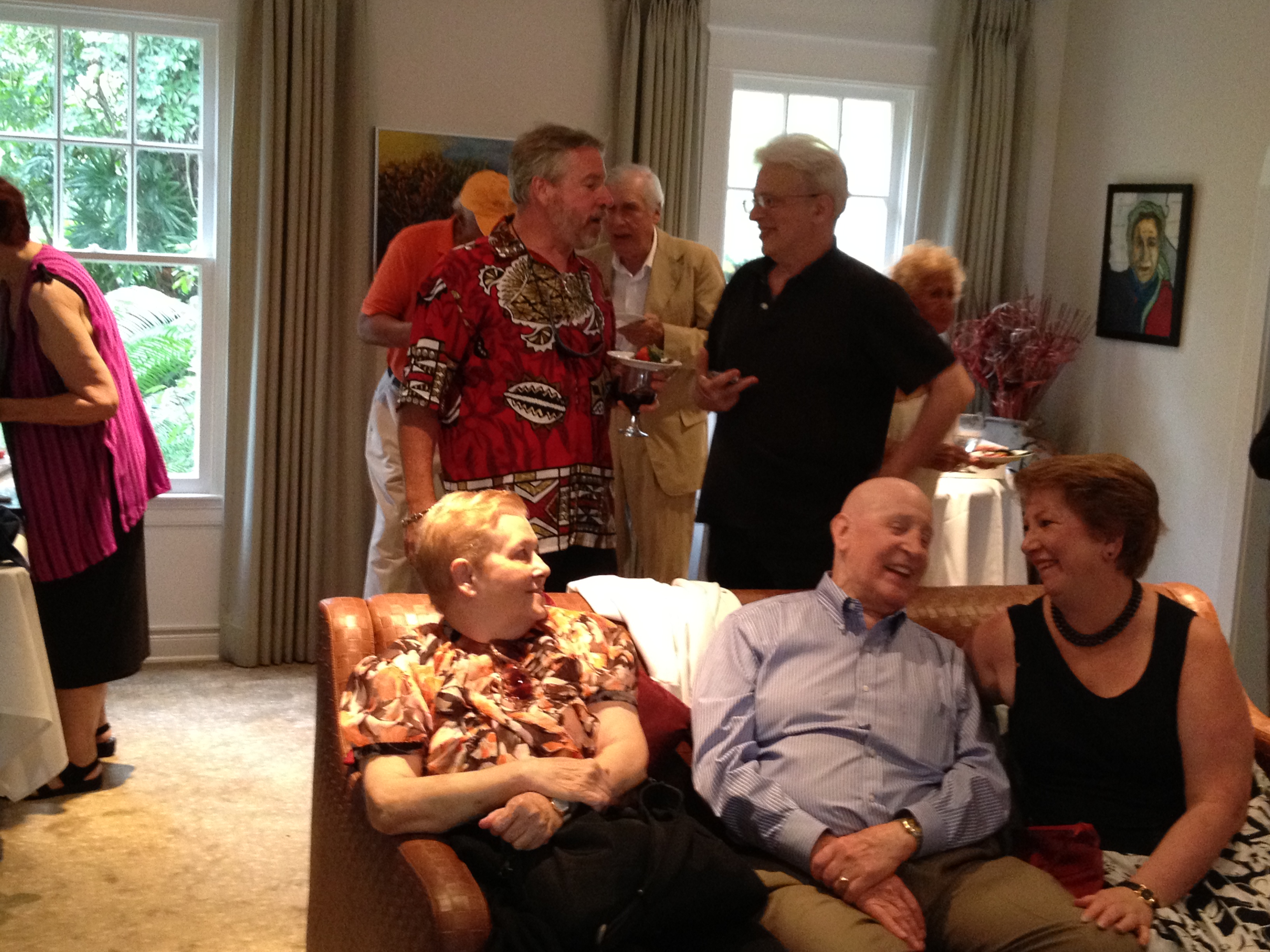
Bradley and I have had a chance to catch up with lots of family and friends. We’ve made a couple trips across Florida to Naples to visit Bradley’s father in Bonita Springs and his mother and sister in Estero. I have reconnected with some of my women’s group golfing friends from Maryland who now live in Palm Beach and we’ve had some fun golf outings. We’ve had several friends from VA and FL drop by the boat for visits. As I write this, we are in Virginia, visiting Bradley’s daughter Margy, hubby Bryant, and son Tyler. We came up to attend a dinner to honor one of our best friends, Lloyd, who is completing 15 years as Dean of the Enginieering School at George Mason University. We’ll be catching up with several more friends over the weekend.
In February we attended the Miami boat show where we researched lots of new technology, bought a few new things, and attended a gathering of Nordhavn owners aboard our old friend Sweet Hope, the Nordhavn who guided us down the ICW last year. It was great to meet many of the owners we have known only by email. We look forward to catching up with some of them and many we have yet to meet as we begin cruising for real next month!

Grandpa Bradley gives Tyler a driving lesson
John and Leanne, who have been our partners for the past eight months, have decided to take the plunge and buy a boat of their own. They’ll be heading back to NZ to go back to work for a short time to earn some money while they are shopping. Our new cruising partners will be joining us in April and will be introduced in our next update. Our plans are to conduct some sea trials around Palm Beach before heading to the Bahamas for some fun!
See updated book reviews and recommended books. Click below for a two minute video showing some sights and sounds from our passage to Florida followed by a photo gallery. Click any photo to enlarge.
-

- A Manatee was a special guest at the Nordhavn party

-
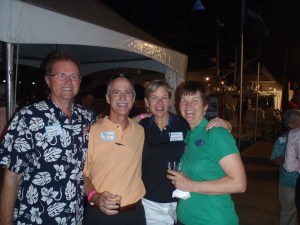
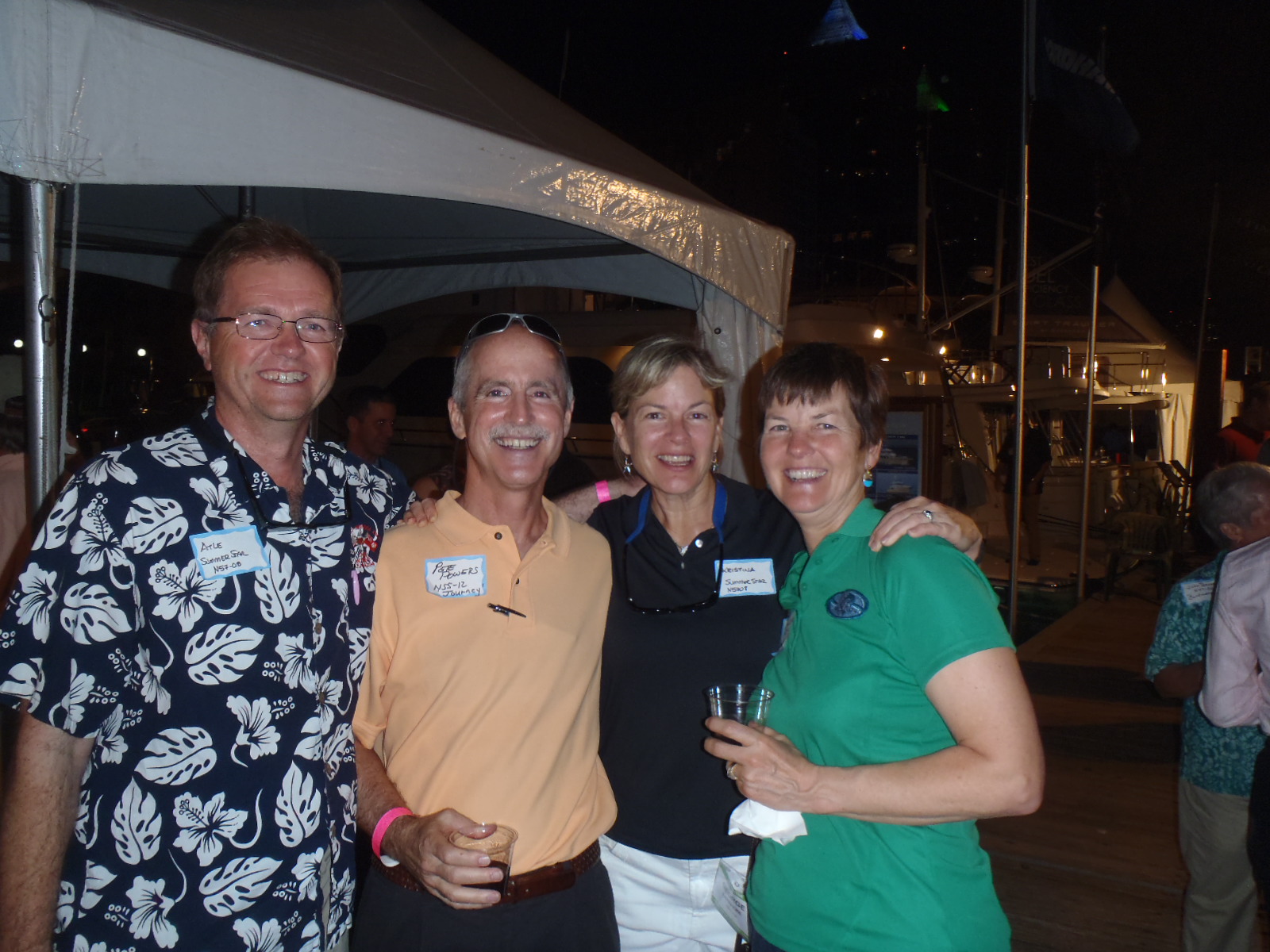
- Kathy with Nordhavn owners Atle, Peter, and Kristina
-

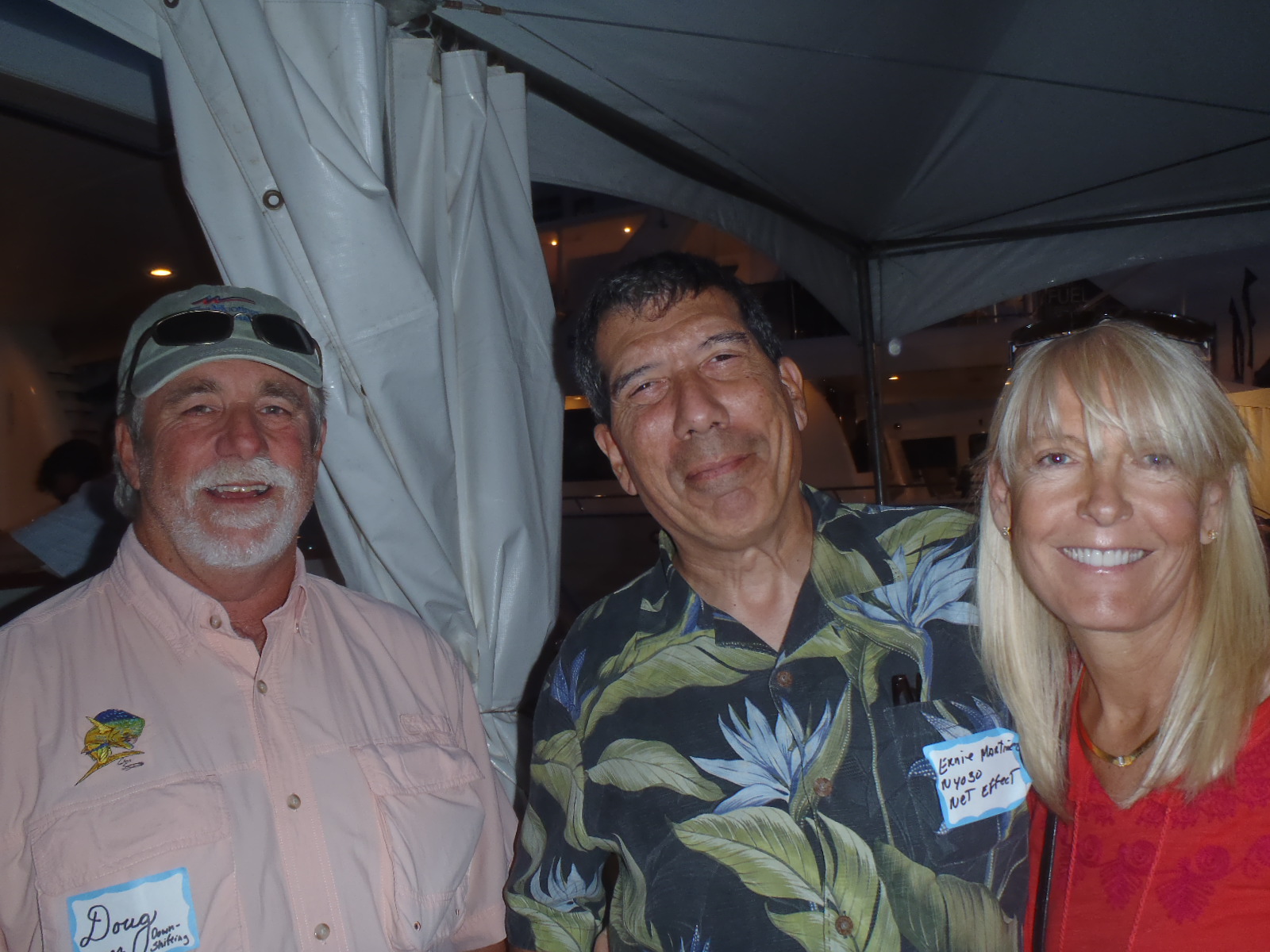
- Nordhavn owners Doug Bullock with the Martinezes
-
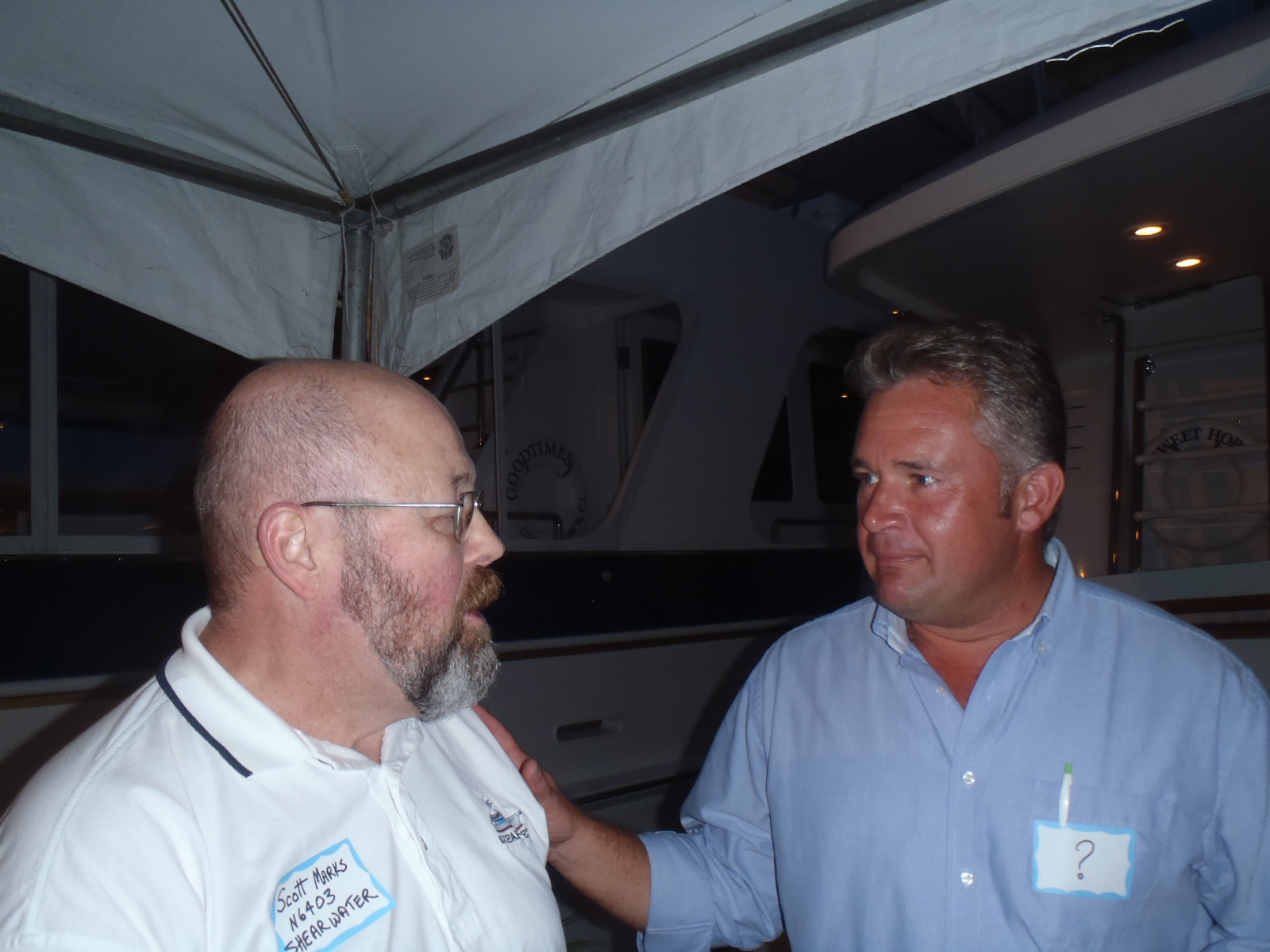
- Owner Scott Marks and Sweet Hope Captain George Morgan-Harris
-
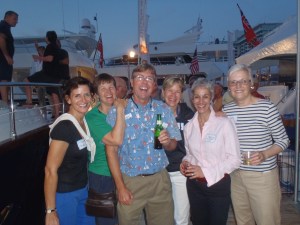
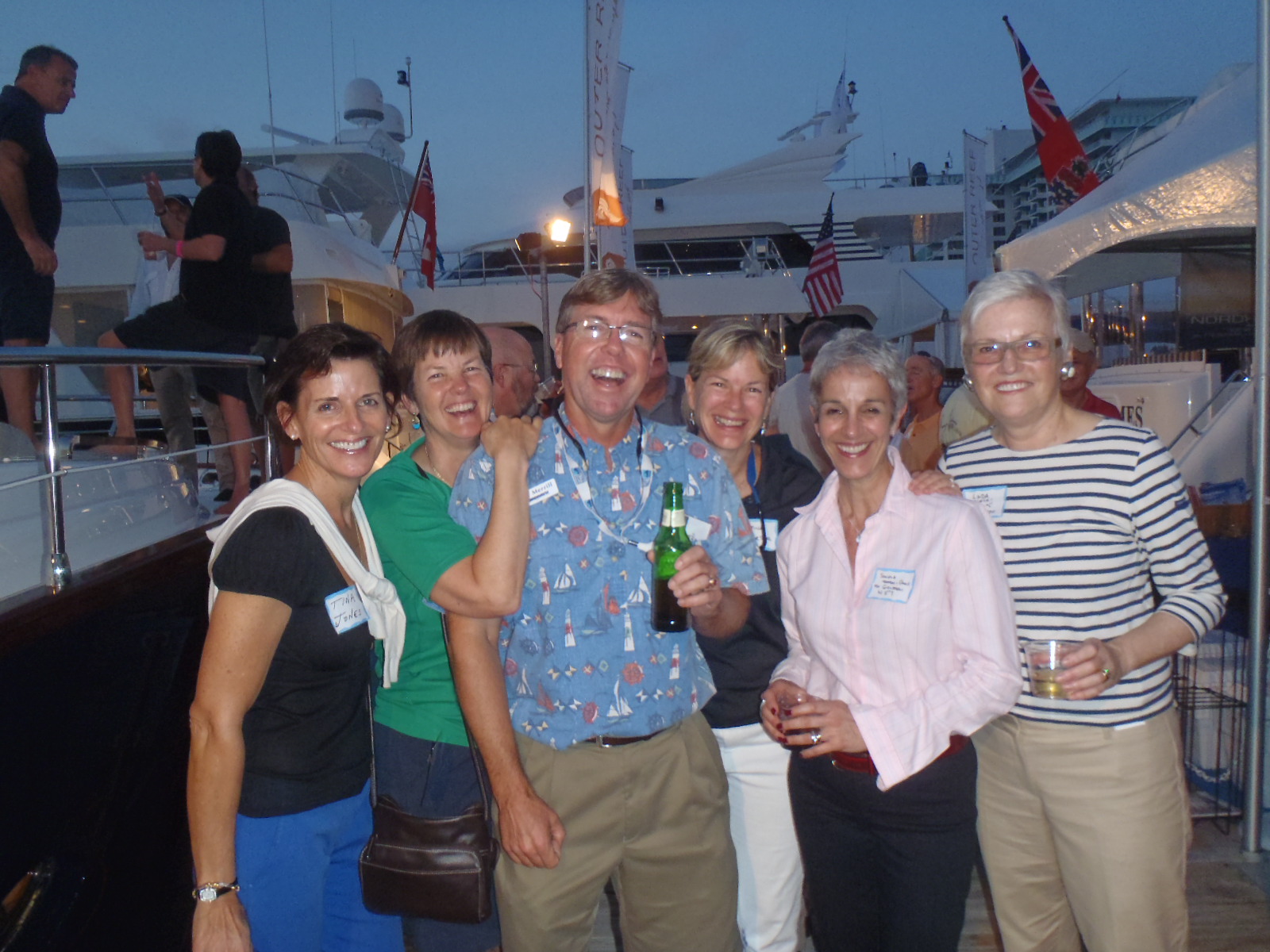
- Jeff Merrill with “the Nordhavn Ladies”
-

- Milt Baker with Scott Marks and Doug Klassen

-

- Bradley with Steve D’antonio and owners John and Tina

-
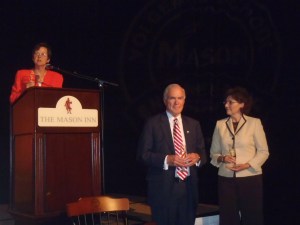
- Kathy leads a toast to Lloyd

Back to Palm Beach (February 2012)
Posted by Kathy Clark in Trips on February 11, 2012
February 10, 2012
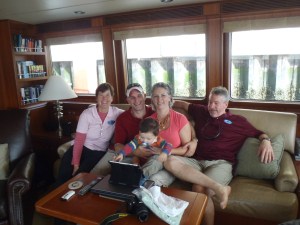
Kathy, Matt, AnnMarie and Bradley with Jack who wants to get on E-Trade
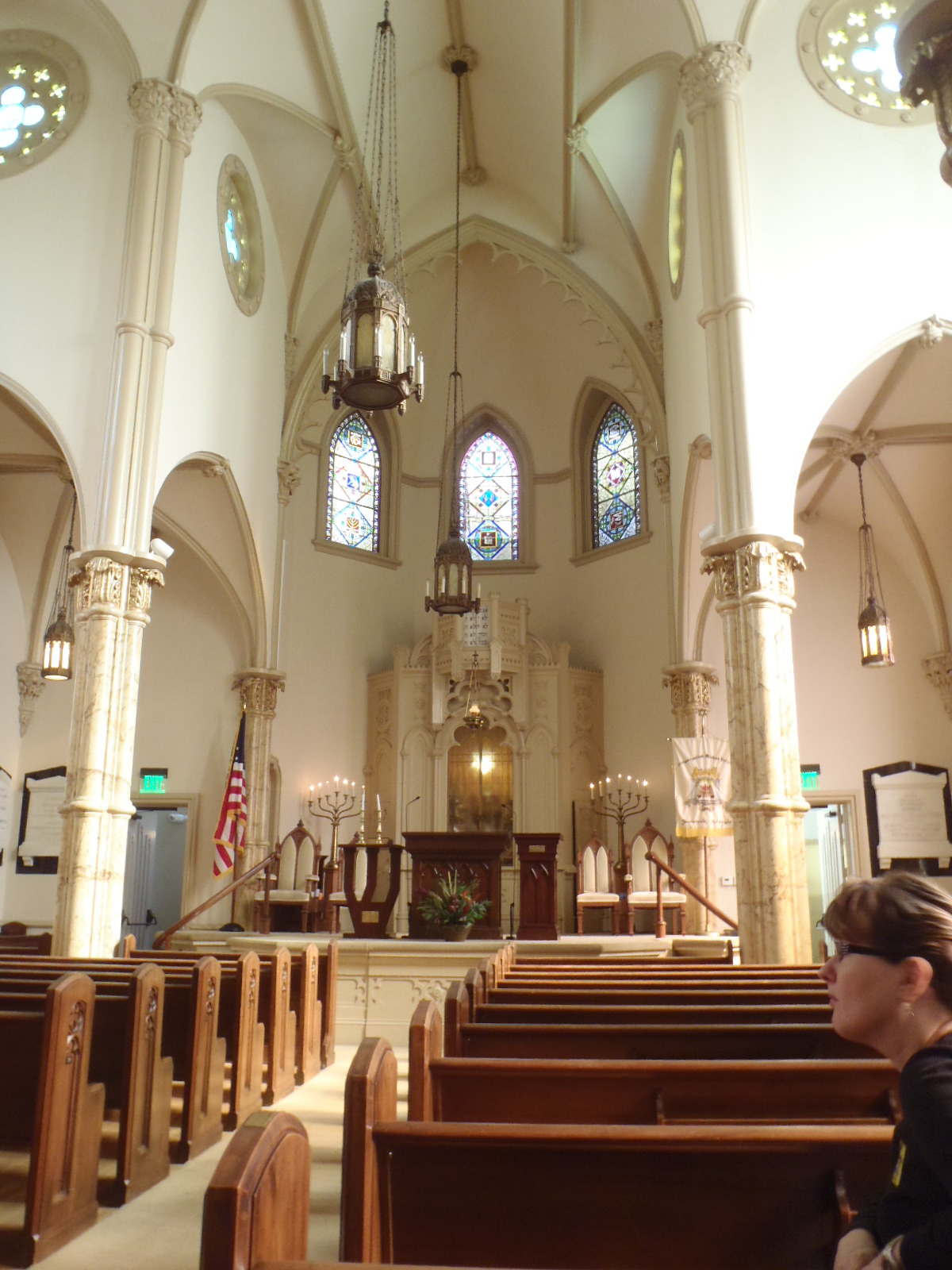
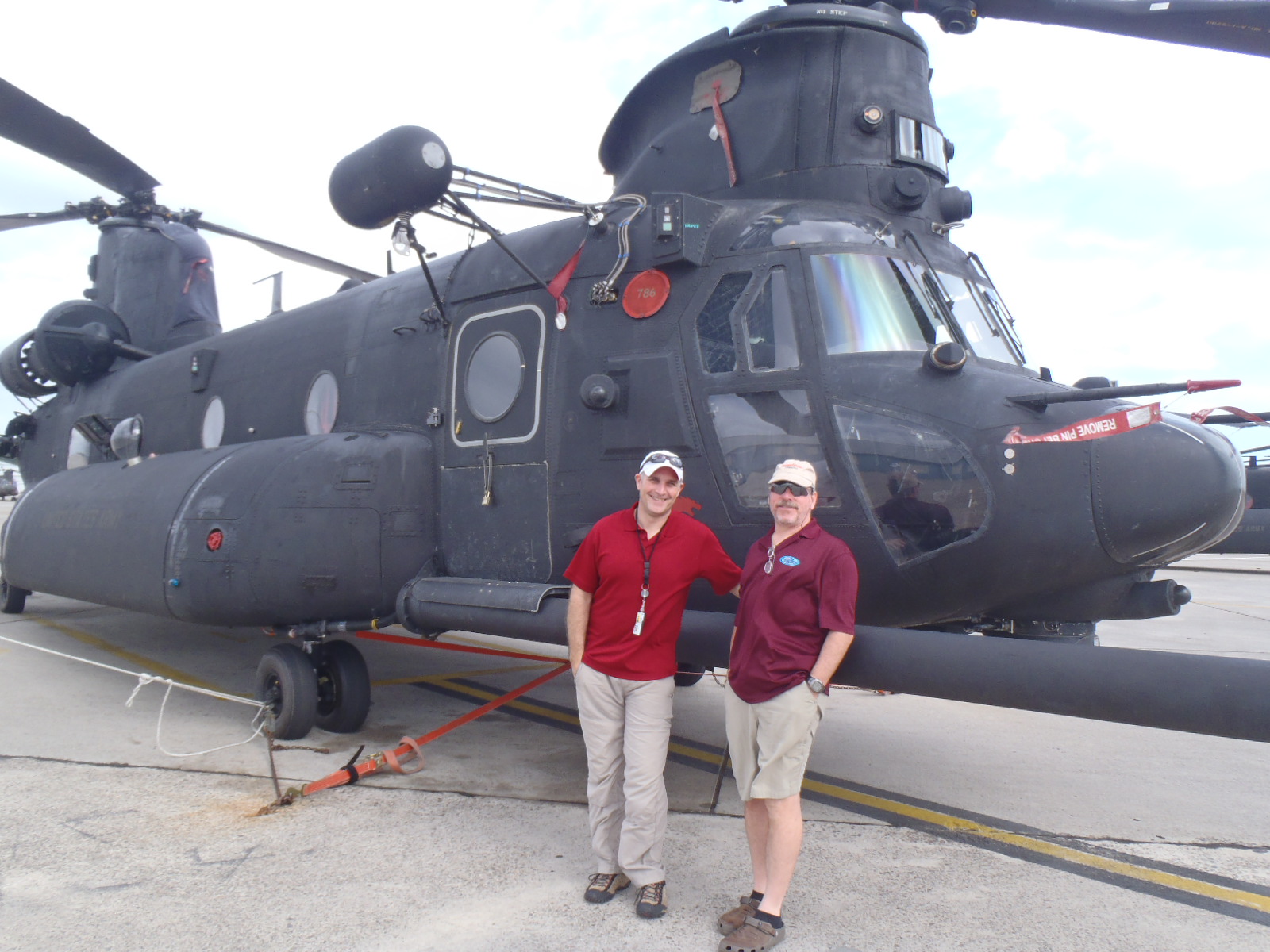
We had a great rest stop in Savannah. It’s a great town, filled with history. Sherman spared Savannah from destruction during the Civil War (known in these parts as the War of Northern Aggression) so it has wonderful old buildings and cobblestone streets. Walking the old downtown is fun and educational. Staying at the Westin’s marina allowed us access to all the resort facilities, so we enjoyed the hot tub, fitness center, sauna, and golf course. A free water ferry provided transportation across the river to downtown. Bradley and I had a chance to catch up with a long lost friend Ann Marie, daughter of one of my closest friends. We enjoyed meeting Ann Marie’s husband Matt and son Jack. Matt is an Army helicopter pilot and he took us to the military base to see his Chinook. It’s quite a machine and we greatly enjoyed the chance to see it up close and personal! We walked through many of the squares reading all about the history of Savannah and visited the Ship Museum and the Mickve Israel Temple, the third oldest Jewish congregation and only Gothic-style synagogue in the US.
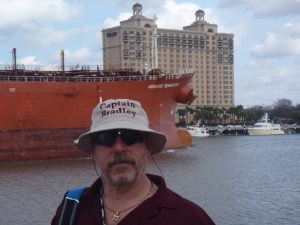
Bradley, the busy Savannah River, and Shear Madness at the Westin dock in the background
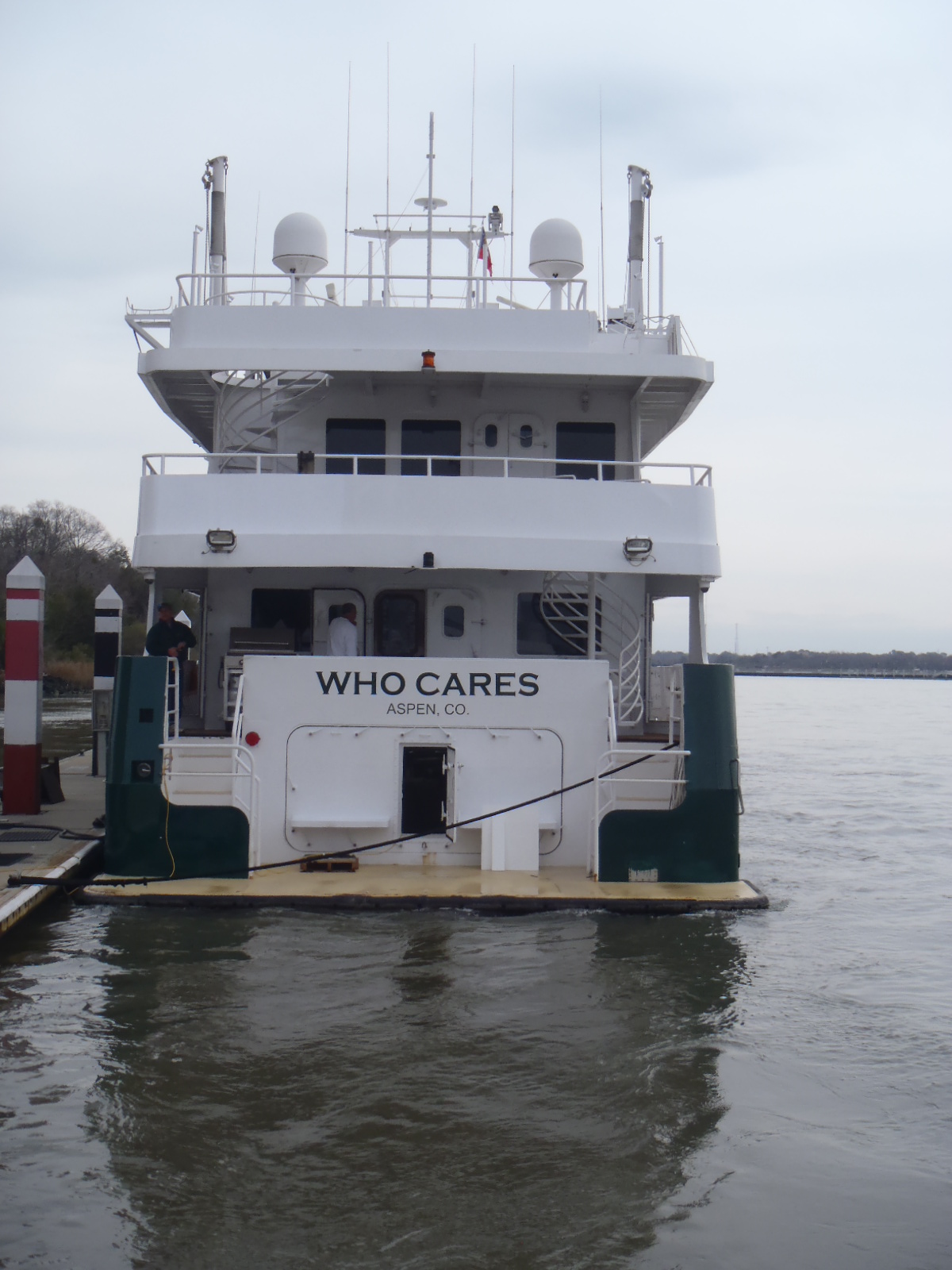
Our dockmate at the Westin marina was a 102 foot boat called Who Cares, which travels along with its two fishing vessels named So What and Whatever. We loved the names and enjoyed meeting Captain Richard. We hope to catch up with the boat in the Bahamas in a couple months. After a great few days of relaxation, good food, and nice people, we were ready to make the 320+ mile trip to North Palm Beach, a journey that would take a little less than two days. The Savannah River has 8-foot tides, so we departed just before noon in order to make it out of the Savannah River on the ebbing tide (so as not to go against the current on the way out) and to arrive in Palm Beach after sunup two days later. Conditions were good, though not quite as smooth as the previous legs. Since leaving Jarrett Bay, we’ve been keeping a list of the things that aren’t working quite right – there are quite a few things on the list which we will address in Florida, but none that we can’t work around (and these will be reported on in a separate post for those who are interested).
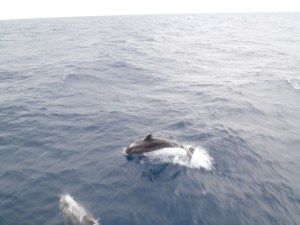
Dolphin jumping - timing these jumps for a photo is hard!
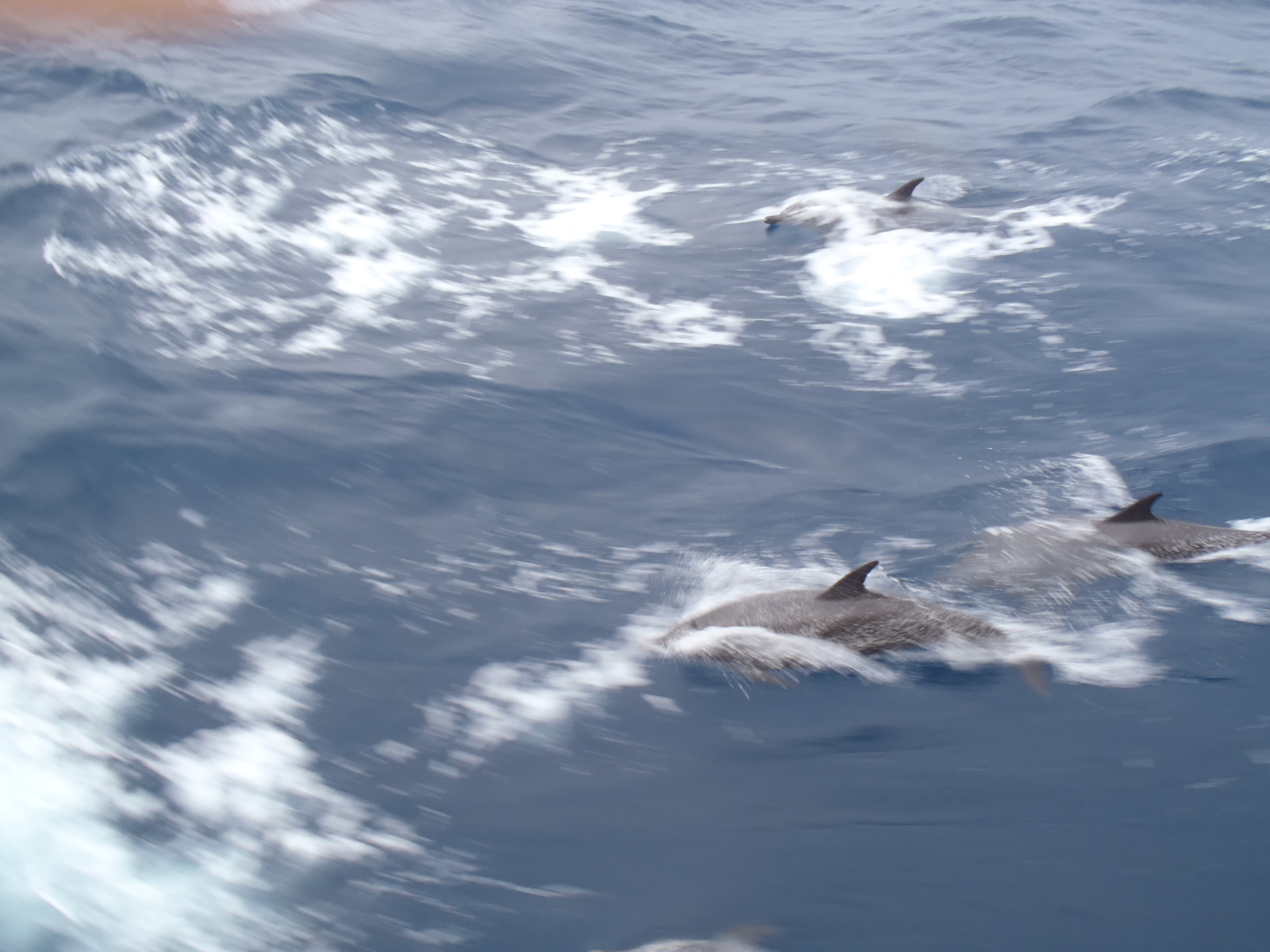
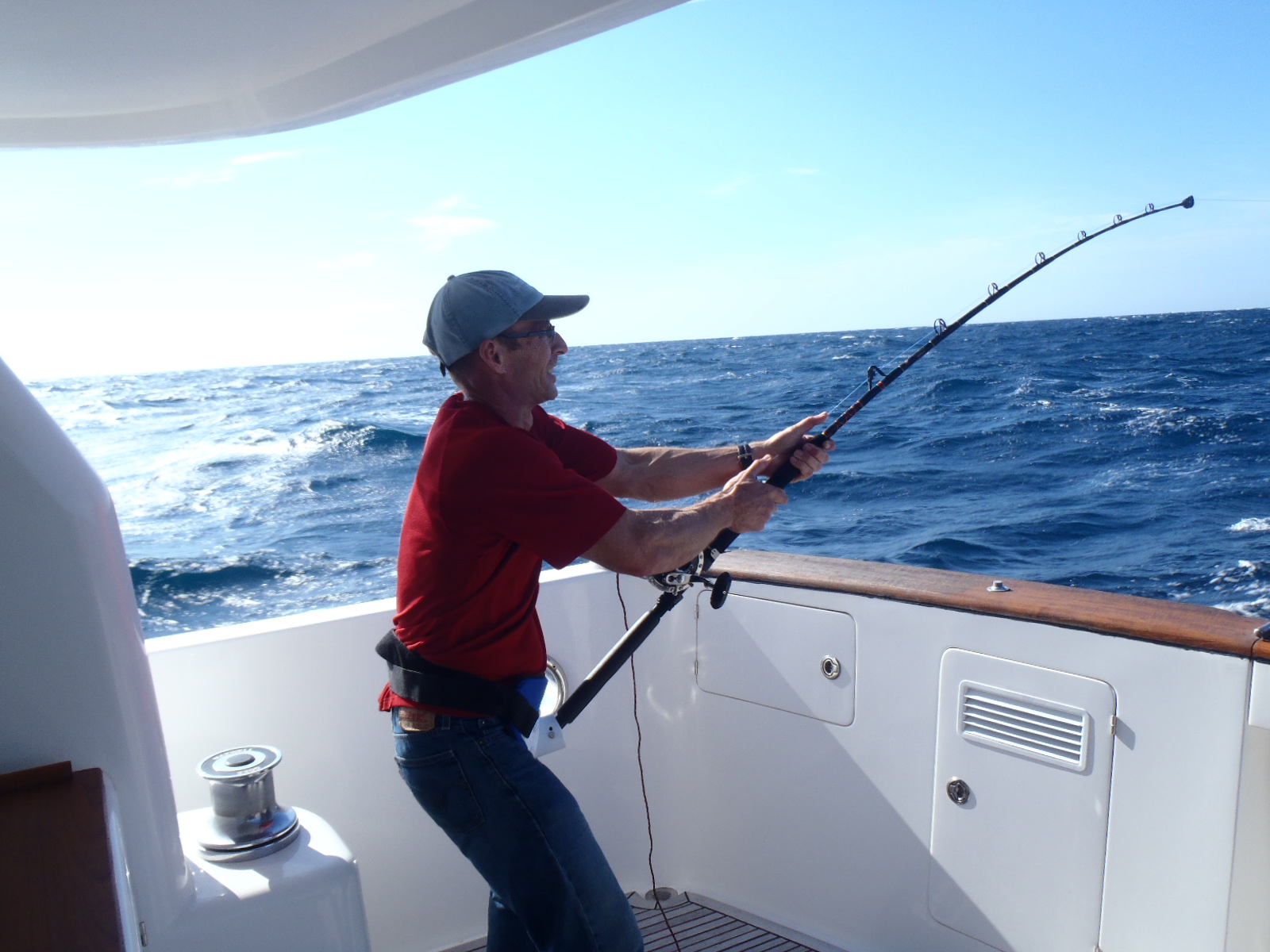
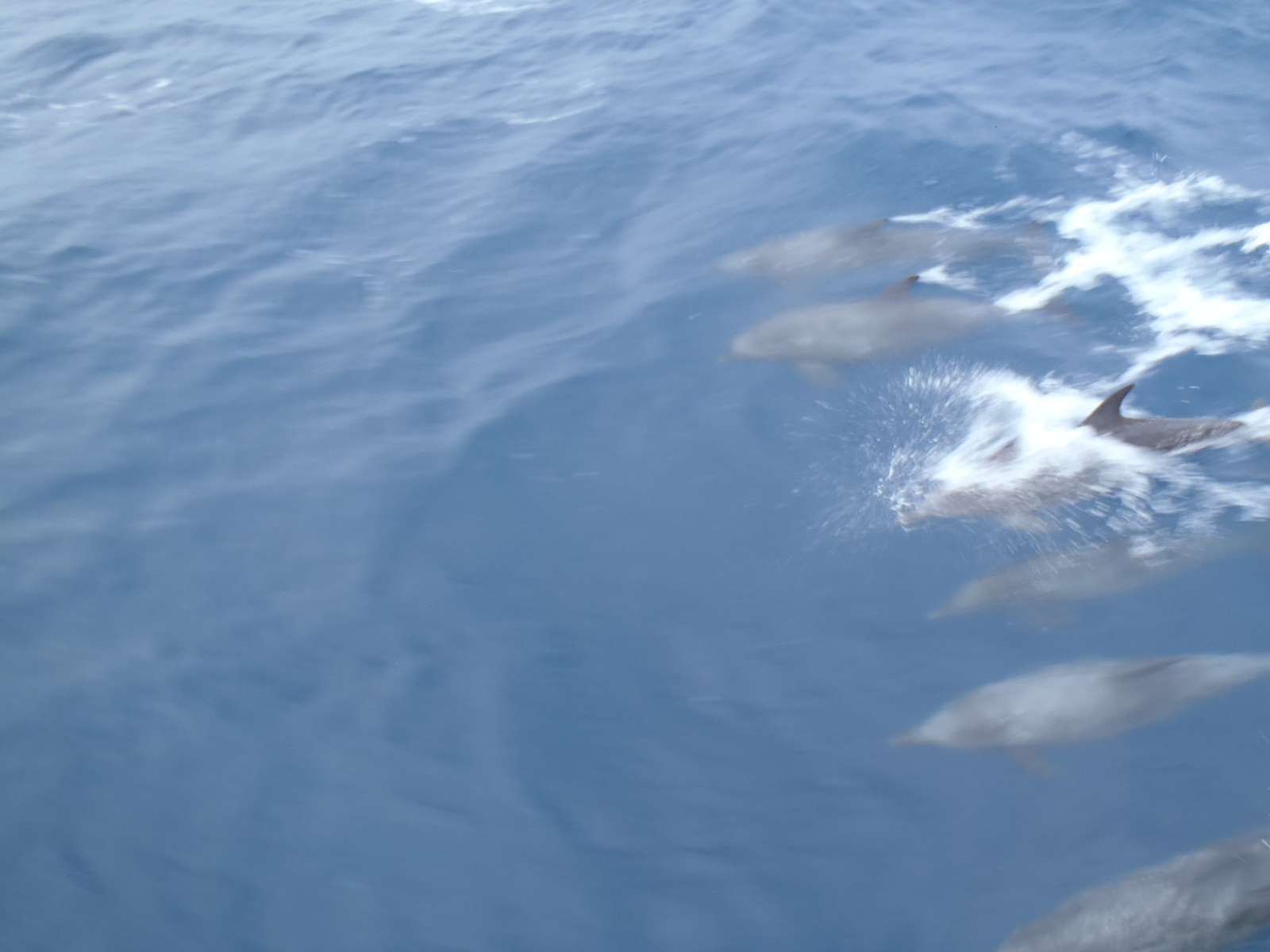
After an uneventful night during which we saw little traffic, we had some morning visitors – literally dozens of spotted dolphins that swam along with us for over an hour, frolicking in our bow wake and performing stunning acrobatics. No matter how often we see dolphins, we just never get tired of it! Next it was time to give the fishing poles a try. Out went the lines and then – nothing. Hours passed, the wind blowing about 20-25 knots, and waves building to 4-5 feet. Suddenly, we heard it – the fishing line making its distinctive noise! When we hook a fish, we slow the boat down in order to bring it in. Even a small fish is difficult to haul in at a speed of 8 knots! And this did not appear to be a small one. But when we slowed the boat down, the autopilot immediately sounded an alarm and lost its heading. Other alarms started going off. As we stopped our forward progress, the stabilizers lost their ability to hold the boat steady and the building waves started to rock us nicely. Mind you, the boat has no problem with this, but it’s amazing how different it feels to the crew when you’re getting knocked about. John was on the back deck trying to reel in a monstrous fish, with Leanne assisting, Bradley and I were trying to get our electronics settled down, and meanwhile several things in the galley and salon went crashing to the floor.
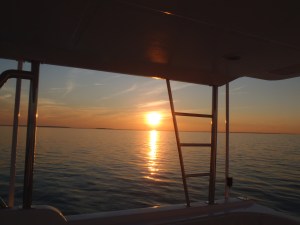
Sunset at sea
Things were soon under control again and we made a note of all the things that had set off alarms. Mostly it was caused by our satellite compass losing heading information – a problem we had experienced in similar conditions during our shorter sea trial in Beaufort. This remains on our list to fix once we reach Palm Beach. However, it became clear that we could not slow the boat enough to recover the fish (we were doing 6 knots in neutral) and if we wanted it, we would need to turn into the wind and waves and go back towards it. Regrettably, we decided not to do that and cut the line. Although we lost the fish, it was an excellent sea trial, confirming a few things that need to be fixed. Besides the fish, we also lost a bottle of wine which crashed to the galley floor during the rough part. Fortunately, it did not fall on our brand new carpet!
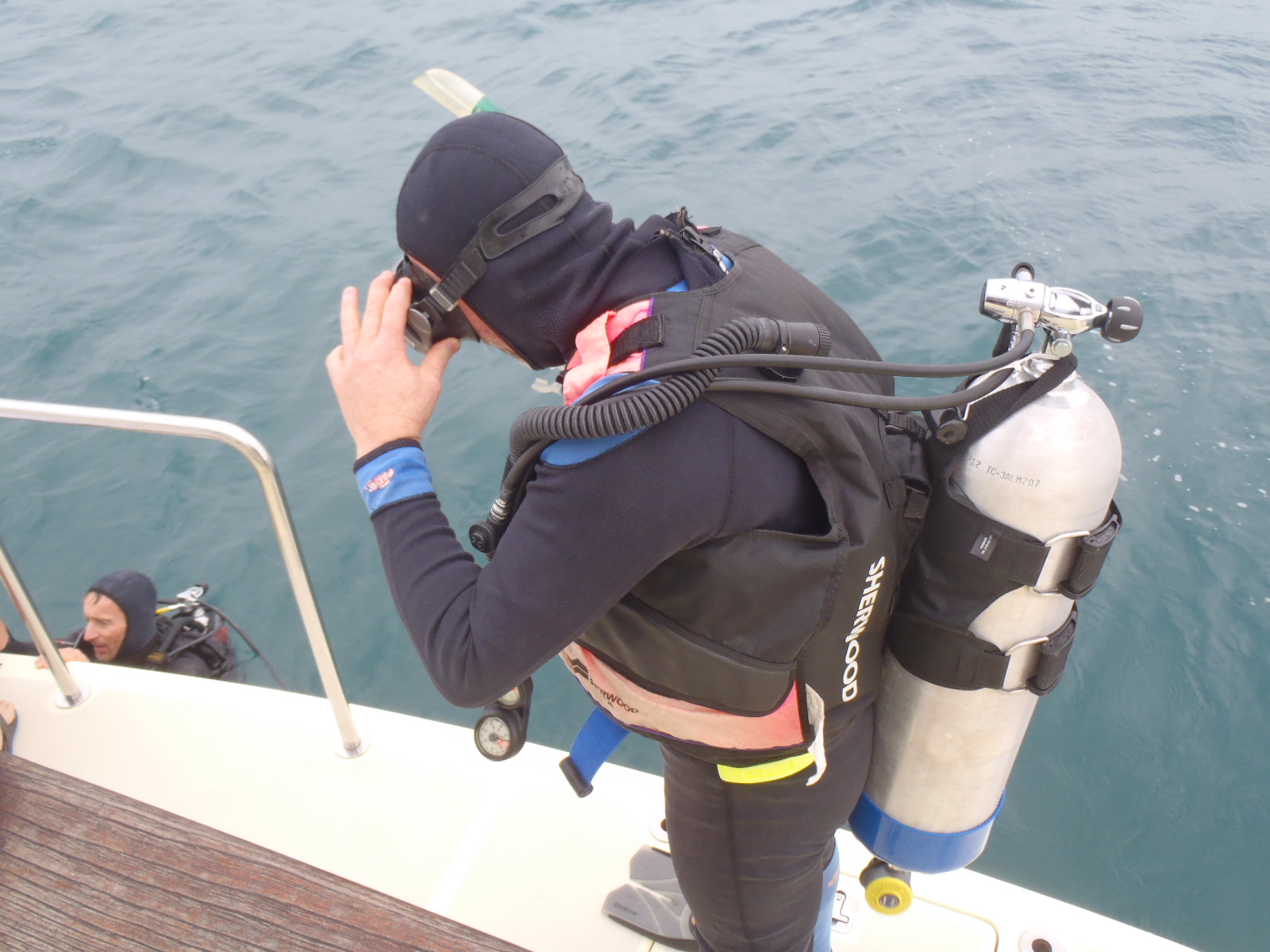
As night fell and we cruised along the Florida coast, the traffic increased. We passed several ships and tugs, including the Carnival Pride cruise ship, which it seems we pass on every trip up or down the coast! As dawn approached, we arrived at Palm Beach. We entered Ft. Worth Inlet and dropped our anchor so that the guys could dive and inspect and clean the bottom of the boat. They did this with great efficiency, pleased with how everything looked and giving the bottom a very gentle wipe to remove any burgeoning growth. We raised our anchor and continued on into Old Port Cove Marina where we will be for a few weeks while we wrap up our repairs.
Click below to see a video of the sights and sounds from our passage to Savannah (on Youtube). It is meant to show various aspects of a passage and is not set to music so that you can hear some of the actual sounds. It lasts a little over 6 minutes. Continue down for more photos.
And finally, here is a video of the dolphins we saw along the way.
To Savannah (February 2012)
Posted by Kathy Clark in Trips on February 4, 2012
February 4, 2012
Our next planned stop was Savannah, a trip of just 54 miles. Savannah lies about 15 miles up the Savannah River, a heavily used commercial waterway. Ideally we would have liked to leave St. Helena in daylight and enter the Savannah River in daylight, but the short days and the distance involved made that a difficult task. So we decided to pull our anchor in the late afternoon and enter Savannah at night. All went well and we again had a calm and pleasant passage. We continued to keep notes about small problems with our new systems that will need to be addressed in Florida, but again, most everything performed well. We reached the mouth of the Savannah River at about midnight and though it’s been a while since we did a night entrance to a busy port, Bradley handled the navigation and radio duties like a pro. We passed several ships that were outbound and were overtaken by a few that were inbound. By 2am we were safely moored at the dock of the Westin Golf Resort and Spa. We are looking forward to some sightseeing and relaxation here! And since we have a good internet connection here, below are some photos from our last day in Beaufort and our trip to St Helena Sound via Charleston. Click on any photo to enlarge.








Heading South (January 2012)
Posted by Kathy Clark in Trips on February 1, 2012
February 1, 2012

Bradley in the Pilot House with new electronics
We have awoken to a wonderful morning in St. Helena Sound in SC, between Charleston and Hilton Head. Our departure from Jarrett Bay went smoothly and we’ve had amazing weather for the first few days. For the first leg of our trip, we wanted to do a day trip in order to test our new systems more extensively. We thought of going to Wrightsville Beach, but it has a tricky entrance and we would be pushing the limits of daylight by the time we got there. So we decided instead to depart Beaufort, see how everything went for the first couple hours and then either return to Beaufort or, if things were going well, continue on overnight to Charleston.
We could not have had better conditions for this trip. Unlike our sea trial of a couple weeks ago where we were tossed around pretty good, this time the seas were calm and peaceful.

The Navy Helicopter engaged in exercises
There were a few minor problems with our systems, which I will detail at the end of this post for those interested, but for the most part, things worked well. After the two-hour assessment point, we decided to push on to Charleston. We saw very little traffic along the way. We did encounter a Canadian Naval Warship and a US Warship conducting exercises and had our first ever VHF radio call with a US Navy Helicopter, which was hovering just above the water and asked us to alter course. As sunset approached, we prepared for an overnight passage. What a gorgeous night! The skies were clear and there were millions of stars. Seas were calm with winds from between 10-20 knots. Electronics, stabilizers, and electrical systems all performed well. We pulled into Charleston Harbor in late afternoon escorted by a bunch of playful dolphins who put on a great show and dropped the hook (anchor). Although we have some good friends in Charleston from our previous visits there, we did not call them as we did not plan to launch the tender and go ashore. It was just a place to get a good night’s sleep before continuing on.

St Helena sunset
The next morning was perfect. After a beautiful sunrise above Ft. Sumter, we raised anchor and continued south to St. Helena. Along the way we conducted some testing of our autopilot system (see below) and gained even more confidence in our systems and how to use them. The past four months of work now seem worth it. The cruising guide book we have warned that the entrance to St Helena is very tricky with lots of shoaling but we had no trouble coming in. Once again a greeting committee of dolphins played on our bow and we were anchored in time for a perfect sunset. The only disappointment of the day was that we had deployed our fishing poles for this trip but had failed to catch a fish. So it was leftovers for dinner – which wasn’t bad – we made a fabulous oyster stew with the leftovers from Steve’s oyster roast!
For those that are interested, here is a summary of some of the issues we had on the way. I will be providing a more detailed report of all the work we did in the coming weeks.
- We have NavNet 3D and Nobeltec Trident which provide chart plotting and other navigational aids. These systems do talk to each other so that a route created in one system is automatically sent to the other. There were a couple cases in which we activated or modified routes in NavNet and had to close and restart Nobeltec in order to have them show properly. We’re still learning how to use these systems together effectively.
- On the first leg, our autopilot had difficulty making turns of more than 30 degrees. It would oversteer, then have difficulty correcting. On the second leg we conducted some tests and changed a setting in both NavNet and Nobeltec – the waypoint arrival radius. It turns out this was set too low – to 100 feet. That meant that the software did not recognize that we had arrived at a waypoint until we were on top of it, then by the time the autopilot received the instruction to turn, we were past the waypoint, meaning the turn had to be larger. By increasing the “arrival radius”, we now “arrive” at the waypoint and send the instruction to the autopilot 300 feet in advance, making for a smoother turn and no more oversteering. We’ll continue our tests on the next leg.
- We noticed that in Nobeltec the “Time to Go” to a waypoint is sometimes incorrect and different than that shown in NavNet. We will report this to Nobeltec.
- We have had several sensor failure alarms on our Furuno 2100 radar. We are continuing to record and gather information to diagnose.
- We had one instance of NavNet shutting down unexpectedly.
- When we replaced our Nauticomp monitors, they come with controllers which power the monitors on and off, allow input selection, and provide dimming for night use. Initially, the controllers did not dim the monitors. This was corrected by Nauticomp with a software upgrade (which required new units to be installed). The new units did dim the monitors properly, but did not dim themselves. As a result, at night, the monitors were dim but the controllers were lit up like little neon signs! We had to cover them with paper towels to preserve our night vision. Nauticomp has a fix for this already, so we will correct when we arrive in Florida.
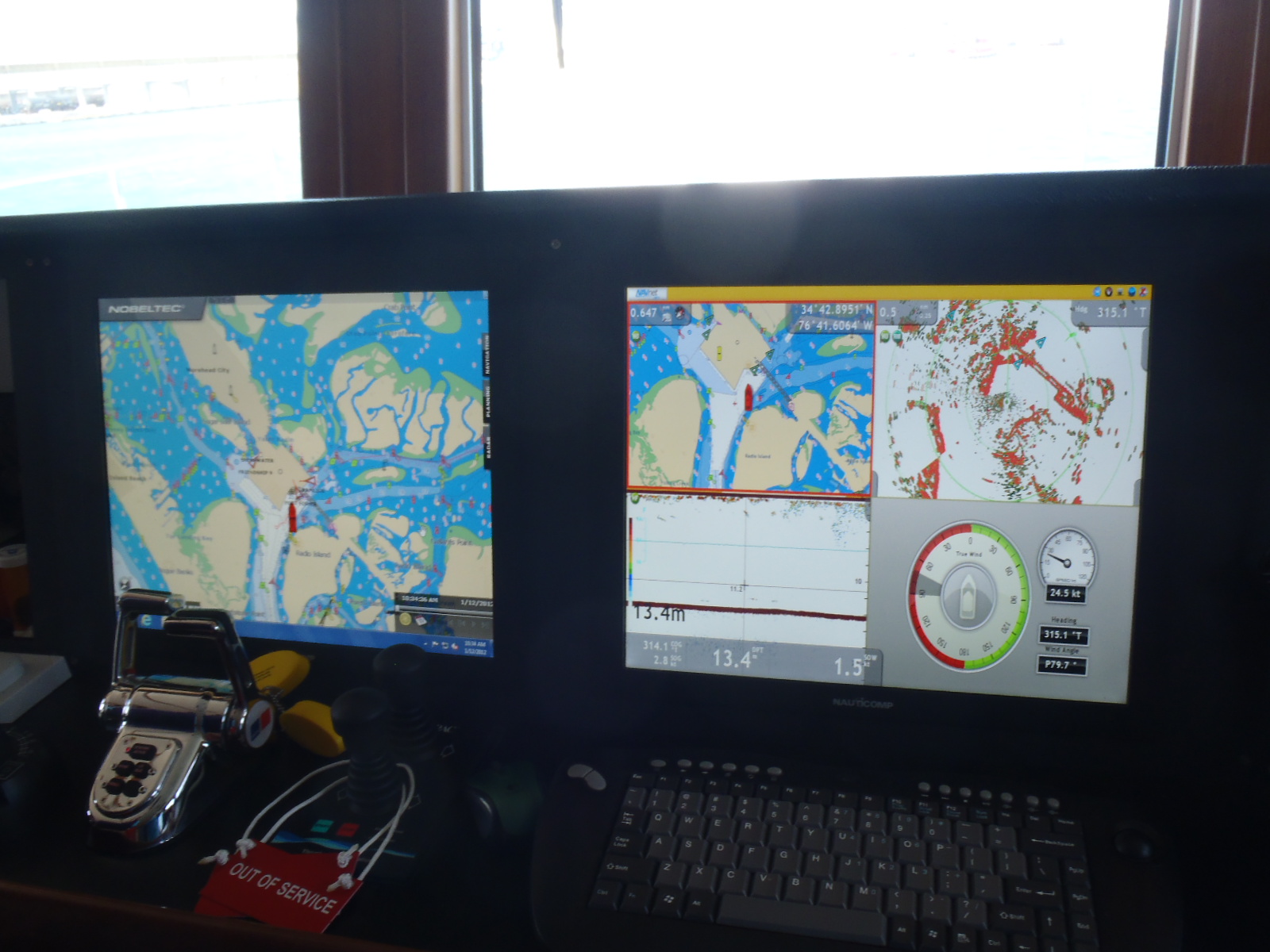
On watch with 19 knots of wind outside - we love sailing, BUTa Nordhavn does have some advantages! ! Note that is Nobeltec on the left and NavNet on the right
The above list is not meant to be complete or extensive – just to give you a feel for the kinds of things we are experiencing. Luckily none of them are serious enough to be safety issues. We continue to be very attentive when on watch and very conscious of every waypoint change when running on autopilot!
Once again, photos on this post are limited due to bandwidth issues – we are using an AT&T tethering data plan with a Telular device which provides a boat based wifi system. But it’s not high speed and we have limits on data. However, it is nice to be here where all we can see is water and shoreline with no people, no boats, and no cars in sight and still have internet and cell phone access!
Click on the Comment button to leave a comment.
Farewell Jarrett Bay (January 2012)
Posted by Kathy Clark in Trips on January 30, 2012
January 29, 2012

Jenny enjoying a bone we brought her during her recovery. She has a bandaged front paw and stitches in her head.
It is with distinctly mixed emotions that we bid farewell to Jarrett Bay, where Shear Madness has been and the community of Sea Gate where her crewed have lived for the past four months. One of the best things about the cruising life is the unexpected wonderful things that can come from what at first seem to be disasters or plain bad luck. Yes, there’s been a lot of tough, grind it out work in facilitating our repairs. There have been many frustrations along the way. And I will write more about those later, I promise. But now we are feeling good. We are back on the water with all the repaired systems running just fine. We have calm seas and little wind. These conditions are about as good as it gets. We are headed south and will stop in at either Charleston, SC or St. Helena, just a little further south for a night or two before heading on to Savannah.
But as happy as we are to be back on our journey, it was hard the past couple days saying goodbye to all the great new friends we made in Beaufort. Sea Gate, the community where we rented our house, is a fabulous place, full of people who will share their internet connection, invite you to their parties, lend you their books, invite you to dinner, loan you their cars, and become lifelong friends in a very short time. Sea Gate even has a neighborhood dog, Jenny, who serves as the unofficial mayor. Jenny does live in a house, but she is most often out on patrol, welcoming guests and keeping up with everyone in the community. She was one of the first ones we met when we went out for our first walk in the neighborhood. The spirit of Sea Gate was evident when Jenny was hit by a car and disappeared into the woods. It was late afternoon and soon the word was out – everyone needed to help find Jenny! Bradley and I took to our bikes and the search was on.
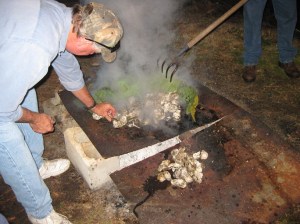
Steve checks to see if the oysters are done
The amazing thing was how many people were out there looking – on foot, on bike, in golf carts, in cars, even in the cab of a semi. We were all scouring the streets and trails, stopping to visit with one another and share a real sense of community. Unfortunately we did not find Jenny, even when the search continued the next day. But lo and behold, late that evening, she showed up, battered and bruised, but alive and with no serious injuries. She’s going to be just fine and within minutes the word was spreading and we were ecstatic to get the call that she was OK. We had a chance to attend several dinner parties as well as the community Holiday and New Year’s Eve parties. During our last week, we had dinner invitations almost every night. It’s hard to put into words how special our Sea Gate experience was.
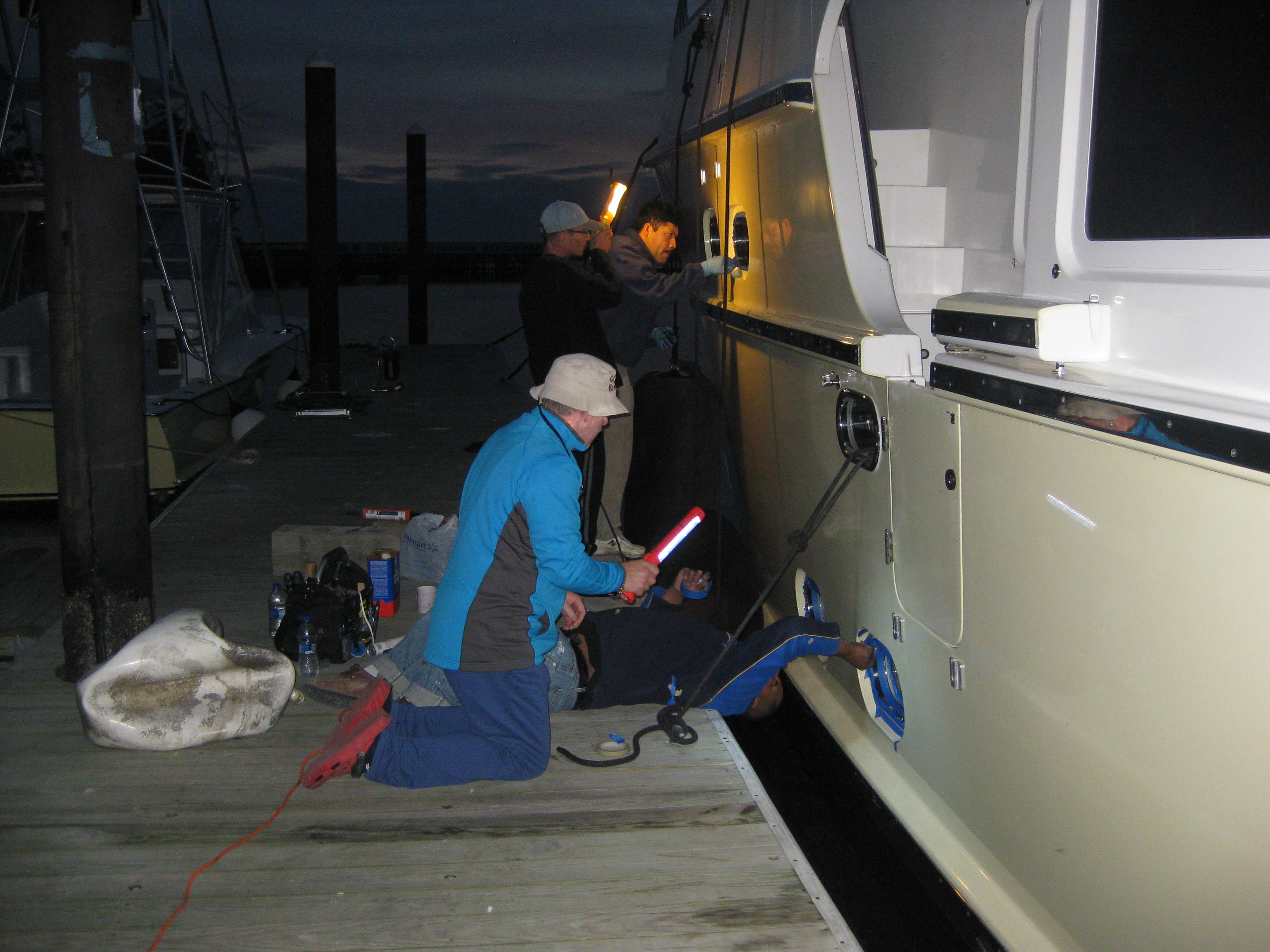
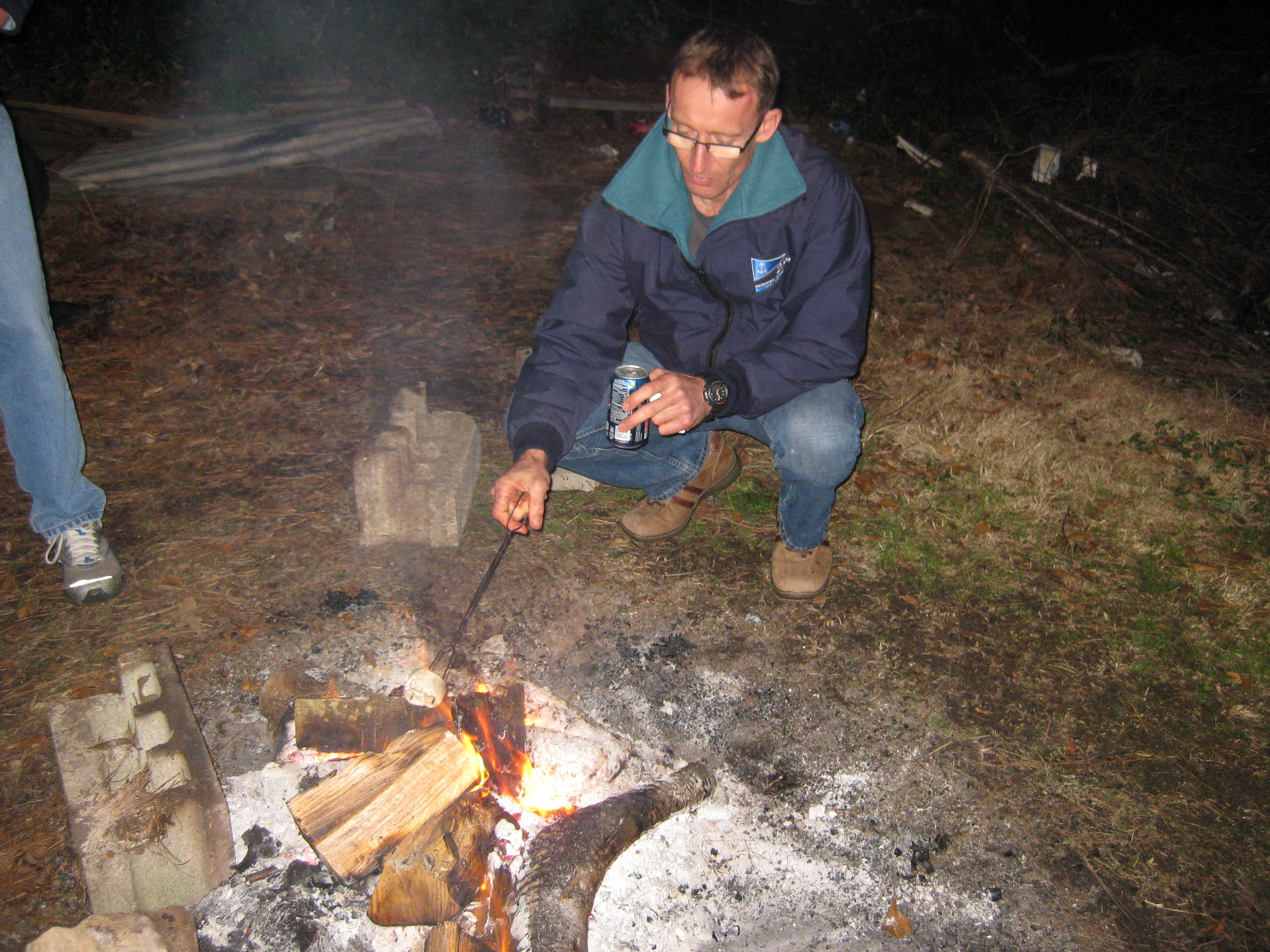
We also made many friends among those who did work on Shear Madness while she was at Jarrett Bay. Our electrician Steve and his family adopted John and Leanne for Christmas while Bradley and I headed to Virginia and Florida. And Steve’s family also hosted us all for a good bye oyster roast at their home the night before our departure. If you’ve never been to a good ole southern oyster roast, you don’t know what you’re missing! A fire, some cinder blocks, a piece of tin, a wet blanket, some sawhorses and plywood for a table, some vinegar, hot sauce and cornbread, followed by Smores at the campfire – all I can say is YUM!

Doreen and Scarlett, two of our photogenic Sea Gate friends at the Shear Madness Happy Hour
Once the boat repairs were nearly complete and we were back in the water, we invited all our new friends on board for a Happy Hour. This marked our official transition from “work mode” back to “Cruise mode”. Now we are heading south – we’ll do an overnight passage to St. Helena or Charleston, then on to Savannah, and then to Florida. The entire Shear Madness crew would like to thank all our new friends in NC and all our old friends from all over the world for your support and friendship over these past months.
This is being published while underway with limited bandwidth, so photos will be minimal! More will be posted later……as I publish this we are now about an hour away from Charleston Harbor and will anchor there for the night. Another post about our passage to follow shortly!
Click on the comment button below to leave a comment.
Fill ‘Er Up! (January 2012)
Posted by Kathy Clark in Trips on January 26, 2012
January 26, 2012

Make sure this is the DIESEL tank!
Filling up your Nordhavn is not quite like filling up your car. Shear Madness holds 4465 gallons of diesel in 5 separate tanks. Two aft tanks hold 1400 gallons each, two forward tanks hold 800 gallons each, and a “day tank” holds 65 gallons. The engines draw fuel from the day tank which can accept fuel from any of the other tanks through a series of valves and transfer pumps. Fully loaded, our fuel weighs over 32,000 pounds, so it’s important to keep the port and starboard tanks relatively equal to prevent listing to one side or the other.
We had only a couple hundred gallons of fuel in our tanks when we arrived in NC. Since we were planning to fill up, the first step is to negotiate a good price! Given the variation in fuel prices between states and between marinas within states, filling up at the wrong place can costs hundreds of dollars.
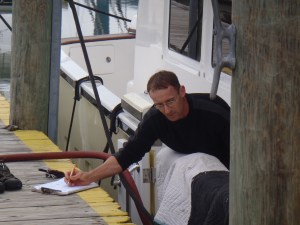
John keeps track of how muc is added as we alternate filling between tanks
A check of marinas up and down the east coast and input from fellow Nordhavn owners who have recently fueled up confirmed our own research that showed NC was a good place to buy fuel. Jarrett Bay agreed to match the price of another marina if we committed to a large purchase, so we were able to get a good discount off the regular price.
The next step is to move the boat to the fuel dock. It’s just a short move, but despite the lack of wind (good), there was a very strong current (bad) making Bradley thankful for the fully operational bow and stern thrusters. We took our time and made a couple approaches to the fuel dock where we were soon safely moored.

Bradley and John determine how much more we need in aft tanks
Next is to determine the order in which to fill the tanks. First, the day tank is filled from fuel in the other onboard tanks. Then we ensure that we have opened the diesel fill holes (which look just like the ones for filling the water tanks – there are many stories out there of people putting water in their fuel tanks or vice versa!). Then we ensure that the hose we are putting in is connected to Diesel fuel, not gasoline (ditto previous comment). Before adding the fuel, we add the appropriate amount of fuel treatment – in our case Stanadyne Performance Formula Diesel Fuel Additive, which is designed to clean, protect, and stabilize the fuel. Then we start fueling the aft tanks, adding several hundred gallons to one before switching to the other in order to keep them somewhat balanced. This is repeated until both tanks are at the desired level. Then this process is repeated for the forward tanks. Throughout this process, John is monitoring the hose while Bradley is observing the tanks from inside the boat, watching the sight gauges as fuel is added and ensuring no leaks are apparent. John and Bradley communicate via two-way radio to ensure that all is OK and to coordinate switching between tanks. Someone on the dock monitors the gallon counter and keeps John apprised of how much fuel has been added.

Leanne and Lisa (from Jarrett Bay) finish with the gasoline for the tender
The whole process takes several hours. Once we are full of diesel fuel, we also take on some gasoline, which is used in our tender (the smaller boat used for going ashore when we are at anchor). Our tender holds about 60 gallons of gasoline and we have an onboard tank that holds an additional 60 gallons.
The next step is the hardest of all – we have to pay for the fuel! In this case, we had agreed to pay by check in order to get the best price. Since we do almost all our banking online these days, writing a real check is a bit of a novelty! We took on 3800.2 gallons of diesel and 76 gallons of gasoline, so the total was just over $13,000. Fortunately, we don’t have to fill up very often! This will take us over 4000 miles, enough to get us to Florida, the Bahamas, Nova Scotia and Newfoundland, back to the Caribbean, and then some!
For now, we just move back to our regular dock, full of fuel and ready to go! After all these months, we are finally ready to go cruising. But wouldn’t you know it – now the weather has decided to turn nasty, with high winds and big seas forecast through the weekend. So we’ll stay put until this passes, then start our journey south. Hopefully this will give me a chance to post a couple more updates!
Here’s a short (1 min) video of the process, set to appropriate music:
Click below to comment.
Splash! (January 2012)
Posted by Kathy Clark in Trips on January 14, 2012
January 13, 2012
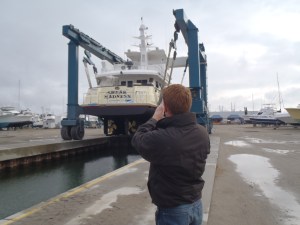
The Paparazzi are out as Shear Madness hits the water!
Shear Madness is back in the water! Much more work has been done and I will provide more details of that work in my next post, but for now, we are tired of talking about work and repairs! Yesterday we conducted sea trials! That means we went out into the ocean to test all the newly installed and/or repaired electronics, hydraulics, bow and stern thrusters, and inverters. Ideally, you do not want to conduct sea trials in calm waters – it’s good to have a bit of seas in order to give the systems a good test. Well, we sure did that! Winds were blowing 25-30 knots as we left the dock. Engines, bow and stern thrusters performed well and soon we were back on the water! We headed down the intracoastal waterway (ICW).
Along for the ride were Brian from Celtic Marine Electronics and Justin from American Bow Thruster (ABT) to test and fine tune the systems they had installed. While still in the ICW we performed some tests and turned some slow circles to calibrate compass and autopilot systems. Brian was able to find and correct a problem that was causing inaccurate heading data to be sent to the autopilot resulting in problems holding a course. Once corrected, the autopilot performed well, so we headed for the open ocean.
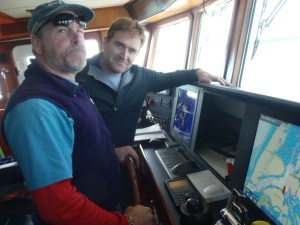
Brian and Bradley in calm waters during sea trial
The good news is that the systems, as well as the crew, got quite a good test! As the ICW gave way to the ocean, the wind was a-blowing and the waves were steep and short, resulting in a pretty wild ride! In fact, it was the roughest conditions we have experienced on this boat. Fortunately the boat and the systems handled things pretty well, as did the crew. Since we had not anticipated such rough conditions, we had not adequately secured everything and had a few “flying missiles” and a few crashes and bangs, but no serious damage. After a good run in which we turned in all directions to give the stabilizers a good workout with seas coming from all directions, we turned and headed back into the ICW. We all breathed a sigh of relief as we entered the calmer waters.
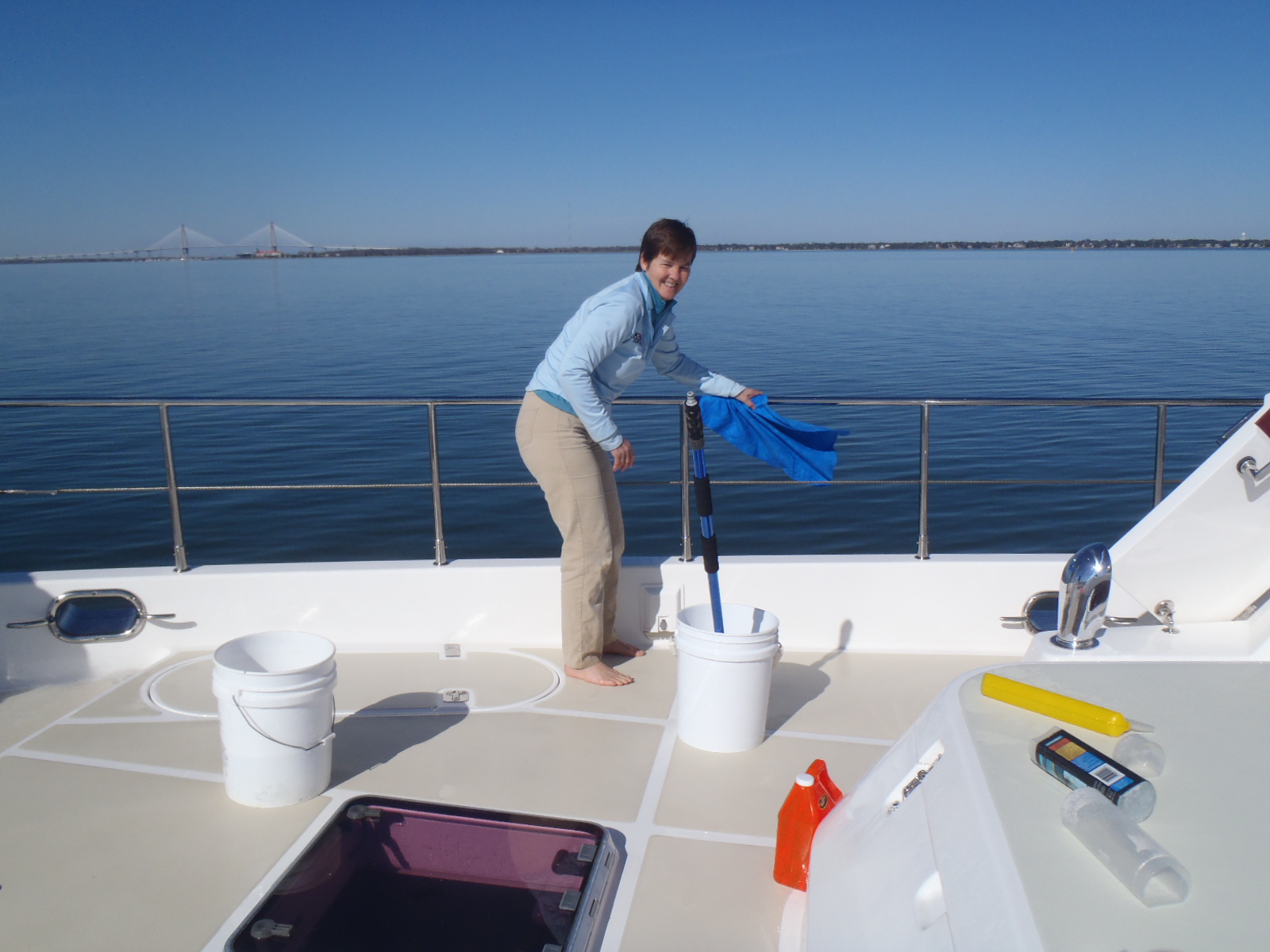
While there are still a few minor issues to deal with, the end is now in sight! We are hoping to depart NC within the next week or two. The boat has now been washed and the interior thoroughly cleaned. It’s starting to look like a boat again and not a mad scientist’s workshop.



 Shear Madness